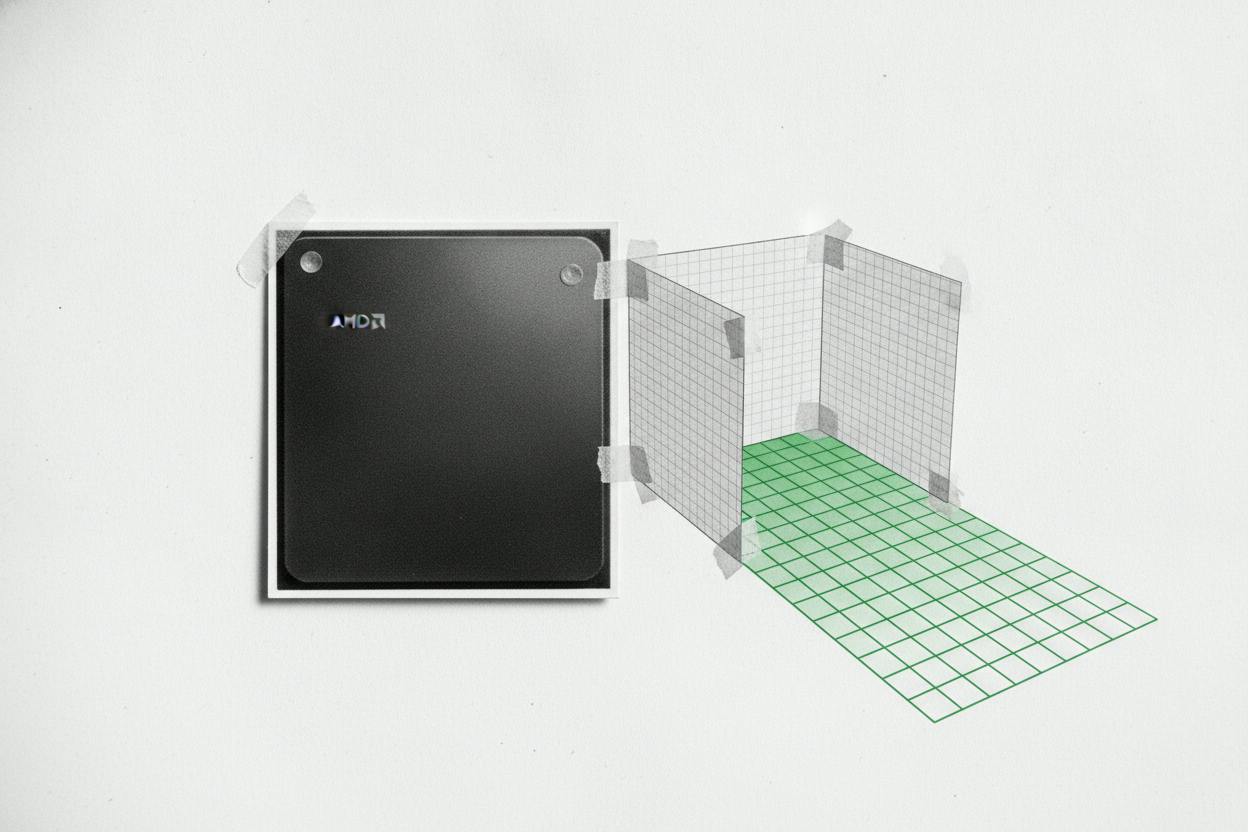
Advanced Micro Devices (AMD) said it will acquire World Labs, the artificial intelligence startup co-founded by Stanford professor Fei-Fei Li, for $8.2 billion in an all-stock deal. The acquisition, expected to close by the end of 2026, marks one of AMD's largest bets yet on the next phase of AI computing.
As part of the agreement, Li will join AMD as chief scientist, bringing one of the most recognized names in AI research into the chipmaker's executive ranks. World Labs focuses on "spatial AI" — technology that helps machines understand and interact with the three-dimensional physical world, rather than just processing text and images.
Why spatial AI matters
Most of today's AI excitement revolves around large language models that power chatbots and writing assistants. Spatial AI goes a step further: it aims to give machines a working model of physical space, enabling applications in robotics, autonomous vehicles, augmented reality, and industrial design. Think of it as teaching computers not just to read and write, but to navigate and manipulate the real world.
That shift could open up new markets for chipmakers. Training and running spatial AI models requires enormous computing power, often specialized graphics processors (GPUs) and custom accelerators. AMD, which has long competed with Nvidia in the GPU market, sees this as a chance to gain ground in an area where Nvidia has been dominant.
The all-stock angle
AMD is paying with its own shares rather than cash. That structure preserves cash for other priorities but means World Labs' investors will receive AMD stock, tying their payout to AMD's future performance. All-stock deals are common in tech, especially when the acquirer's shares are highly valued, but they can dilute existing shareholders. AMD investors will want to watch how much the deal adds to the share count and whether the growth justifies it.
The deal is expected to close by the end of 2026, subject to regulatory approvals and other customary conditions. Until then, both companies will operate separately.
What it means for investors
For everyday investors, the news is a reminder that the AI race is broadening beyond chatbots. AMD is signaling that it wants a piece of the hardware and software stack for spatial computing, a field that could eventually touch everything from factory robots to virtual try-on tools for shopping.
Several things are worth watching:
- Execution risk: Big acquisitions often take time to pay off. Integrating a research-heavy startup into a large chipmaker is not guaranteed to go smoothly.
- Competition: Nvidia, Intel, and a host of well-funded AI startups are all chasing similar opportunities. AMD will need to show it can convert research into products that customers actually buy.
- Dilution: Because the deal is all-stock, AMD's share count will rise. That can pressure per-share earnings unless the acquired business eventually contributes meaningful profit.
- Timing: The deal won't close until late 2026, so any financial impact is still years away. Near-term, AMD's stock will likely trade on its core chip business and broader market sentiment.
Investors should also keep an eye on the broader market backdrop. Tech stocks have been sensitive to interest rates and economic data. For example, Treasury yields near multi-decade highs have recently weighed on growth shares, and any sustained rise in yields could make investors less willing to pay up for long-dated AI promises. Meanwhile, some analysts see opportunities in chip stocks after recent selloffs, as noted in coverage of JPMorgan's view on an AI selloff.
AMD's move also comes as the AI landscape evolves rapidly. Competitors are making their own bets: for instance, OpenAI recently paused training on a major model, highlighting how unpredictable the frontier can be. And consolidation is picking up elsewhere in tech and finance, from Nubank and Monzo's early deal talks to Citi weighing an IPO for Banamex.
For now, AMD's acquisition is a strategic statement: the company wants to be a leader in spatial AI, not just a supplier of chips for today's chatbots. Whether that translates into shareholder value will depend on execution, competition, and how quickly the market for spatial computing develops. Investors should treat the deal as a long-term bet, not a quick catalyst.