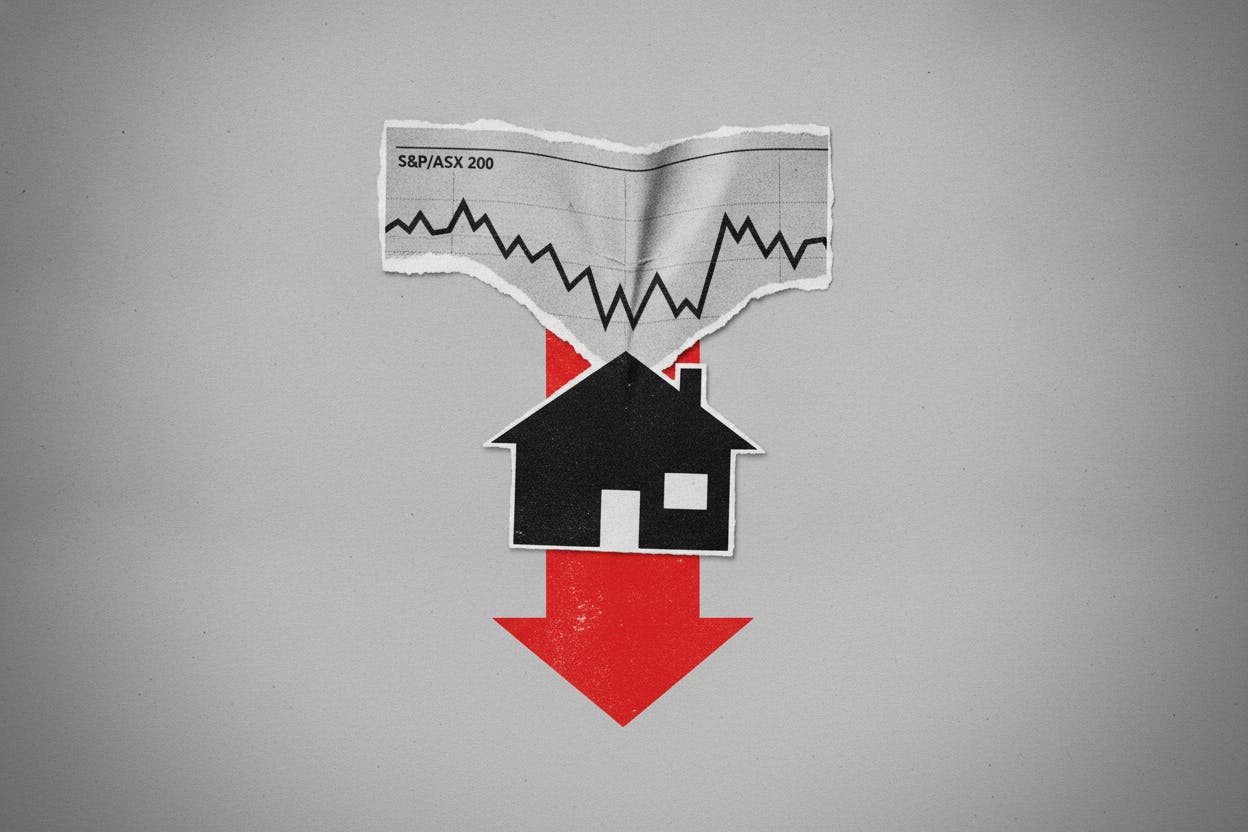
Australia's stock market extended its recent slide on Wednesday, with the S&P/ASX 200 falling 0.5% after new data showed June brought the country's steepest home-price decline in three-and-a-half years. The drop in property values rippled through several sectors, highlighting how higher interest rates are beginning to bite the broader economy.
Housing data rattles confidence
The housing data was the clearest signal yet that the Reserve Bank of Australia's aggressive rate hiking cycle is cooling the property market. When borrowing costs stay elevated, housing often feels the strain first, and falling prices can quickly dent household confidence. That's because many Australians tie a large portion of their wealth to their homes, and a decline in property values reduces the sense of "paper wealth" that supports spending.
The impact showed up most clearly in consumer discretionary stocks, which sank 2.2% in their biggest intraday drop since May 12. When home prices fall, people often pull back on optional spending—think furniture, appliances, and travel—before weaker demand shows up in jobs or earnings. Supermarket giant Coles slipped 2.1%, pulling the broader consumer staples sector lower as well.
Miners drag, banks steady
Miners were another major drag on the index, as iron ore prices eased. BHP fell 1.2% and Rio Tinto dropped 1.3%, reflecting ongoing concerns about demand from China, the world's largest steel producer. The weakness in mining stocks added to the broader market's downbeat tone.
Big banks, however, steadied after the prior session's selloff. National Australia Bank rose 2.2% and Westpac gained 0.7%, providing some support to the index. The banking sector's resilience suggests investors see the housing downturn as manageable for lenders, at least for now, given strong employment and low levels of distressed selling.
Northern Star jumps on CEO change
In a bright spot, Northern Star Resources jumped as much as 4% after naming Suresh Vadnagra as its new chief executive officer. The gold miner also said preliminary annual gold sales met revised guidance, reassuring investors after a period of uncertainty. The update came about a month after activist investor Elliott Management built a stake in the company, raising expectations that changes could be on the way.
Gold miners often benefit from falling home prices and weaker economic data, as investors seek safe-haven assets. Northern Star's gain stood out in a day when most sectors were in the red.
What it means for investors
For everyday investors, the key takeaway is that falling home prices don't just affect real estate—they can ripple through the entire stock market. Consumer discretionary stocks are often the first to feel the pain, as households cut back on non-essential spending. That's why a housing data point can quickly translate into relative pressure on ASX consumer discretionary names versus more defensive sectors, even if the headline index is being pushed around day to day by miners and banks.
Investors should also watch for further housing data in the coming months. If prices continue to fall, it could signal broader economic weakness and potentially lead to earnings downgrades for companies exposed to consumer spending. On the other hand, if the housing market stabilizes, it could remove a key headwind for the stock market.
The broader market backdrop remains challenging, with central banks around the world still grappling with inflation. In Europe, June inflation cooled to 2.8%, but energy prices remain hot, as noted in European Stocks Dip as June Inflation Cools to 2.8%, Energy Prices Stay Hot. Meanwhile, oil prices have slipped on easing supply fears, as covered in Oil Prices Slip as US-Iran Talks and Shipping Recovery Ease Supply Fears. These global factors will continue to influence the ASX in the weeks ahead.
For now, the message from the market is clear: higher rates are starting to reshape the Australian economy, and investors should be prepared for more volatility as the full impact of tighter monetary policy unfolds.