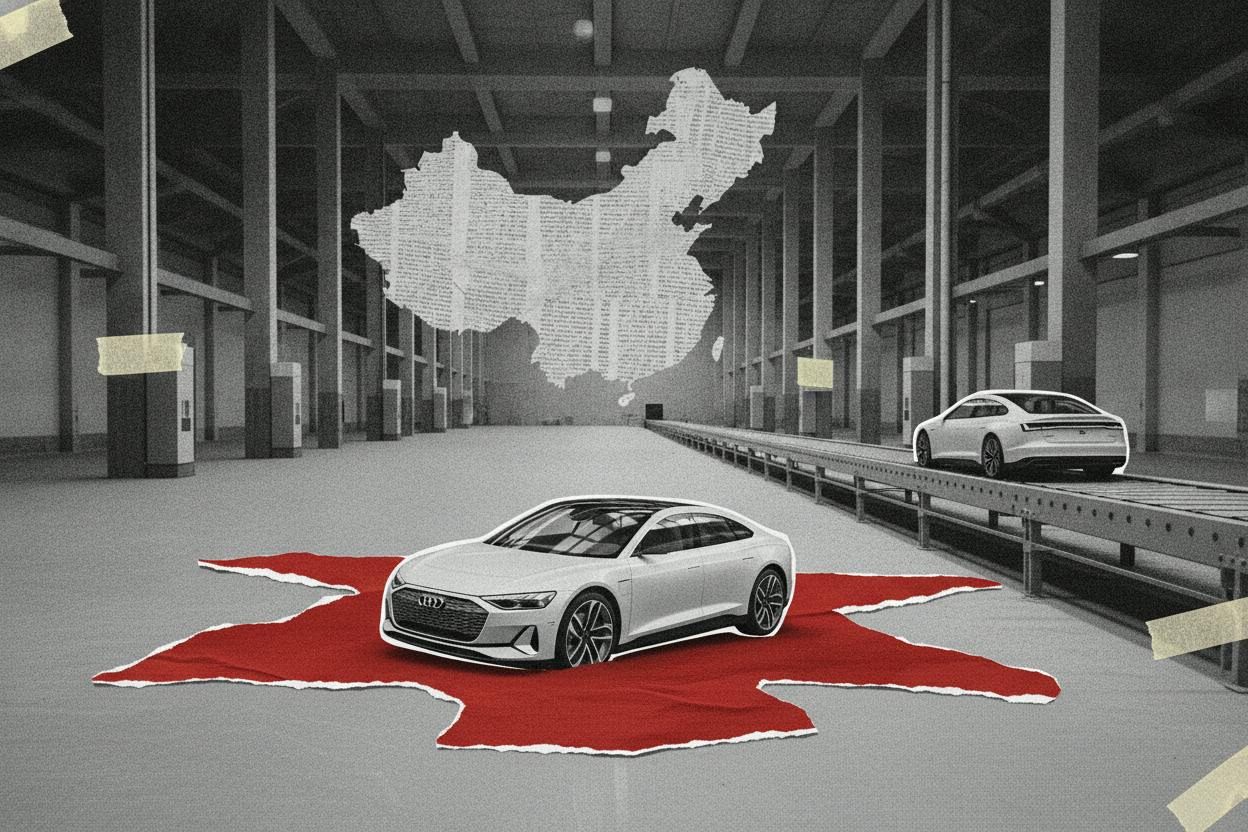
Audi's electric-vehicle plant in Changchun, China—a joint venture with state-owned automaker FAW—is reportedly running at less than 10% of its capacity, according to a report from Handelsblatt. The German business daily estimates the site could lose about €500 million this year as demand for the locally built Q6 e-tron and A6 e-tron remains weak.
Audi declined to comment on the specific figures, but told Reuters it has recently adjusted production because China's premium EV market has grown more slowly than the company expected. The report highlights the challenges foreign automakers face in the world's largest car market, where domestic brands have surged ahead in electric vehicles.
Why a nearly empty factory hurts so much
The core problem is simple math. Factories carry large fixed costs—depreciation on equipment, staffing, utilities, and maintenance—that must be paid regardless of how many cars roll off the line. When output collapses, those fixed costs get spread across far fewer vehicles, turning each one into a money-loser even if the sticker price holds up.
That dynamic helps explain how a single plant can rack up a €500 million loss estimate. At under 10% utilization, the plant is essentially running at a fraction of its intended scale, and the per-car cost burden becomes enormous.
For Audi, the situation is especially awkward because the Changchun plant was meant to be a cornerstone of its China EV strategy. The Q6 e-tron and A6 e-tron are premium models that were expected to compete with offerings from Tesla and local rivals like NIO and BYD. But China's premium EV segment has not grown as fast as Audi anticipated, and competition has intensified.
What this means for investors
Investors tend to treat weak sales as a cyclical issue—something that will recover when the market turns. But a severely underused factory can become an accounting and restructuring story. If Audi concludes that volumes in China won't rebound soon, the next steps often involve formally shrinking the footprint, which can bring restructuring expenses and sometimes write-downs on equipment and other assets tied to the plant.
That matters for Volkswagen Group, Audi's parent, because these costs can repeat across quarters and muddy what analysts call "earnings quality." When a company's reported profits are buffeted by one-off charges, it becomes harder for markets to trust forward guidance—including Audi's already-lowered 2026 revenue and profitability targets, which it cut last month.
The situation in China is part of a broader trend. Foreign automakers have been losing ground in the world's largest EV market, where domestic brands now dominate. China's electric vehicle boom has been a tailwind for some commodities, but for legacy automakers like Audi, it has meant intense price competition and shifting consumer preferences.
Investors should watch for any announcements about restructuring or capacity adjustments at the Changchun plant. If Audi decides to reduce its footprint, that could trigger charges that weigh on Volkswagen's earnings. Conversely, if demand picks up, the plant could quickly return to profitability—but that seems unlikely in the near term given the current market conditions.
The broader context is also important. China's economy has been struggling to regain momentum, and consumer confidence remains fragile. Chinese stocks have slipped despite policy support, and iron ore prices are near four-year lows as industrial demand stays soft. These are signs that the Chinese consumer is not spending as freely as automakers had hoped.
The road ahead for Audi
Audi is not alone in facing this challenge. Other foreign brands have also struggled to gain traction in China's EV market, and some have announced plans to cut costs or adjust their strategies. But Audi's situation is particularly notable because of the scale of the reported loss and the fact that it comes after the company already lowered its guidance.
For everyday investors, the key takeaway is that a plant running at under 10% capacity is not just a sales problem—it's a financial problem that can linger for years. Fixed costs don't disappear when demand falls, and the longer the plant sits idle, the more it drains the parent company's bottom line.
Volkswagen's stock may already reflect some of this pessimism, but the risk of further charges remains. Investors should keep an eye on Audi's quarterly reports for any mention of restructuring or impairment charges related to the Changchun plant. If the company announces a formal downsizing, that could be a sign that it expects the weak demand to persist.
In the meantime, Audi's experience serves as a cautionary tale about the risks of building capacity ahead of demand in a fast-changing market. The EV transition is not a straight line, and even well-funded automakers can stumble when they misjudge the pace of adoption.



