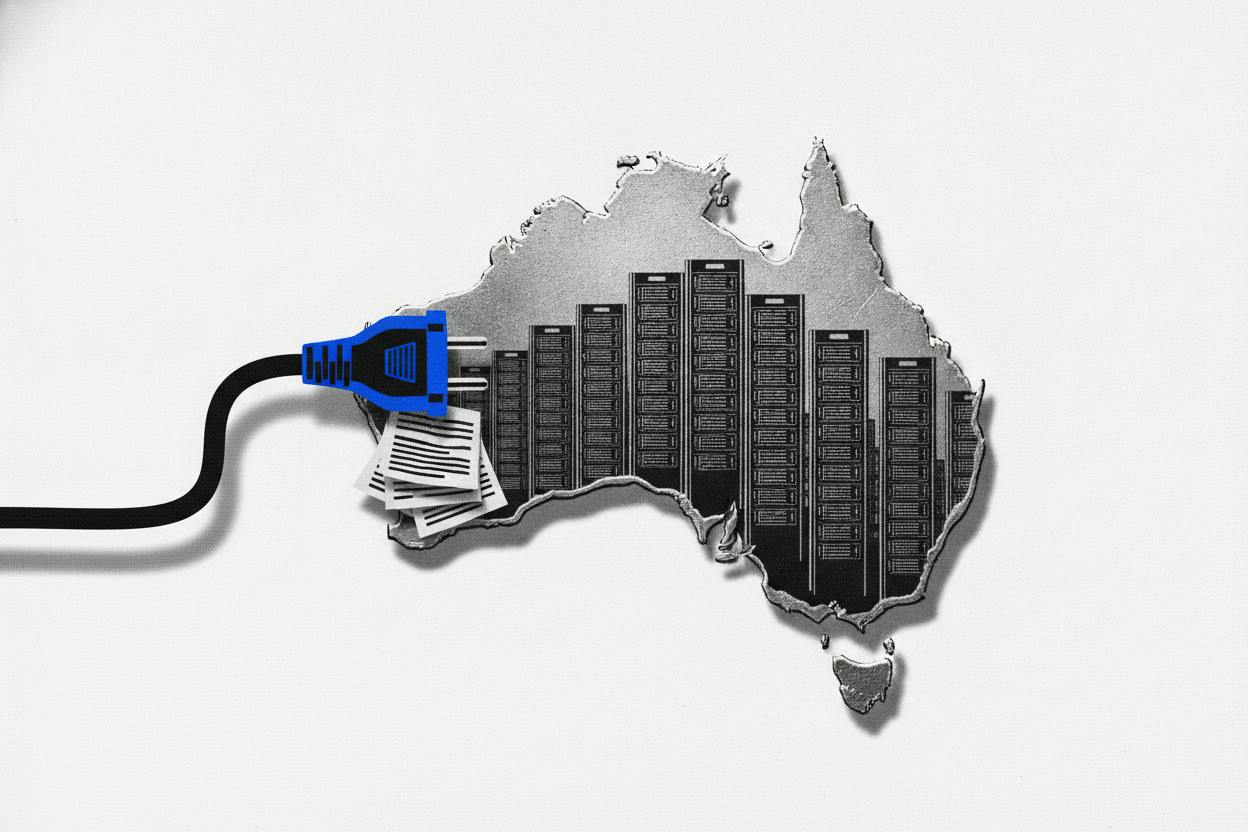
Australia's data center boom is picking up speed, but the real bottleneck isn't land or servers—it's electricity. In a Tuesday report, Commonwealth Bank of Australia (CommBank) raised its estimate for feasible new data center capacity to 7 gigawatts (GW) from 6 GW, citing surging demand from artificial intelligence (AI) and cloud computing. That could translate into roughly AU$260 billion of investment by the mid-2030s, according to the bank.
To put that in perspective, 7 GW is enough to power several million homes. But it's a far cry from the numbers floating around in project announcements. CommBank noted that about 23 GW of data center capacity has been publicly disclosed, while the Australian Energy Market Operator (AEMO)—the body that runs the national electricity grid—shows 225 projects seeking almost 67 GW of connection capacity as of June.
Those headline figures can be misleading. Many applications overlap, and multiple developers may be competing to serve the same customers. Paper demand doesn't automatically translate into physical transmission lines or power generation. CommBank's 7 GW forecast is meant to reflect what's actually feasible once you strip out duplication and account for real-world constraints.
Why the power grid is the key constraint
The immediate hurdle is energy infrastructure. Building a data center is one thing; getting it connected to the grid is another. Approvals can take years, and community opposition to new transmission lines and substations often adds friction. Even when projects get the green light, the queue for grid connections is long and competitive.
CommBank's forecast also assumes Australia captures a meaningful share of global AI computing demand. That's not guaranteed—other countries are racing to attract the same hyperscale data center investments. But if Australia does win that business, the payoff could be substantial, not just for tech companies but for the broader economy.
The bank's revised outlook comes as AirTrunk, a major data center operator, recently secured a A$4.25 billion green loan for a Sydney facility, underscoring the scale of capital flowing into the sector. It also echoes trends seen elsewhere, such as ZTE's profit surge on AI data center demand, highlighting how this boom is a global phenomenon.
What it means for investors
For markets, CommBank's 7 GW call shifts the focus from hype to execution. When everyone is chasing grid access at once, the scarce asset isn't land or servers—it's a signed connection agreement. With AEMO showing nearly 67 GW of connection requests versus CommBank's view of what's feasible, investors are likely to reward companies that can demonstrate they have secured power contracts, permits, and a spot in the connection queue.
That puts execution risk front and center for Australia-listed developers and landlords tied to data centers, including Nextdc, Goodman Group, and DigiCo Infrastructure REIT. Companies with clear evidence of connected capacity and realistic delivery dates may see their shares supported, while those stuck in the approval backlog could face discounts.
The broader backdrop is also worth watching. Australia's push to process more minerals onshore, as outlined in the government's minerals plan, could add to electricity demand, making grid capacity even more contested. Meanwhile, consumer spending is softening, which could weigh on the overall economy even as data center investment ramps up.
For everyday investors, the takeaway is that the data center boom is real, but it's not a straight line. The AU$260 billion figure is an opportunity, not a guarantee. The winners will be those who can navigate the power grid, not just those with the flashiest AI ambitions.