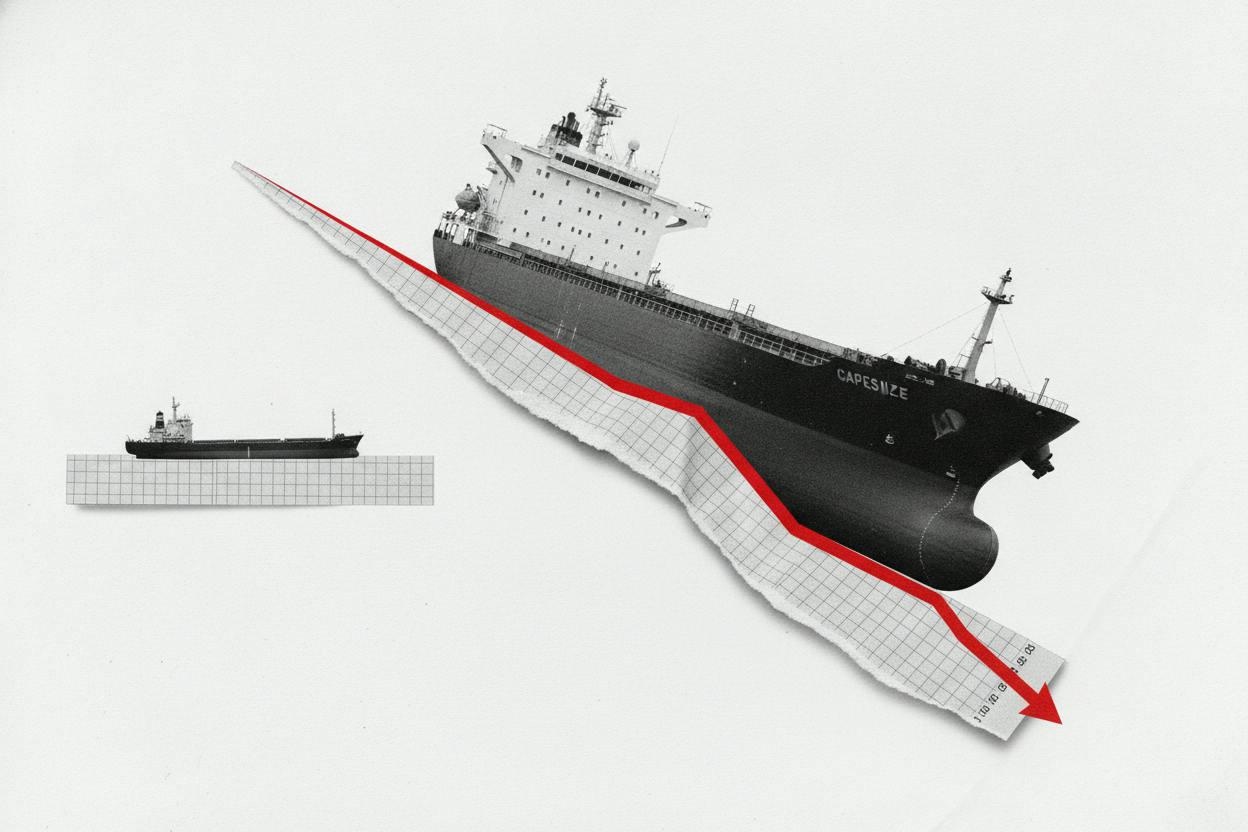
The Baltic Dry Index (BDI), a closely watched gauge of global shipping costs for raw materials, fell for a seventh consecutive session on [day], reaching its lowest level in two months. The index dropped 51 points to 2,801, its weakest reading since August 20, as rates for the largest bulk carriers—known as capesize ships—continued to slide.
The decline was led by the capesize sub-index, which fell to 3,994, its lowest since late July. Average capesize earnings dropped to $32,719 per day, a notable retreat from recent highs. Capesize vessels are the giants of the dry-bulk fleet, each capable of hauling around 150,000 tons of cargo, and they dominate the transportation of iron ore and coal—two commodities that are central to global steelmaking and energy generation.
What is the Baltic Dry Index?
The BDI is published by the Baltic Exchange, a London-based marketplace that has been tracking shipping rates for centuries. It compiles the daily charter rates for a range of vessel sizes, from capesize (the largest) down to panamax and supramax (smaller and more versatile). The index is often seen as a leading indicator of global economic activity because it reflects the demand for moving raw materials across the world's oceans.
When the BDI rises, it typically signals stronger demand for commodities and trade. When it falls, as it has recently, it can point to softer demand or an oversupply of ships. But the index is also sensitive to seasonal patterns, port congestion, and even geopolitical events that can disrupt shipping lanes.
Why are capesize rates falling?
The latest drop in capesize rates comes as iron ore futures also declined on the same day. Traders pointed to ample supply and elevated inventories at Chinese ports, which have dampened the need for fresh cargoes. China is the world's largest buyer of iron ore, and its steel mills are a key driver of capesize demand. When Chinese buyers slow their purchases or rely on existing stockpiles, the demand for large bulk carriers tends to weaken.
Falling capesize rates can have a direct impact on the delivered cost of commodities. Freight is a real input cost, and when it drops, the all-in price that steelmakers pay for iron ore or coal—once the cargo arrives—can also fall. This can put downward pressure on delivered (CFR) prices, even if the miner's headline price remains unchanged. For investors, that means a lower BDI can translate into lower input costs for steel producers and potentially thinner margins for miners and shipping companies.
Smaller vessels tell a different story
Not all dry-bulk shipping is suffering. While capesize rates slid, panamax rates held flat at 2,432, and supramax rates actually ticked up to 1,833. Panamax ships are smaller than capesize and typically carry grains, coal, and smaller iron ore loads. Supramax vessels are even more versatile, often hauling a mix of bulk commodities and minor bulks.
This divergence suggests the current weakness is not a broad-based slowdown in global trade, but rather a softness concentrated in the largest-bulk lanes—namely iron ore and coal. That is a useful signal for investors, as it points to a specific commodity dynamic rather than a general economic downturn.
What it means for investors
For everyday investors, the BDI is not a household name, but it can have ripple effects across markets. A sustained drop in capesize rates can pressure the stocks of dry-bulk shipping companies, whose earnings are closely tied to charter rates. It can also weigh on miners, especially those focused on iron ore, as lower freight costs can reduce the effective price they receive for their product.
On the other hand, falling freight costs can be a positive for steelmakers and other manufacturers that rely on imported raw materials, as their input costs may ease. The split between vessel sizes also matters: with panamax flat and supramax higher, investors get a clearer signal that the weakness is centered on “big bulk” rather than a broad-based squeeze across all dry-bulk shipping.
Looking ahead, market participants will be watching Chinese port inventory data and steel production levels for clues about whether capesize demand will recover. Seasonal factors, such as the approach of winter in the northern hemisphere, can also influence shipping patterns. For now, the BDI's slide is a reminder that commodity prices and shipping costs are intertwined, and that shifts in one can quickly affect the other.
As always, investors should consider the broader context. The BDI is just one indicator among many, and its movements can be volatile. But for those with exposure to shipping, mining, or steel-related stocks, the recent trend is worth monitoring.



