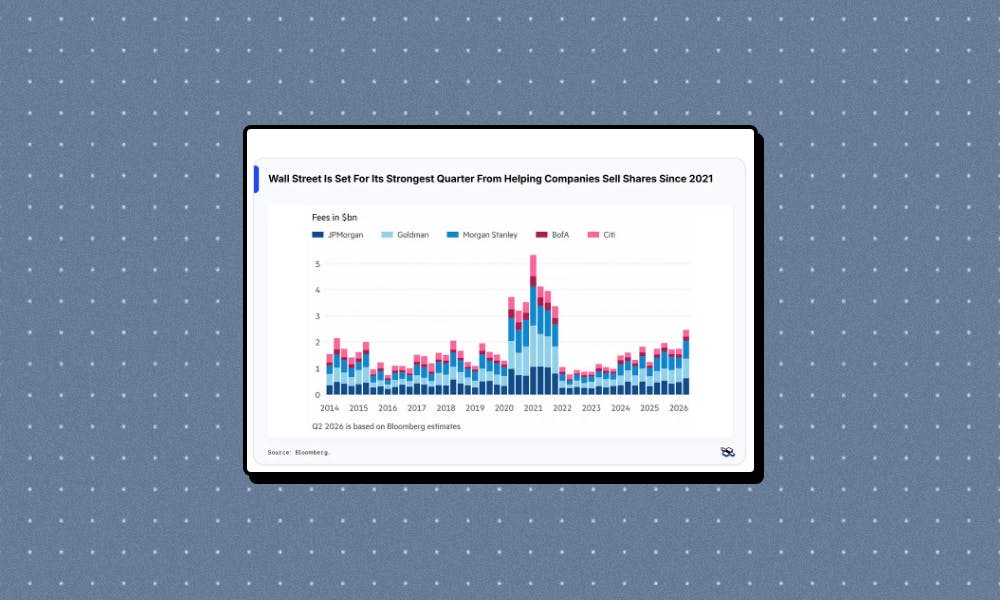
Wall Street's dealmaking engine is roaring back to life. America's five largest investment banks are expected to report a combined $11.1 billion in investment-banking fees for the second quarter, a 27% jump from the same period last year and the highest quarterly haul since 2021.
The numbers, based on analyst estimates, signal that the long drought in corporate dealmaking may finally be over. After two years of sluggish activity, rising stock markets, easing interest rate uncertainty, and a backlog of private equity deals are all converging to reignite the fee machine that powers the world's biggest financial institutions.
Equity Capital Markets Lead the Charge
A big chunk of the fee bonanza is coming from equity capital markets (ECM) — the business of underwriting stock offerings. ECM fees across the five banks are forecast to reach $2.5 billion, driven by a wave of initial public offerings and secondary share sales.
The standout contributor was SpaceX's blockbuster IPO. The rocket company's public debut generated a record $500 million in fees for 23 banks, with Goldman Sachs and Morgan Stanley each pocketing an estimated $100 million. That single deal underscores how a handful of high-profile listings can supercharge quarterly results for Wall Street's elite.
The broader IPO market is also showing signs of life after a prolonged slump. Companies that delayed listings during the pandemic-era volatility are now testing the waters, encouraged by near-record stock indexes and investor appetite for new names. This trend is particularly visible in the tech sector, where firms like SK Hynix have recently debuted on U.S. exchanges.
M&A Advisory Fees Surge
Mergers and acquisitions are also contributing to the fee recovery. Advisory fees — the money banks earn for counseling companies on deals — are expected to climb roughly 30% to more than $4 billion. The revival is being fueled by a combination of factors: corporate balance sheets are flush with cash, private equity firms are under pressure to deploy capital, and the regulatory environment has become more predictable.
Deal activity had been frozen for much of 2022 and 2023 as rising interest rates made financing expensive and valuation gaps between buyers and sellers were too wide to bridge. Now, with the Federal Reserve signaling a potential shift toward rate cuts later this year, the cost of borrowing is becoming more manageable, and companies are more willing to strike deals.
Boutique investment banks like Houlihan Lokey are also well-positioned to benefit from the M&A rebound, as mid-market deals gain momentum alongside mega-mergers.
What It Means for Investors
For everyday investors, the surge in investment-banking fees is a clear signal that Wall Street's profit engine is firing on all cylinders again. Banks like Goldman Sachs, Morgan Stanley, JPMorgan Chase, Bank of America, and Citigroup are the primary beneficiaries. Higher fee income directly boosts their bottom lines, which can translate into stronger stock performance and potentially higher dividends or share buybacks.
However, investors should note that much of this good news may already be reflected in share prices. Bank stocks have rallied in recent months as the market anticipated a dealmaking recovery. The key question now is whether the momentum can be sustained into the second half of the year.
Another factor to watch is the broader market rotation. As investors rotate out of high-flying tech stocks into other sectors, financials could attract fresh inflows. If the dealmaking rebound broadens beyond the top five banks, regional and mid-tier investment banks may also see a lift.
For those holding bank stocks, the next few quarters will be telling. If the IPO pipeline remains active and M&A continues to accelerate, the current fee surge could mark the beginning of a sustained upcycle — not just a one-quarter blip.