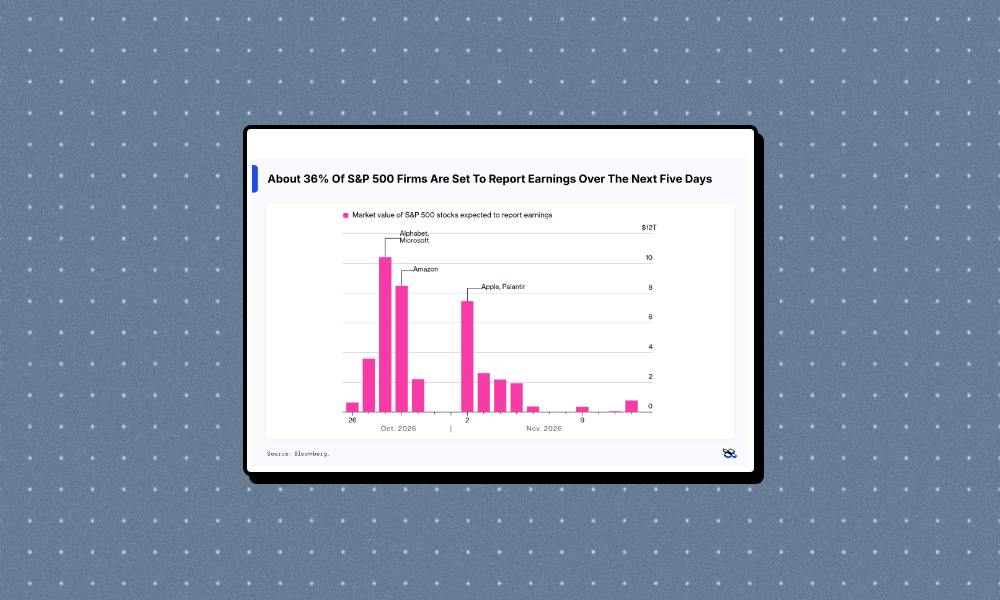
This week, Alphabet, Microsoft, and Amazon are all expected to report double-digit revenue growth, but investors are increasingly focused on a different number: how much more they plan to spend on artificial intelligence—and when those investments will start generating real returns.
The shift in mood was on full display last week when Meta, despite delivering encouraging earnings, saw its shares tumble 6.1% after announcing plans to increase its future spending commitments by $125 billion, bringing the total to $825 billion. The market's reaction sent a clear signal: strong earnings are no longer enough to satisfy Wall Street.
Why investors are losing patience
For the past year, Big Tech has been engaged in an AI arms race, pouring tens of billions of dollars into data centers, chips, and research. The logic was simple: whoever builds the most powerful AI infrastructure will dominate the next wave of computing. But as the bills come due, investors are starting to ask harder questions.
Rising borrowing costs are making that spending more expensive. With interest rates still elevated, the cost of financing these massive capital expenditures is climbing, squeezing margins and putting pressure on balance sheets. At the same time, AI revenue growth—while real—has not kept pace with the scale of investment, leading to mounting concerns about debt levels across the sector.
Meta's stock drop was a warning shot. Even though the company beat expectations on the top and bottom lines, the market punished it for signaling that the spending spree is far from over. That reaction is likely to weigh on investor sentiment as Alphabet, Microsoft, and Amazon report their own numbers.
What to watch in this week's earnings
For Alphabet, Microsoft, and Amazon, the key metrics will go beyond revenue and earnings per share. Investors will be parsing management commentary for clues on capital expenditure guidance, AI-related revenue contributions, and any signs that the pace of spending is slowing.
Microsoft's Azure cloud business and Amazon's AWS are seen as bellwethers for AI demand. Analysts are watching closely to see if growth in these units is accelerating enough to justify the heavy investment. Some on Wall Street, including BofA, have projected strong AWS growth in the third quarter, but the market will want to see it in the numbers.
Alphabet, meanwhile, is under pressure to show that its AI investments are translating into advertising and cloud revenue, rather than just costs. The company has been integrating AI into its search and cloud offerings, but investors are looking for concrete evidence of returns.
The broader market backdrop is also important. Treasury yields have eased recently as investors await both Big Tech earnings and the Federal Reserve's next decision on interest rates. Lower yields can support stock valuations, but they also reflect uncertainty about the economy and the path of borrowing costs.
What it means for investors
For everyday investors, the takeaway is that the AI boom is entering a new, more skeptical phase. The days of rewarding companies simply for talking up AI are over. Now, the market wants to see a clear path from spending to profitability.
This doesn't mean AI is a bust—far from it. But it does mean that investors should expect more volatility in tech stocks as companies navigate the gap between investment and payoff. Companies that can demonstrate strong AI revenue growth alongside disciplined spending are likely to be rewarded, while those that keep spending without showing results could face sell-offs like Meta's.
It's also worth remembering that Big Tech's AI spending has broader implications. The massive capital outlays are a key driver of demand for chips, data centers, and energy, which ripples through the entire market. If the spending slows, it could affect a wide range of suppliers and related industries.
As the earnings reports roll in this week, keep an eye on the language executives use around AI. Phrases like "investment cycle" and "long-term opportunity" are common, but the market is increasingly looking for specifics: when will these investments start generating meaningful returns?
For now, the patience of Wall Street is wearing thin. The companies that can show they are turning AI spending into revenue will likely be rewarded; those that can't may face the same fate as Meta.