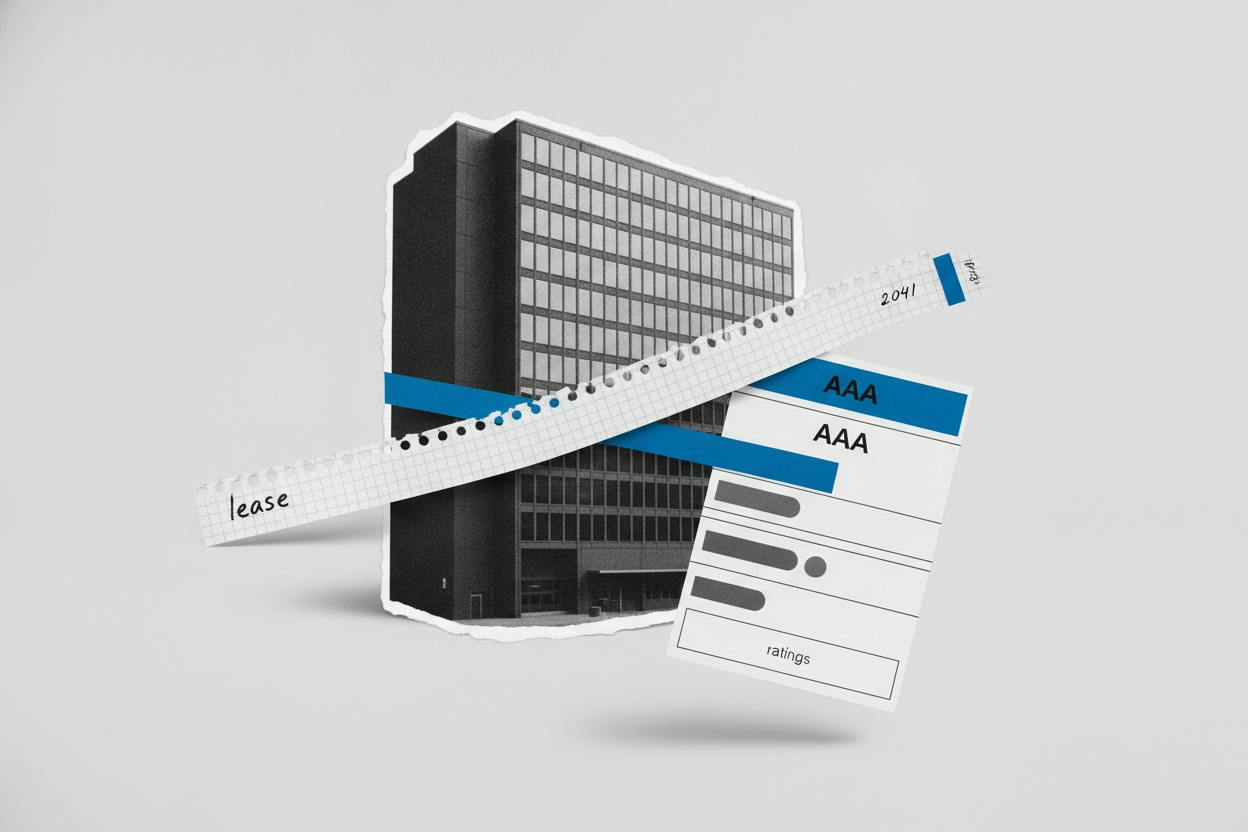
Blue Owl Capital is testing investor appetite for data center debt with a $513 million commercial mortgage-backed securities (CMBS) deal tied to a Northern Virginia facility leased to Amazon through 2041, according to a Bloomberg report. The financing, arranged by Citigroup, is one of the latest signs that Wall Street is finding new ways to fund the booming data center boom.
What is a CMBS?
For everyday investors, CMBS stands for commercial mortgage-backed securities. These are bonds created by pooling together commercial mortgages—loans on properties like office buildings, shopping centers, or, in this case, data centers—and then selling slices of that pool to investors. Each slice, or tranche, carries a different level of risk and return. The safest slices get paid first and earn lower yields, while riskier slices offer higher yields but absorb losses first if the underlying loans default.
In this deal, Bloomberg reports that roughly $375 million of the bonds are expected to be rated AAA—the highest credit rating—and are initially being marketed at about 1.95 percentage points above a benchmark rate. Another $112 million is expected to be rated AA, priced around 2.6 percentage points above the benchmark. These spreads are the extra yield investors demand over a risk-free rate, and they serve as a key indicator of how the market views the risk.
Why Amazon's lease matters
The pitch to bond buyers is straightforward: Amazon, one of the world's largest companies, has signed a long-term lease on the property through 2041. That contractual commitment turns a highly specialized asset—a 54-megawatt data center—into a steadier stream of cash flows. For investors, the tenant's credit quality does much of the heavy lifting, reducing the risk that the property sits empty or fails to generate income.
Data centers are a hot commodity these days, driven by the explosion in artificial intelligence and cloud computing. Companies like Amazon, Microsoft, and Google are spending heavily to expand their digital infrastructure. That demand has created a surge in financing needs, and owners are increasingly looking beyond traditional bank loans to fund these projects.
What it means for investors
If this CMBS deal clears at or near the initial pricing talk, it could set a new benchmark for how much it costs to borrow against data centers with strong tenants. That would be significant for the broader market. It would signal that public bond markets are willing to fund "hyperscaler" data centers—facilities operated by the largest cloud providers—at prices that can compete with bank loans or private credit.
For investors, this matters in a couple of ways. First, it could lead to more data center CMBS deals coming to market, giving bond investors more options to gain exposure to the AI infrastructure boom. Second, it provides a pricing signal for the entire sector. When a deal like this prices, it becomes a reference point for other owners looking to refinance or raise new debt, potentially making CMBS a more repeatable financing route.
The deal also highlights the growing intersection of real estate finance and technology. Data centers are a unique asset class—they require massive upfront capital, specialized equipment, and reliable power. But with long-term leases from creditworthy tenants, they can behave more like stable income-producing properties, which is exactly what bond investors like to see.
Broader context
This isn't happening in a vacuum. The data center boom has been a major theme across markets, with companies like Soitec raising its outlook on AI-driven demand for optical chips, and CATL pitching off-grid power solutions for data centers. At the same time, Malaysia's data center boom has hit a hurdle from US AI chip export rules, showing how policy can affect the sector's growth.
For everyday investors, the key takeaway is that the financial machinery behind the AI boom is evolving. While most people think of data centers as physical buildings, they are also financial assets that need to be financed, refinanced, and eventually sold. The terms of deals like this one reveal how confident lenders and bond buyers are in the long-term profitability of the AI infrastructure buildout.
Looking ahead
The success of Blue Owl's offering will be closely watched by market participants. If the bonds sell well, it could encourage more data center owners to tap the CMBS market, increasing the supply of these bonds. That would give investors more choices and potentially tighten pricing over time. Conversely, if the deal struggles, it could signal that investors are becoming more cautious about data center valuations, especially in a higher interest rate environment.
For now, the deal is a reminder that the data center boom is not just a tech story—it's also a financing story. And for investors, understanding how these deals are structured and priced is becoming increasingly important as the digital economy continues to expand.



