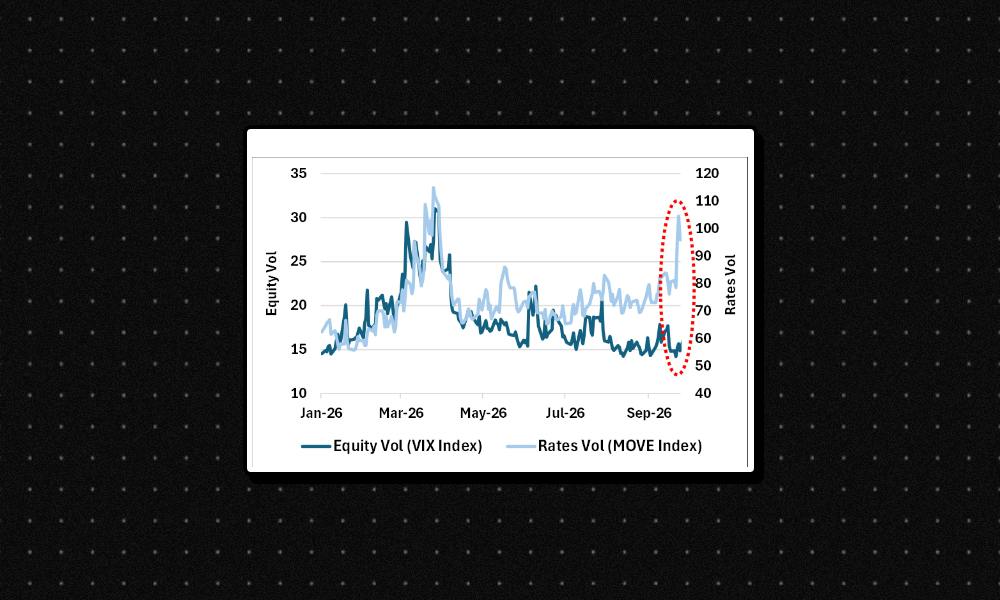
Something unusual is happening across US markets: bonds are getting a whole lot more turbulent, but stocks are acting like nothing’s going on. Last week, volatility in US government bonds jumped to its highest level in months, while expected stock-market volatility stayed close to its lowest level in a year. This divergence has caught the attention of market watchers, who are trying to figure out what it means for everyday investors.
Two different yardsticks for fear
To understand what’s going on, it helps to know the two main gauges being compared. The MOVE Index tracks expected volatility in US Treasury bonds, giving a read on how much movement investors are pricing in for the bond market. The Cboe Volatility Index, better known as the VIX, measures expected volatility in the broader US stock market, based on a basket of S&P 500 Index options. Both are often called “fear gauges” because they rise when investors expect bigger price swings.
Last week, the two suddenly went their separate ways. The MOVE Index spiked to its highest level in months, signaling that bond investors are bracing for choppier trading in Treasuries. Meanwhile, the VIX stayed near its lowest level in a year, suggesting stock investors are feeling relatively calm.
Why bonds are getting jumpy
Bond volatility often rises when there’s uncertainty about interest rates, inflation, or the path of the economy. In recent weeks, a mix of factors—ranging from shifting expectations about Federal Reserve policy to concerns about government borrowing—has made the Treasury market more unpredictable. When bond prices swing more wildly, it can ripple through everything from mortgage rates to corporate borrowing costs.
For stocks, the picture looks different. Equity investors have been buoyed by resilient corporate earnings and hopes that the economy can avoid a sharp downturn. That optimism has kept the VIX subdued, even as the bond market sends signals of unease.
What the divergence could mean
Historically, stock and bond volatility tend to move together, especially during times of stress. When one spikes, the other often follows. So this gap is unusual and could be a warning sign. Some analysts suggest that stocks may be underestimating the risks that bond investors are already pricing in. If bond turbulence persists, it could eventually spill over into equities, catching complacent stock investors off guard.
On the other hand, the divergence might simply reflect different dynamics. Bond markets are reacting to specific factors like debt supply and rate expectations, while stocks are focused on earnings and the broader economic outlook. In that case, the calm in stocks could be justified—at least for now.
What it means for your portfolio
For everyday investors, this divergence is a reminder that markets don’t always move in lockstep. It also underscores the importance of diversification. If you hold both stocks and bonds, you might see different levels of turbulence in each part of your portfolio. While stocks have been relatively calm, bond funds could experience more price swings in the coming weeks.
It’s also worth noting that low stock volatility doesn’t guarantee smooth sailing ahead. The VIX is a measure of expected volatility, not a prediction of the future. Markets can turn quickly, and a sudden shock—whether from inflation data, geopolitical events, or a surprise Fed move—could send the VIX spiking just as fast as the MOVE Index did.
Investors should keep an eye on both gauges. If bond volatility continues to climb, it might be a sign that broader market turbulence is on the horizon. But for now, the stock market is choosing to look the other way.
Related reading
For more on how volatility is affecting markets, check out our coverage of stocks slipping as Treasury yields rise and energy stocks slipping despite LNG deals. Also, see how softer inflation cooled rate hike bets in Australia and the RBI stepping in to curb rupee volatility.