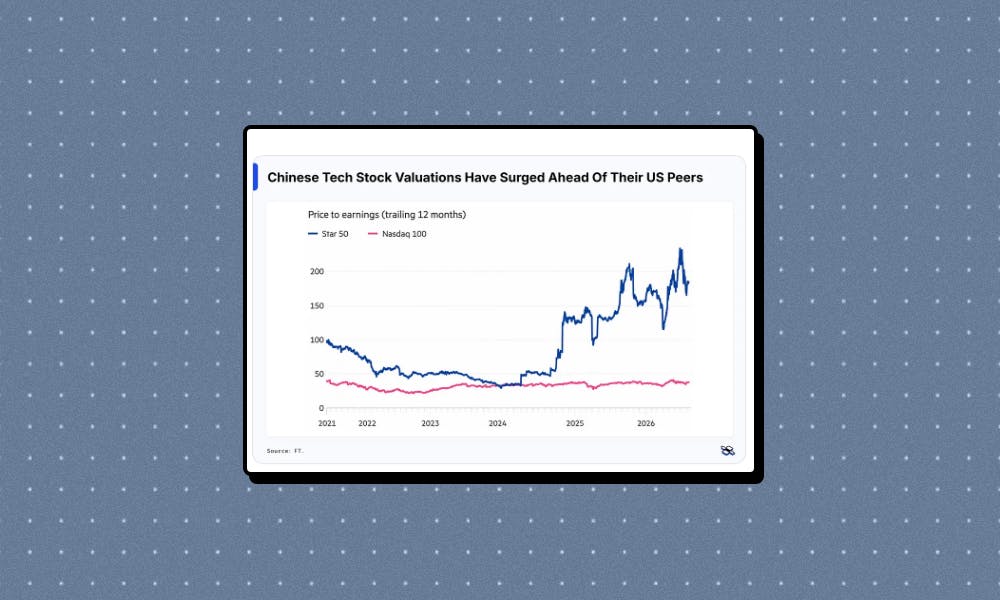
China's artificial intelligence boom is sending tech valuations into the stratosphere, and investors are willingly paying up. The Shanghai Star 50 index, which tracks the country's most innovative tech companies, has climbed 29% this year, even as the broader Chinese stock market has barely moved. That surge has pushed the index's price-to-earnings (P/E) ratio above 150, a level that makes even the Nasdaq 100's roughly 35 look modest by comparison.
The core bet behind this rally is that China can close the AI gap with the United States. That's a big if, and the stakes are high for anyone holding these stocks.
Why the excitement is real
There are genuine reasons for the optimism. Chinese companies have been rolling out new AI models that rival those from US tech giants. Homegrown chipmakers are making progress, even as US export controls limit access to the most advanced semiconductors. And there's a wave of robotics startups looking to list, which suggests the ecosystem is maturing beyond just software.
The Chinese government is also throwing its weight behind the shift. State-backed buying, relaxed listing rules, and a strategic push for semiconductor self-sufficiency are all part of the plan. That kind of policy support can give a sector a powerful tailwind, as we've seen in other countries when governments decide to back an industry.
But here's the thing: when a market is priced for perfection, there's little room for error. If any of these bets stumble—a model that underperforms, a chip that doesn't meet expectations, or a slowdown in government support—the correction could be sharp.
What the numbers tell us
The valuation gap is stark. A P/E ratio above 150 means investors are paying $150 for every $1 of current earnings. That's a huge premium, and it implies that profits will grow at an extraordinary pace for years to come. For context, the Nasdaq 100, which is itself considered expensive by historical standards, trades at around 35 times earnings.
This kind of divergence isn't new. In the late 1990s, tech stocks on both sides of the Pacific traded at similar extremes, and the eventual reckoning was painful. But that doesn't mean it will happen again—it just means the risk is real.
It's also worth noting that the broader Chinese market hasn't participated in the rally. That suggests the AI enthusiasm is concentrated in a relatively small group of companies, which can amplify both gains and losses.
What it means for investors
For everyday investors, the key takeaway is that China's AI stocks are a high-risk, high-reward play. The potential is real, but so is the possibility of a sharp pullback if the market's expectations aren't met.
If you're considering exposure, it's important to understand that you're not just betting on the companies themselves—you're betting on the entire narrative that China can catch up with the US in AI. That's a story that could take years to play out, and it will likely have plenty of twists and turns along the way.
Diversification is your friend here. Putting all your money into a single high-flying sector, no matter how exciting, is rarely a good idea. Instead, consider how these stocks fit into a broader portfolio that includes a mix of asset classes and regions.
Also, keep an eye on the fundamentals. If earnings start to catch up with valuations, the rally could be sustainable. If not, the correction could be brutal. Watch for signs like revenue growth, profit margins, and whether companies are actually generating cash from their AI investments.
The bigger picture
China's AI push is part of a larger global trend. The US is also investing heavily in AI, and other countries are trying to get in on the action. The race is on, and it's not just about technology—it's about economic competitiveness and national security.
For now, the market is betting that China will be a major player. But as with any high-stakes bet, there's no guarantee. The next few quarters will be crucial in determining whether the AI rally is built on solid ground or just hot air.
In the meantime, investors should stay informed and be prepared for volatility. The AI story is far from over, and the market's mood can change quickly. As always, it's wise to focus on the long term and avoid getting caught up in the hype.