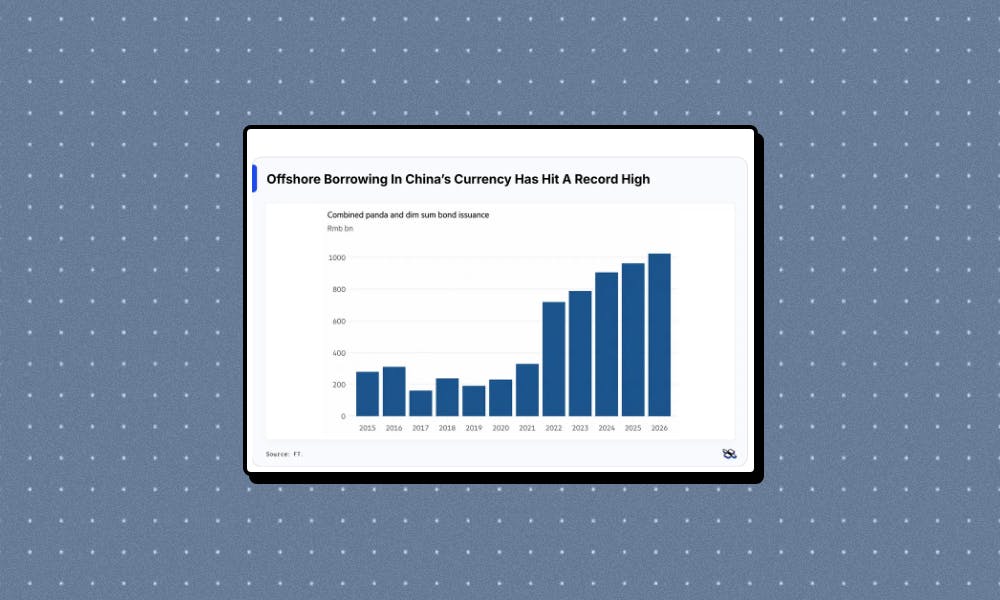
China's ultra-low interest rates are quietly reshaping the global role of its currency, the yuan. With borrowing costs at historic lows, international issuers are flocking to China's offshore and onshore bond markets, pushing issuance past last year's record in record time.
According to recent data, issuance across China's "dim sum" and "panda" bond markets has already topped 1 trillion yuan (about $149 billion) this year. That surpasses the previous annual record, underscoring how cheap yuan funding has become a magnet for foreign governments, banks, and corporations.
Why yuan bonds are suddenly so attractive
The main draw is price. China's 10-year government bond currently yields just 1.68%, compared with 4.78% for its US Treasury counterpart. That gap makes borrowing in yuan significantly cheaper than in dollars or other major currencies, even after accounting for currency hedging costs.
For foreign entities—from sovereign governments to multinational banks—issuing yuan-denominated bonds allows them to raise funds at a fraction of the cost they would face elsewhere. At the same time, Chinese companies are increasingly tapping offshore markets to finance their overseas operations, adding to the demand for yuan-linked instruments.
This trend is part of a broader shift in global finance, where low interest rates in one country can ripple across borders. Just as the US dollar's dominance has long been tied to the depth and liquidity of US markets, China's cheap money is giving the yuan a more prominent role in international capital flows.
Beijing's helping hand
The Chinese government is actively encouraging this development. Authorities have expanded mainland investors' access to Hong Kong's bond market, making it easier for domestic capital to flow into yuan-denominated debt issued offshore. This move not only deepens the market but also supports the internationalization of the yuan—a long-standing policy goal for Beijing.
Hong Kong has traditionally been the hub for dim sum bonds (yuan-denominated bonds issued outside mainland China), while panda bonds are sold by foreign issuers inside China. Both markets have grown rapidly as China has gradually opened its capital account and relaxed rules for foreign participation.
The timing is notable. While China's economy shows mixed signals, with inflation data pointing to uneven demand, the bond market's appeal remains strong. Low yields reflect the central bank's accommodative monetary policy, aimed at supporting growth amid a property downturn and sluggish consumer spending.
What it means for investors
For everyday investors, the rise of yuan bonds may seem distant, but it has tangible implications. First, it signals that China is serious about making the yuan a global reserve and funding currency, which could affect currency markets and international trade dynamics over time.
Second, the yield gap between Chinese and US government bonds is a reminder of how divergent monetary policies can create opportunities—and risks. Investors who hold yuan assets may benefit from relatively stable exchange rates and attractive yields, but they also face currency risk if the yuan depreciates.
Third, the expansion of Hong Kong's bond market access could open new avenues for retail investors in mainland China, though most foreign investors will still need to navigate regulatory hurdles.
It's also worth noting that China's bond market is not without risks. Credit quality varies, and some issuers may struggle if the economy slows further. However, the sheer scale of issuance suggests that global investors see value in diversifying into yuan-denominated assets.
As China continues to liberalize its financial markets, the yuan's role is likely to grow. Whether that will challenge the dollar's dominance remains an open question, but for now, cheap money is doing what cheap money does: attracting attention.