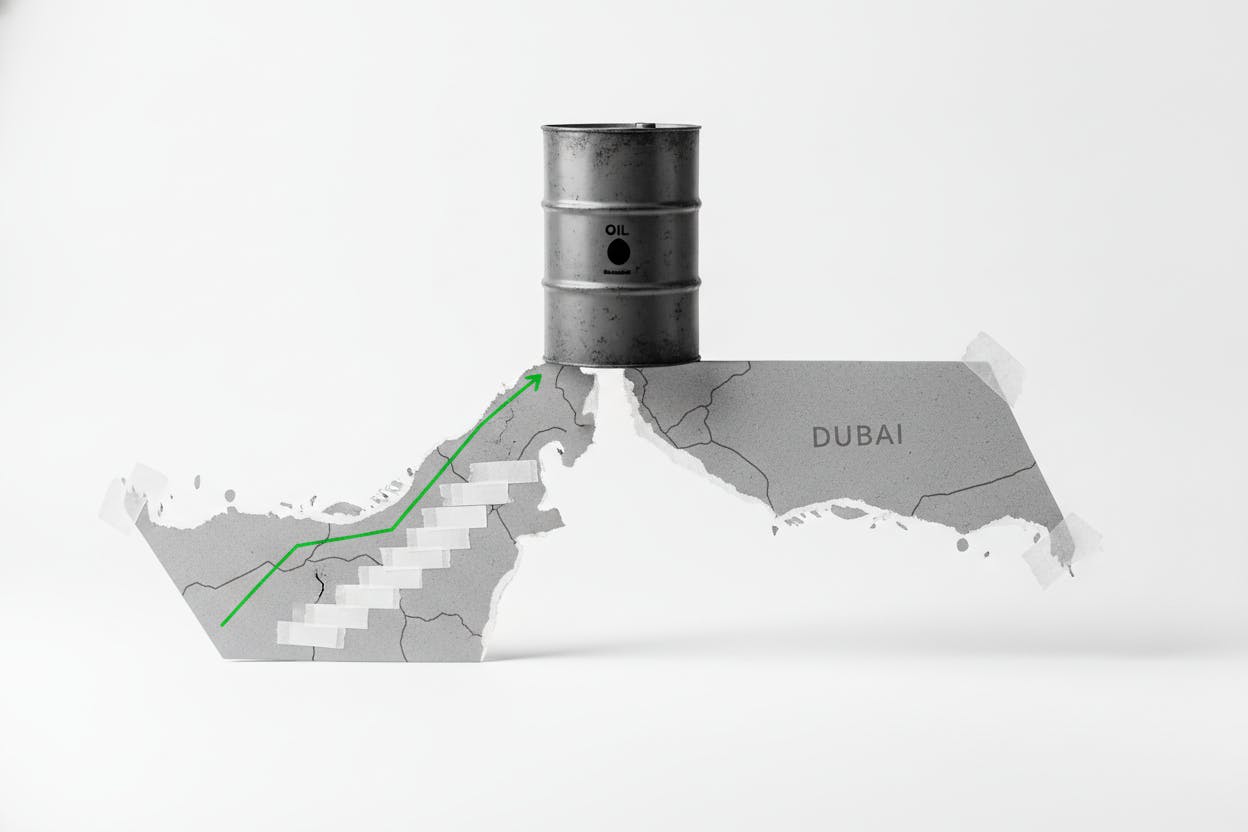
Middle East tensions pushed Brent crude back above $100 a barrel on Wednesday, but the impact on UAE stock markets was far from uniform. Abu Dhabi's benchmark index rose, while Dubai's slipped, highlighting how oil price spikes can have divergent effects even within the same country.
What happened
Brent crude futures traded around $100.87 a barrel, up about 3% on the day, after fresh headlines about US-Iran conflict raised fears of supply disruptions in the Gulf. The move rippled through regional markets, but the reaction was split.
Abu Dhabi's FTSE ADX General Index gained 0.854%, while Dubai's DFM General Index fell 0.324%. The divergence is a classic example of how different market structures respond to the same macro shock.
Why Abu Dhabi rose and Dubai fell
Abu Dhabi's market is dominated by heavyweight energy-linked firms, including oil giant ADNOC and its subsidiaries, as well as large banks and industrial companies. When crude prices jump, those companies' earnings prospects improve, which tends to lift the index.
Dubai, by contrast, is more geared toward real estate, tourism, and consumer-facing sectors. Its market is often seen as more sentiment-driven, and rising oil prices can stoke fears of regional instability, which tends to hit those stocks harder. Investors may also worry that higher energy costs could weigh on global growth, which would hurt Dubai's trade and tourism-dependent economy.
Oil's broader market impact
The move above $100 is significant because it marks a return to a level that often triggers anxiety in global markets. Higher oil prices can feed into inflation, which in turn influences central bank policy. As we've seen in European markets and Japan's Nikkei, oil at this level tends to weigh on equity sentiment elsewhere.
For Gulf markets, the calculus is different. Higher oil revenues are generally positive for government budgets and state-linked companies, which is why Abu Dhabi can rally. But the same tensions that push oil up can also raise the risk premium investors demand for holding assets in the region, which is part of why Dubai slipped.
What it means for investors
For everyday investors, the key takeaway is that oil price spikes don't affect all stocks equally. If you hold a broad UAE index fund, you're exposed to both dynamics: the energy boost and the risk-off sentiment. Diversification across sectors and geographies can help smooth out these swings.
It's also worth watching how long oil stays above $100. If tensions ease, crude could quickly retreat, and the Abu Dhabi rally might fade. Conversely, if the conflict escalates, oil could push higher, potentially widening the gap between the two markets.
Investors should also keep an eye on how global central banks react. As noted in gold's recent rise, geopolitical tensions often drive safe-haven demand. If oil keeps climbing, it could complicate the inflation fight, leading to higher-for-longer interest rates, which would hit growth-sensitive sectors everywhere.
The bottom line
Wednesday's split in UAE stocks is a reminder that markets are not monoliths. Even within a single country, different sectors can react very differently to the same news. For investors, understanding what drives each market—energy in Abu Dhabi, sentiment in Dubai—can help you interpret daily moves and position your portfolio accordingly.
As always, it's important to focus on your long-term goals rather than reacting to short-term swings. Oil at $100 is a headline-grabbing number, but its lasting impact on your investments depends on how long it stays there and how the broader economy responds.