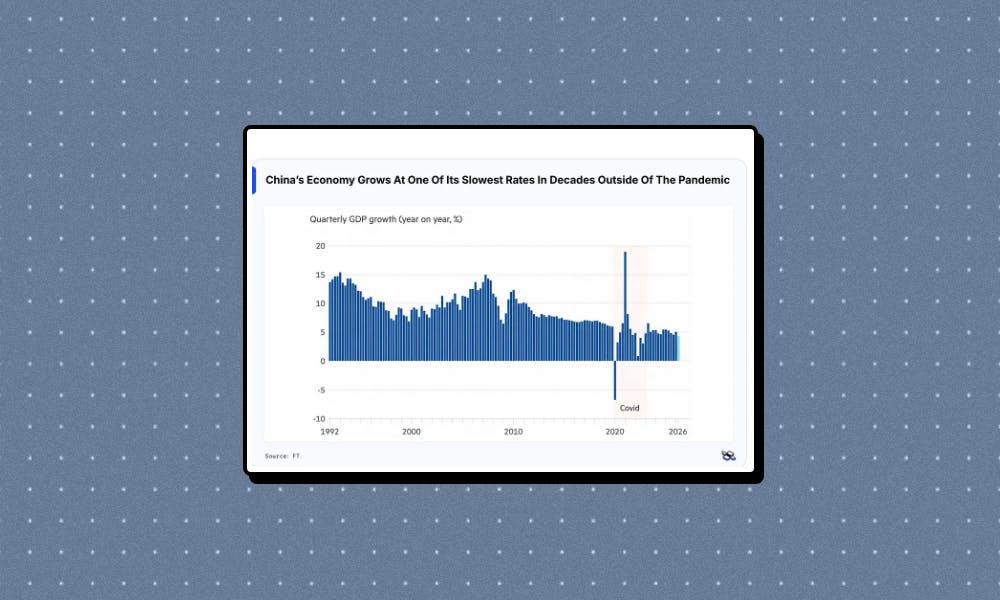
China's economic growth fell short of the government's target in the second quarter, intensifying pressure on policymakers to roll out fresh stimulus measures. The world's second-largest economy expanded 4.3% year-on-year in the April-to-June period, below the official target range of 4.5% to 5% and marking its weakest pace in over three years.
The data, released Monday, underscores the challenges facing Beijing as it tries to revive growth amid a prolonged property downturn and sluggish domestic demand. The miss comes just weeks before a key Politburo meeting, where top officials are expected to discuss economic policy and potentially announce new support measures.
What drove the slowdown?
The main culprit was a sharp drop in fixed-asset investment, which fell 5.7% in the first half of the year compared to the same period in 2024. Fixed-asset investment—a broad measure that includes spending on infrastructure, real estate, and manufacturing—is a key engine of China's economy. The decline reflects ongoing weakness in the property sector, which remains a major drag on growth despite repeated government efforts to stabilize it.
Property investment, in particular, has been hit hard by a combination of developer debt troubles, weak homebuyer confidence, and regulatory tightening. The sector's struggles have rippled through the broader economy, weighing on construction, materials, and local government finances.
On a more positive note, consumer spending showed tentative signs of life. Retail sales rose 1% year-on-year in June, a modest improvement from recent months, though still well below pre-pandemic levels. Factory output, meanwhile, remained resilient, supported by strong export demand for AI-related products and other high-tech goods.
What it means for investors
For investors, the weaker-than-expected GDP reading is a reminder that China's recovery remains uneven and fragile. The data has already weighed on Chinese stocks, with major indices sliding on Monday. The China Stocks Slide as Q2 GDP Growth Misses Forecasts, Property Woes Deepen report highlighted the market's negative reaction.
The slowdown also has implications for global commodity markets. China is the world's largest consumer of industrial metals like copper, and weaker growth there can dampen demand. A separate report noted that Copper Slips on Weak China Data but Supply Woes and Oil Surge Limit Losses, reflecting the mixed signals for raw materials.
For everyday investors, the key question is whether Beijing will respond with more aggressive stimulus. The government has already taken steps to support the economy, including cutting interest rates and easing property purchase restrictions. But the Q2 miss suggests those measures may not be enough.
What to watch next
All eyes are now on the Politburo meeting, which is expected later this month. The Politburo is the top decision-making body of the Chinese Communist Party, and its economic meetings are closely watched for signals on policy direction. Officials could announce new fiscal spending, further monetary easing, or additional support for the property sector.
Another key indicator to watch is bank lending. A recent report showed that China's June Bank Lending Misses Expectations as Economic Slowdown Persists, suggesting that credit demand remains weak. If lending doesn't pick up, it could signal that businesses and households are still cautious about borrowing and spending.
For now, the outlook for China's economy remains uncertain. The government's growth target for the full year is around 5%, but achieving that will require a significant pickup in the second half. Whether Beijing can deliver the right mix of policies—and whether those policies will be enough to revive confidence—remains to be seen.