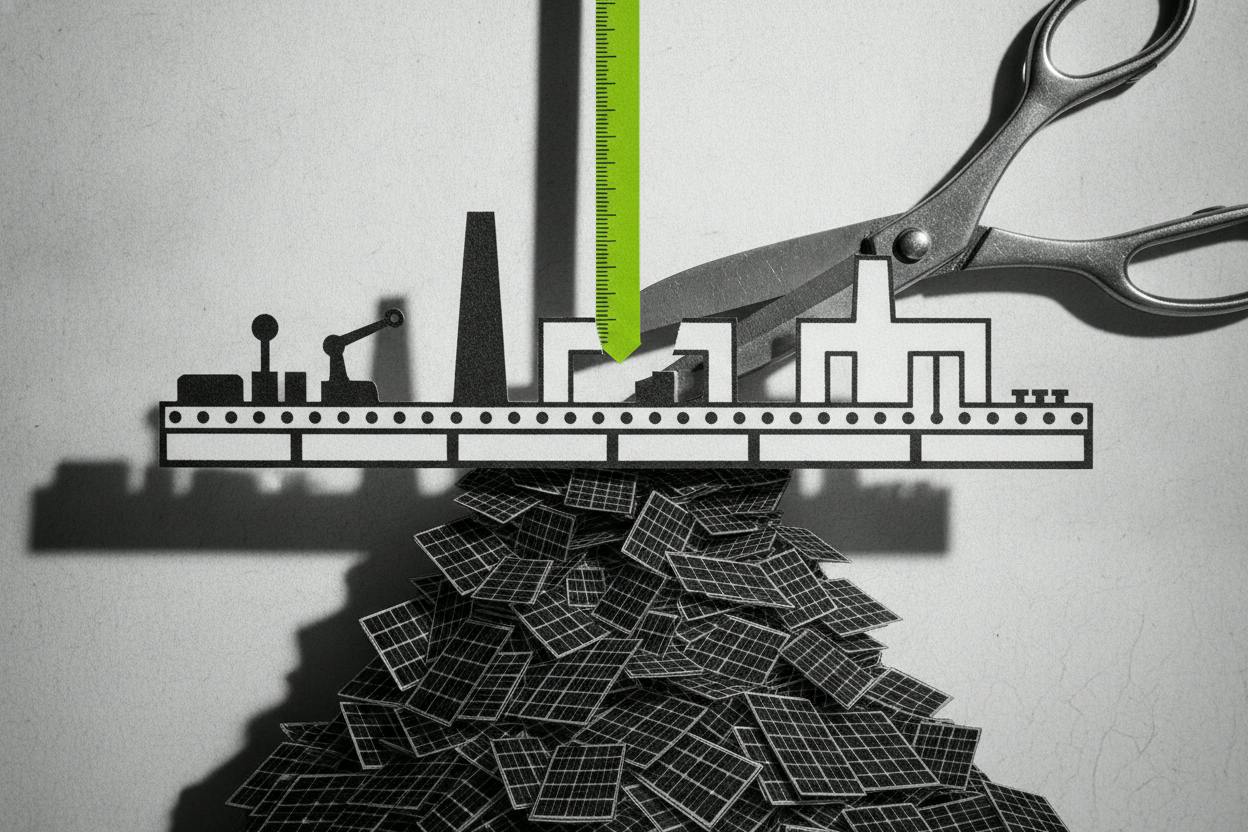
China's biggest solar manufacturers are shrinking their workforces at a rapid clip, but the cost-cutting has not been enough to offset a brutal market downturn. A Reuters review of company filings shows that Longi Green Energy, Trina Solar, Jinko Solar, JA Solar, and Tongwei ended 2025 with a combined 154,061 employees, down 21% from the previous year. That follows an already steep reduction in 2024, meaning the industry's largest players have now shed hundreds of thousands of jobs over two years.
The cuts are broad-based, touching factory floors, research teams, and administrative staff alike. Notably, some companies trimmed headcount even without formally announcing layoffs, suggesting attrition and contract non-renewals are doing much of the work.
Why the industry is bleeding
The root cause is a supply glut that has pushed solar panel prices below the cost of production. For much of 2025, manufacturers were selling panels at a loss just to keep factories running and maintain market share. At the same time, demand growth cooled, both in China and in key export markets, leaving the industry with excess capacity and little pricing power.
This is a familiar cycle for commodity-like industries: when too many players expand at once, prices collapse, and the weakest are forced to cut costs or exit. Solar manufacturing has become heavily commoditized, with little differentiation between most panels, so companies compete almost entirely on price.
The job cuts are a direct response to that pressure. By reducing headcount, companies aim to lower fixed costs and narrow their losses. But the scale of the cuts—another 21% in a single year—shows how severe the financial strain has become. Even after trimming, many of these firms still reported net losses for the year.
What it means for investors
For everyday investors, the key takeaway is that China's solar giants are still in survival mode. Cost-cutting alone has not restored profitability, and there is no clear sign that panel prices will recover soon. The industry's overcapacity is massive, and demand is not growing fast enough to absorb it.
Investors should watch for several signals that could indicate a turning point. First, any meaningful rise in panel prices above production costs would be a positive sign. Second, capacity closures or consolidation—such as smaller players exiting the market—could help rebalance supply and demand. Third, policy support from the Chinese government, which has previously intervened in troubled industries, could provide a floor under prices.
It's also worth noting that the pain is not confined to solar. China's broader economy is showing signs of strain, with growth slowing while other Asian economies pick up. The country's trade surplus has hit a 20-month high as exports surge, but that export strength has not translated into robust domestic demand. Meanwhile, factory prices have jumped 5% while consumer inflation remains muted, a sign that industrial overcapacity is still a problem.
For those holding solar stocks or considering them, the message is caution. The industry's leaders are cutting jobs, not losses, and there is no quick fix in sight. Investors should be prepared for continued volatility and potential further declines in share prices.
The bigger picture
The solar industry's troubles are part of a larger trend in Chinese manufacturing. From steel to semiconductors, many sectors are grappling with overcapacity and weak pricing. The government has talked about encouraging consolidation, but so far, the market has been left to sort itself out.
For the global energy transition, the silver lining is that cheap solar panels make renewable energy more affordable. But for the companies making them, cheap is a curse. Until supply and demand rebalance, the pain is likely to continue.
Investors should also keep an eye on how this affects the broader market. The struggles of China's solar giants are a reminder that even in fast-growing industries, profits are not guaranteed. As always, diversification and a long-term perspective are essential.