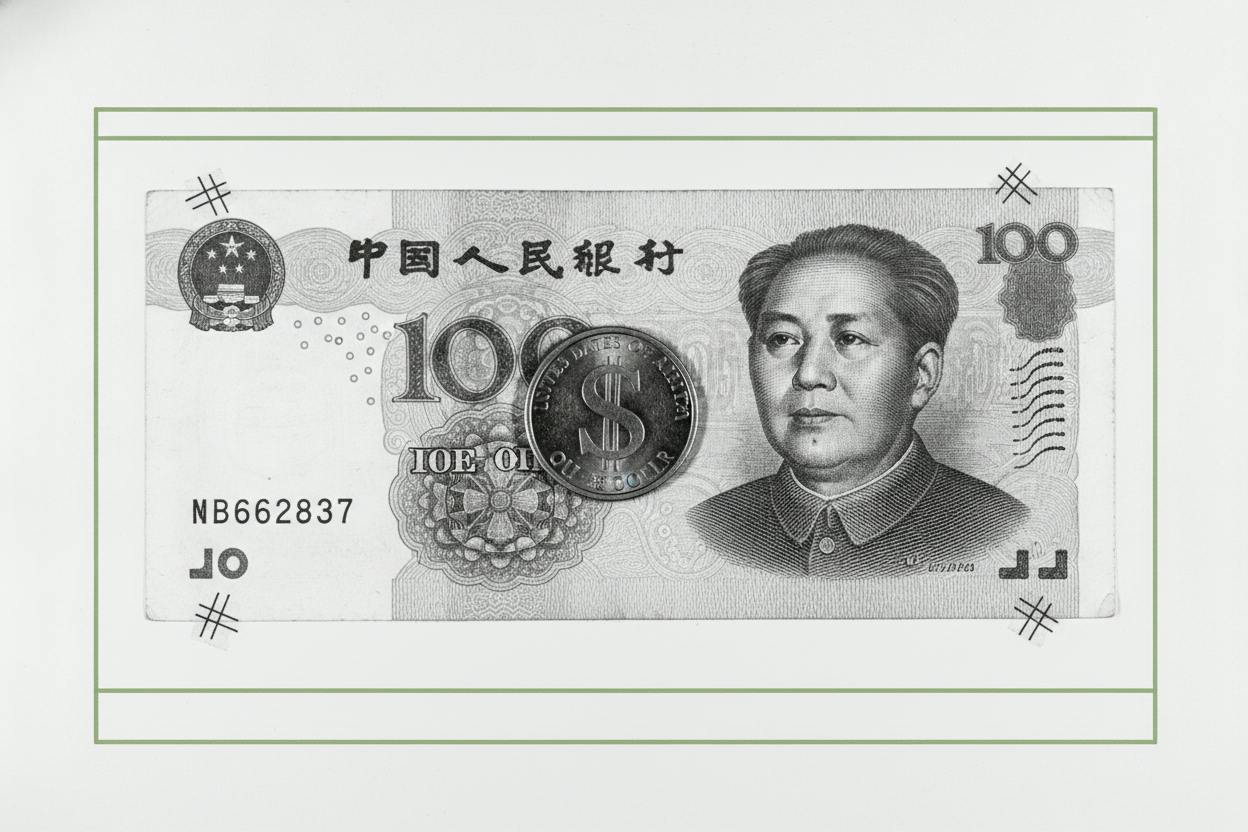
China's yuan held its ground near 6.70 per dollar on [day], even as the US dollar remained strong in global markets. The stability came after the People's Bank of China (PBOC) set another supportive daily midpoint fixing, a signal that policymakers are comfortable with the current level and want to avoid sharp swings.
The midpoint fixing is the daily reference rate that the PBOC sets for the yuan, and it acts as a guide for where the currency can trade within a 2% band. By keeping the fixing supportive, the central bank is effectively signaling that it wants to keep the yuan from weakening too much, even as the dollar's strength puts pressure on many other currencies.
Why the yuan's stability matters
The yuan's resilience is notable because a strong dollar typically weighs on emerging market currencies. When the dollar rises, investors often pull money out of riskier assets, which can push down currencies like the yuan. But China's central bank has tools to manage the exchange rate, and it has been using them to keep the yuan within a comfortable range.
For everyday investors, the yuan's stability is a sign that China is trying to avoid excessive volatility in its currency, which could disrupt trade and capital flows. A stable yuan also helps Chinese exporters by making their goods more predictable in price, and it supports the broader economy by reducing uncertainty for businesses that deal in foreign currencies.
The PBOC's approach is part of a broader pattern. Central banks often intervene in currency markets to smooth out sharp moves, and China has a history of using its daily fixing to guide the yuan. This time, the supportive fixing suggests that the PBOC is willing to defend the current level, at least for now.
What it means for investors
For investors with exposure to Chinese assets, the yuan's range-bound behavior is a positive sign. It reduces the currency risk that can eat into returns from Chinese stocks or bonds. However, it also means that the yuan is unlikely to appreciate significantly in the near term, which could limit gains for foreign investors who convert their returns back into dollars or other currencies.
The stability also has implications for global markets. A stable yuan reduces the risk of a currency war or a sudden shift in trade dynamics, which can be reassuring for investors worldwide. It also contrasts with the volatility seen in other currencies, such as the Japanese yen or the euro, which have been more sensitive to dollar moves.
Looking ahead, investors will be watching the US inflation data, which could influence the dollar's direction. If inflation comes in hot, the Federal Reserve may keep interest rates higher for longer, which would likely keep the dollar strong and put more pressure on the yuan. On the other hand, if inflation cools, the dollar could ease, giving the yuan more room to move.
Related: dollar eases as traders await inflation data
The broader context
The yuan's stability is also part of a larger story about China's economy. While growth has slowed, the central bank has been focused on maintaining financial stability. The PBOC has also been buying gold for months, a move that some analysts see as a way to diversify reserves and hedge against dollar weakness in the long term. China's central bank has been buying gold for 23 straight months, which suggests a long-term strategy to reduce reliance on the dollar.
In the near term, the yuan's range-bound run is likely to continue, barring any major surprises in US economic data or geopolitical events. The PBOC has shown it is willing to use its tools to keep the currency stable, and that is likely to remain the case as long as the dollar stays strong.
For investors, the key takeaway is that the yuan is not likely to be a source of major volatility in the near term. That can be a good thing for portfolio stability, but it also means that currency plays are unlikely to provide much of a boost. Instead, investors should focus on the fundamentals of the assets they hold, rather than betting on big currency moves.
As always, it's important to remember that currency markets can be unpredictable, and central bank policies can change quickly. But for now, the PBOC's supportive stance is keeping the yuan on a steady path, and that is a reassuring sign for markets.