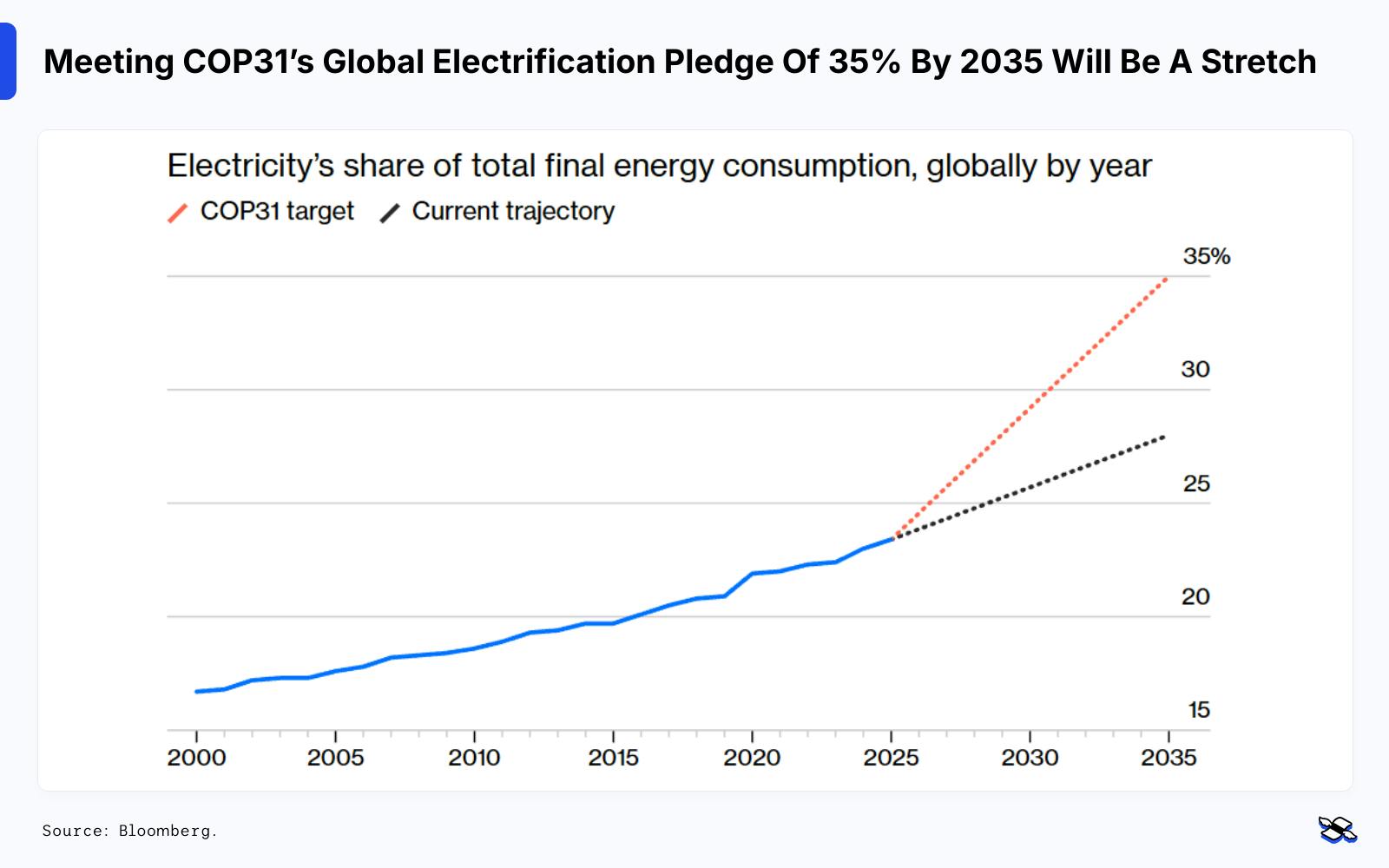
World leaders gathered at the COP31 climate summit in Turkey have set an ambitious target: boost electricity's share of global energy consumption from 23% to 35% by 2035. The so-called “35-by-35” pledge is meant to accelerate the shift away from fossil fuels. But as negotiators dig into the details, a glaring loophole is causing friction.
The pledge, as currently drafted, does not require that the extra electricity come from clean sources. In theory, a country could hit the 35% target simply by building more gas or coal-fired power plants. That has sparked disagreement among delegates, with several European nations pushing for language that would tie the goal to renewable or low-carbon generation.
Why the target matters
Electricity is only one slice of the global energy pie. Today, it accounts for roughly 23% of all energy consumed worldwide. The rest comes from burning fuels directly—for transportation, heating, and industrial processes. Raising electricity's share to 35% would be a significant shift, because electricity can be generated from clean sources like wind, solar, and nuclear, whereas many direct fuel uses are hard to decarbonize.
But the current trajectory suggests the goal is already a stretch. Under existing policies, the world is on track to reach just 28% by 2035—seven percentage points short of the target. Closing that gap would require a massive build-out of new power infrastructure, grid upgrades, and policy support, all within a little over a decade.
The debate over the clean-energy requirement is not just academic. If countries are allowed to count fossil-fuel electricity toward the target, the pledge could end up locking in higher emissions for years. That would undercut the very purpose of the summit, which is to keep global warming in check.
What it means for investors
For everyday investors, the outcome of these negotiations matters more than it might seem. Energy policy shapes the economics of entire industries. If the 35-by-35 pledge is eventually paired with clean-energy requirements, it would likely accelerate investment in renewable power, grid technology, and energy storage. Companies in those sectors could see stronger demand for years to come.
On the other hand, a weaker pledge—one that allows fossil-fuel electricity to count—could slow the transition and keep demand for coal and gas higher for longer. That would support traditional energy companies but could also increase regulatory and climate risks down the line.
The gap between the 28% trajectory and the 35% target also highlights the scale of investment needed. Analysts often point out that meeting such goals requires trillions of dollars in capital, much of it from private markets. For investors, that means opportunities in infrastructure funds, utility companies, and clean-energy technology—but also uncertainty about how quickly policy will move.
It's worth noting that this is not the first time climate pledges have faced implementation hurdles. Previous COP agreements have often set ambitious goals, only to see countries struggle to meet them. The broader economic backdrop—including high interest rates and inflation—can also affect how quickly governments and companies can invest in new energy projects.
For now, the key thing to watch is whether the final COP31 text includes a clean-energy requirement. If it does, expect a stronger push toward renewables. If it doesn't, the pledge may end up being more about optics than actual emissions reductions.
Either way, the debate underscores a fundamental challenge: electrifying the global economy is necessary, but it's not sufficient. The source of that electricity is what will ultimately determine whether the planet benefits.