Corporate America borrowed heavily during an era of rock-bottom interest rates. That era is ending, and the bill is coming due. Over the next several years, companies will need to refinance a staggering $4.3 trillion in bonds, and they'll be doing it at a time when borrowing costs are far higher than they were when the debt was first issued.
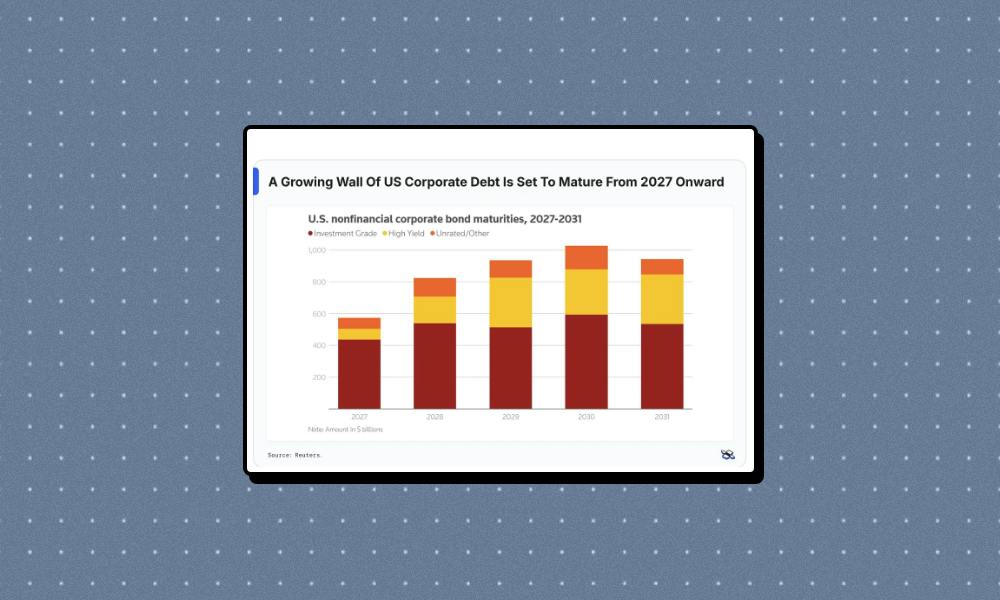
According to the latest data, annual bond maturities are set to climb steadily, from $572 billion in 2027 to more than $1 trillion by 2030. That's a wall of debt that will force companies back to the capital markets, where the 10-year Treasury yield now sits above 5% — a level not seen in years and a far cry from the sub-2% yields that prevailed during much of the post-2008 period.
Why the cheap-debt era is over
For more than a decade, companies took advantage of ultra-low interest rates to lock in inexpensive financing. They issued bonds to fund expansion, buy back stock, or simply refinance existing debt at lower costs. But those bonds are now approaching maturity, and the market environment has changed dramatically.
The Federal Reserve's aggressive rate hikes to combat inflation have pushed Treasury yields sharply higher. The 10-year Treasury yield, a benchmark for corporate borrowing costs, has climbed above 5% — a level that makes new debt significantly more expensive. When companies refinance, they'll have to pay higher coupon rates, which directly eats into profits and cash flow.
For investment-grade companies, the pain is manageable but real. For riskier, high-yield issuers — often called "junk" borrowers — the pressure is much more acute. High-yield maturities are expected to surge from $68.5 billion in 2027 to $314 billion in 2029, when they'll represent roughly a third of all maturities. That's a massive jump in the amount of debt that needs to be refinanced in the riskiest corner of the corporate bond market.
Who's most at risk?
The companies most exposed are those with weaker balance sheets and lower credit ratings. These firms already pay higher interest rates to compensate investors for the added risk, and they'll feel the pinch of higher refinancing costs more sharply. Some may struggle to refinance at all if credit conditions tighten further.
PIMCO, one of the world's largest bond investors, says most companies can likely handle the hit. But the firm also acknowledges that the weaker end of the spectrum — companies with high debt loads and thin margins — could face serious challenges. In a worst-case scenario, some could be forced to restructure or default.
The broader economic backdrop adds to the uncertainty. High interest rates are designed to slow the economy, and a slowdown could reduce corporate revenues, making it even harder for companies to service their debt. At the same time, rising US yields are already pressuring markets, and that pressure could intensify as the refinancing wave builds.
What it means for investors
For everyday investors, this refinancing crunch has several implications. First, if you own corporate bonds or bond funds, you may see yields rise as companies are forced to offer higher coupons to attract buyers. That's good for income, but it also means the value of existing bonds could fall.
Second, if you own stocks, be aware that companies with heavy debt loads may see their profits shrink as interest expenses climb. That could weigh on share prices, especially for smaller, riskier companies. On the other hand, companies with strong balance sheets and low debt are better positioned to weather the storm.
Third, the refinancing wave could create opportunities for savvy investors. As companies scramble to refinance, some may issue bonds at attractive yields. But it also raises the risk of defaults, particularly in the high-yield sector. Regulators are also watching the banking sector, and any stress in corporate credit could ripple through the financial system.
Finally, keep an eye on the 10-year Treasury yield. If it stays above 5%, the cost of refinancing will remain high. If it falls, the pressure eases. A stronger dollar and rising yields are already affecting emerging markets, and the same dynamics are at play in the US corporate bond market.
The bottom line: Corporate America's cheap-debt era is over, and the transition to a higher-cost world will be bumpy. Most companies will manage, but the weakest will struggle. For investors, the key is to focus on balance sheet strength and be prepared for more volatility in both bond and stock markets.