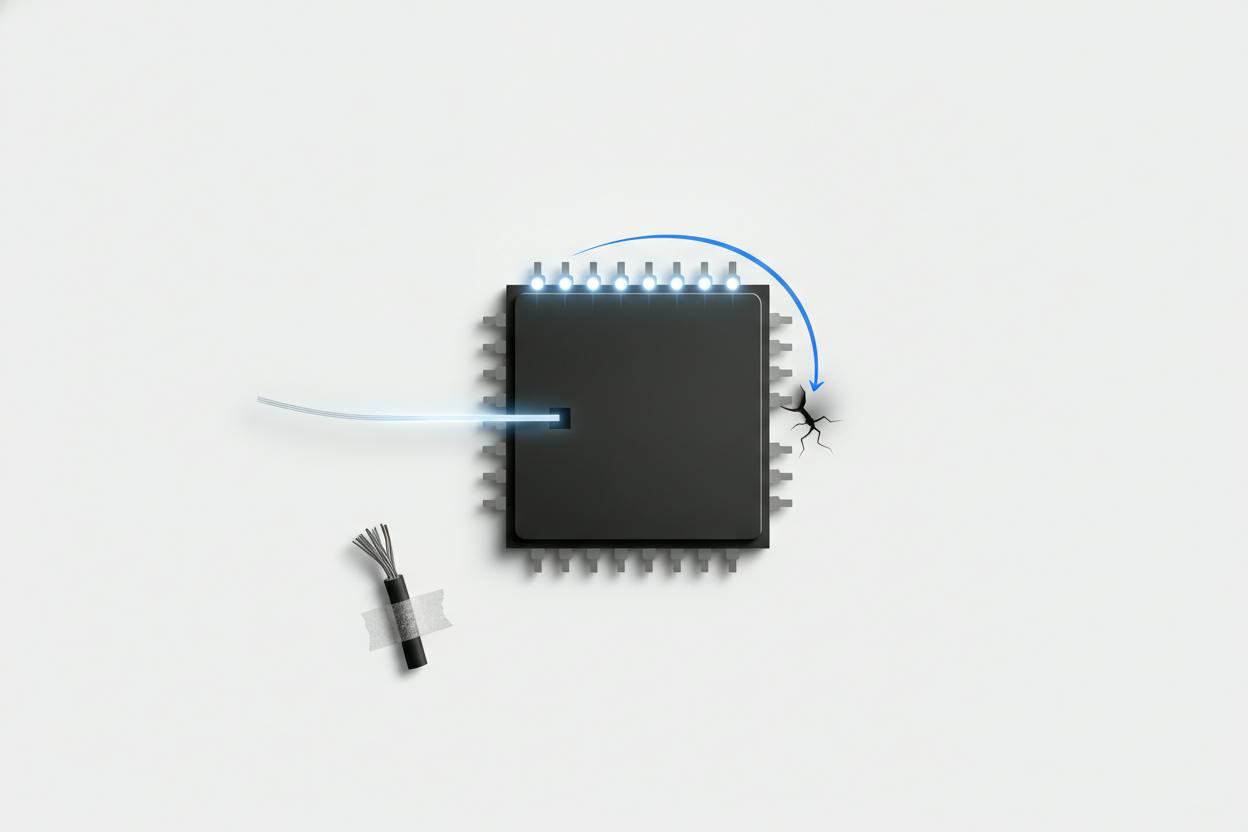
Silicon Valley startup CScale has raised $145 million to push optical connections closer to AI chips, a move that could help data centers move more data faster while avoiding the downtime that has kept lasers off chip packages. The company, backed by chip giants Nvidia and Intel, says its technology can integrate lasers directly onto chips without interrupting data flow when a laser fails.
The funding round was led by Atreides Management, Valor Equity Partners, and Premji Invest, bringing CScale's total funding to $188 million. CEO Martin Lund, a former hardware executive at Cisco Systems, said the company aims to ship its chips by 2028.
Why optics are the next frontier in AI hardware
Today's AI servers rely heavily on copper cables to connect chips inside a server box. Copper is cheap and dependable, but it has a fundamental limitation: it can't carry ultra-fast signals very far without degrading. That forces designers like Nvidia and Advanced Micro Devices to pack processors close together, which in turn creates intense heat and demands complex cooling systems.
Optical links, which send data as pulses of light through fiber, can move far more data over longer distances. The industry has long wanted to bring optics inside the server and eventually right up to the chip package. The problem has been reliability: lasers are components that wear out over time. If a laser fails and forces a full swap of the chip or module, downtime and maintenance costs spike. That's why many current designs keep lasers in replaceable modules rather than integrating them onto the package.
CScale claims it can put lasers onto chips while maintaining traffic when a laser fails, turning what would be an outage into a manageable performance hit. If true, that would remove one of the biggest practical barriers to adopting near-chip optics.
What CScale's technology could change
For data center operators, the appeal is clear: fewer truck rolls, less forced replacement of tightly integrated parts, and higher real-world uptime. Instead of treating interconnects as a hard physical limit that dictates dense layouts and heavy cooling, operators could start weighing optics as an architectural choice focused on reliability, serviceability, and total system cost.
For chipmakers, server builders, and suppliers of cables, transceivers, and cooling gear, this shift would reshape where money gets spent in AI hardware. If optics move closer to the processor, the market for traditional copper interconnects and the cooling systems designed to manage dense layouts could shrink, while demand for optical components and related testing equipment could grow.
The broader AI hardware market is already seeing intense competition and innovation. For instance, Cerebras is supplying its CS-4 chips to a cloud provider for AI inference, showing how startups are challenging the established players. And chipmakers are tapping public markets to fund their ambitions, reflecting the high stakes in this sector.
What it means for investors
CScale's 2028 timeline tests whether "lasers fail" is a downtime problem or a design constraint. If the company succeeds, it could make near-chip optics easier for data center operators to live with, potentially accelerating the adoption of optical interconnects in AI servers.
For everyday investors, this is a reminder that the AI boom isn't just about the chips themselves—it's also about the infrastructure that connects them. Companies that solve the reliability and cost challenges of optical interconnects could become important players in the AI supply chain. However, CScale is still years away from shipping products, and the technology is unproven at scale. Investors should watch for updates on its progress, as well as how Nvidia and AMD respond in their own chip designs.
In the meantime, the broader market continues to digest mixed signals. US job openings dipped in August, but layoffs remain low, suggesting the economy is still holding up. That backdrop matters for tech spending, as data center buildouts depend on corporate confidence and access to capital.
For those tracking the AI hardware race, CScale is a name to keep an eye on. Its success or failure could influence how quickly the industry moves from copper to light, and where the next wave of AI infrastructure investment flows.