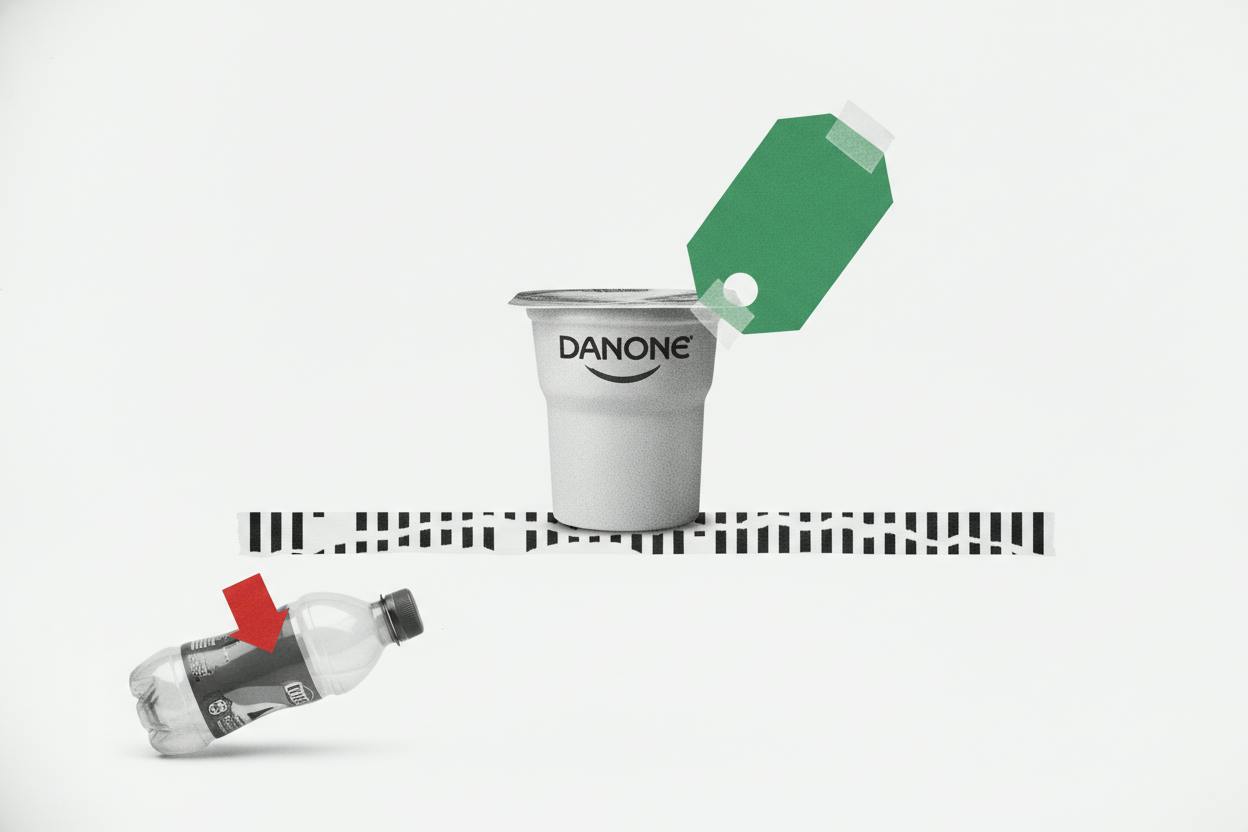
Danone, the French food and beverage giant behind Activia yogurt and Evian water, reported third-quarter organic sales growth of 4% on Thursday, edging past analyst expectations. But the headline number masks a familiar challenge for consumer staples companies: the growth was powered almost entirely by price hikes, not by selling more products.
Revenue came in at €7.233 billion for the quarter, with like-for-like growth of 4.0% versus the 3.7% consensus among analysts, according to Reuters. The breakdown tells the real story: prices rose 3.6% while volumes inched up just 0.4%. In other words, Danone is still passing higher costs on to shoppers rather than seeing a surge in demand.
China's Mizone weighs on the numbers
The biggest drag on the quarter was Danone's waters business in China. The company said weak sales of Mizone, its vitamin-enriched beverage, hurt group growth by about one percentage point. Adverse weather and poor inventory management during a weak season were blamed for the shortfall.
Outside China, the picture was more stable. The Asia Pacific region grew 3.6%, supported by specialized nutrition and essential dairy products. The Americas rose 4.4%, helped by strong demand for high-protein dairy items within its dairy and plant-based portfolio.
Management kept its medium-term targets unchanged, including the 2026 goal of 3%–5% like-for-like sales growth and recurring operating income growing faster than sales. That commitment signals confidence that the current strategy can deliver, even with the China headwind.
What it means for investors
For investors, the key question is whether price-led growth is sustainable. On one hand, if Danone can raise prices without losing many customers, it can protect its gross margins and recurring operating income in a higher-cost environment. That's a positive for profitability.
But there's a flip side. When consumers push back against higher prices, the first warning sign is usually softer volumes as shoppers trade down to cheaper brands or buy less. Danone's volume growth of just 0.4% is already close to flat, so the margin for error is thin.
Investors will likely focus on two swing factors from here. First, can Danone keep using pricing without seeing a bigger hit to demand? Second, can fixing the Mizone issue in China remove that roughly one-percentage-point headwind? If either improves, Danone's 2026 plan becomes less reliant on price hikes and looks more resilient.
This dynamic is not unique to Danone. Across the consumer staples sector, companies are grappling with the same trade-off between pricing power and volume growth. Some, like Symrise, have warned that growth will cool and margins will tighten in the coming quarters. Others, such as Santander, have shown that strong regional performance can offset broader pressures.
For everyday investors, the takeaway is to watch the volume numbers closely. A company that grows purely on price can look good in the short term, but if volumes start to fall consistently, it may signal that the brand's pricing power is fading. Danone's next few quarters will be a test of whether it can balance both.
In the meantime, the company's reaffirmed 2026 targets provide a floor for expectations. If management can deliver on those goals, the stock may continue to reward patient shareholders. But the path is not without risks, and the China waters business remains a wildcard.
As always, past performance is not a guarantee of future results, and investors should consider their own financial situation before making any decisions.