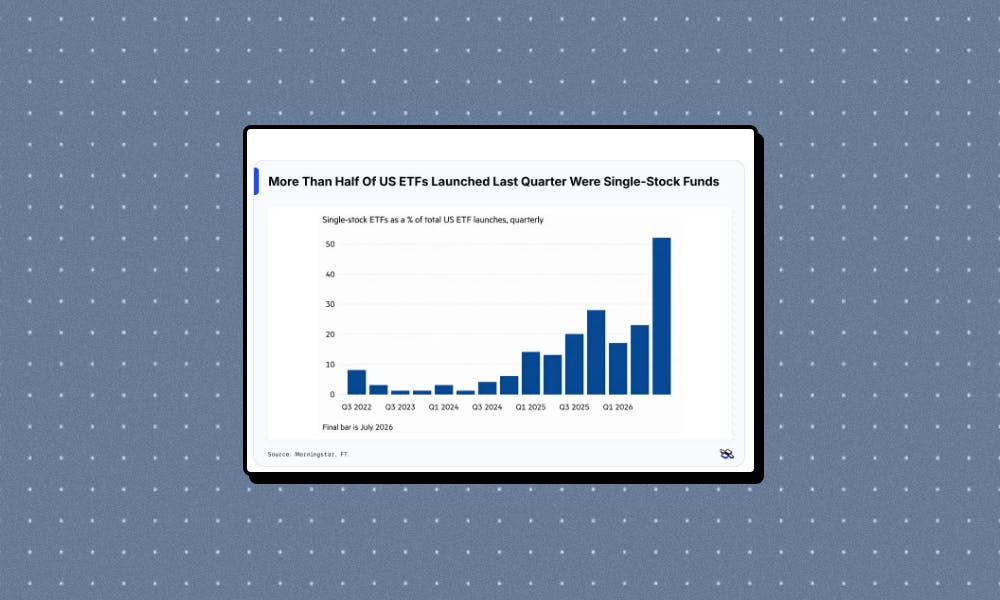
The exchange-traded fund industry has entered a new, stranger phase. More than half of all US ETFs launched in the last quarter were single-stock funds — products that track the shares of just one company rather than a basket of them.
That statistic is the clearest sign yet that the ETF boom is getting a little weird. Investment firms have already launched more than 1,000 ETFs this year, putting 2026 on track for an all-time record. The strategy, industry insiders say, resembles a spaghetti cannon: fire off as many products as possible and hope a few become runaway successes.
What is a single-stock ETF?
A traditional ETF holds dozens or hundreds of stocks, giving investors diversified exposure to a sector, index or theme. A single-stock ETF does the opposite — it tracks the price of one company, often with leverage or inverse options built in. These funds are essentially bets on individual stocks wrapped in an ETF structure, and they have become the fastest-growing corner of the market.
The approach has been inspired by blockbuster launches tied to AI chips and bitcoin, which gathered billions of dollars in just a few months. Firms saw the demand and decided to replicate the formula for any stock that might catch fire. The result: a flood of niche products that would have seemed absurd just a few years ago.
Why now?
The backdrop is a tidal wave of demand. US-listed ETFs attracted over $1 trillion in new money this year alone, as investors of all sizes pour cash into the low-cost, tradeable structure. That flood has encouraged issuers to get creative — or desperate, depending on your view.
With so much money sloshing around, even a tiny slice of a hot new fund can be lucrative. The spaghetti cannon strategy works because the cost of launching an ETF has fallen sharply, while the potential payoff from a viral hit has never been higher. Firms are willing to launch dozens of funds that barely gather assets if one or two turn into billion-dollar behemoths.
This is a marked shift from the industry's early days, when ETFs were mostly broad index funds. Today, issuers are racing to package the latest investing craze before it cools, whether that is AI, crypto, or a single stock that happens to be trending on social media.
What it means for investors
For everyday investors, the explosion of single-stock ETFs is a mixed bag. On one hand, it offers more tools for expressing a specific view. If you are convinced Nvidia will keep rising, there is now an ETF for that — often with leverage to amplify the move.
On the other hand, these products carry risks that many investors may not fully understand. Leveraged and inverse single-stock ETFs are designed for short-term trading, not buy-and-hold portfolios. They can lose value rapidly in volatile markets, and their performance can diverge sharply from the underlying stock over time.
Regulators have taken notice. The Securities and Exchange Commission has flagged concerns about the complexity and potential for investor harm, but has not yet moved to restrict them. For now, the spaghetti cannon keeps firing.
The bigger picture
The ETF industry's shift toward single-stock funds is part of a broader trend: the financialization of everything. Just as Morgan Stanley noted strong demand for data center companies after their IPOs, ETF issuers are trying to capture that same enthusiasm in a tradeable product. The line between investing and speculation is blurring.
Meanwhile, the broader market has been volatile. The S&P 500 dropped 0.6% for a second straight week as tech earnings disappointed, while energy stocks rose on Middle East tensions. In such an environment, single-stock ETFs can amplify both gains and losses.
Investors should remember that not every new ETF is a good fit for a long-term portfolio. The spaghetti cannon may produce some winners, but it also creates a lot of noise. As always, understanding what you own — and why — matters more than chasing the latest launch.



