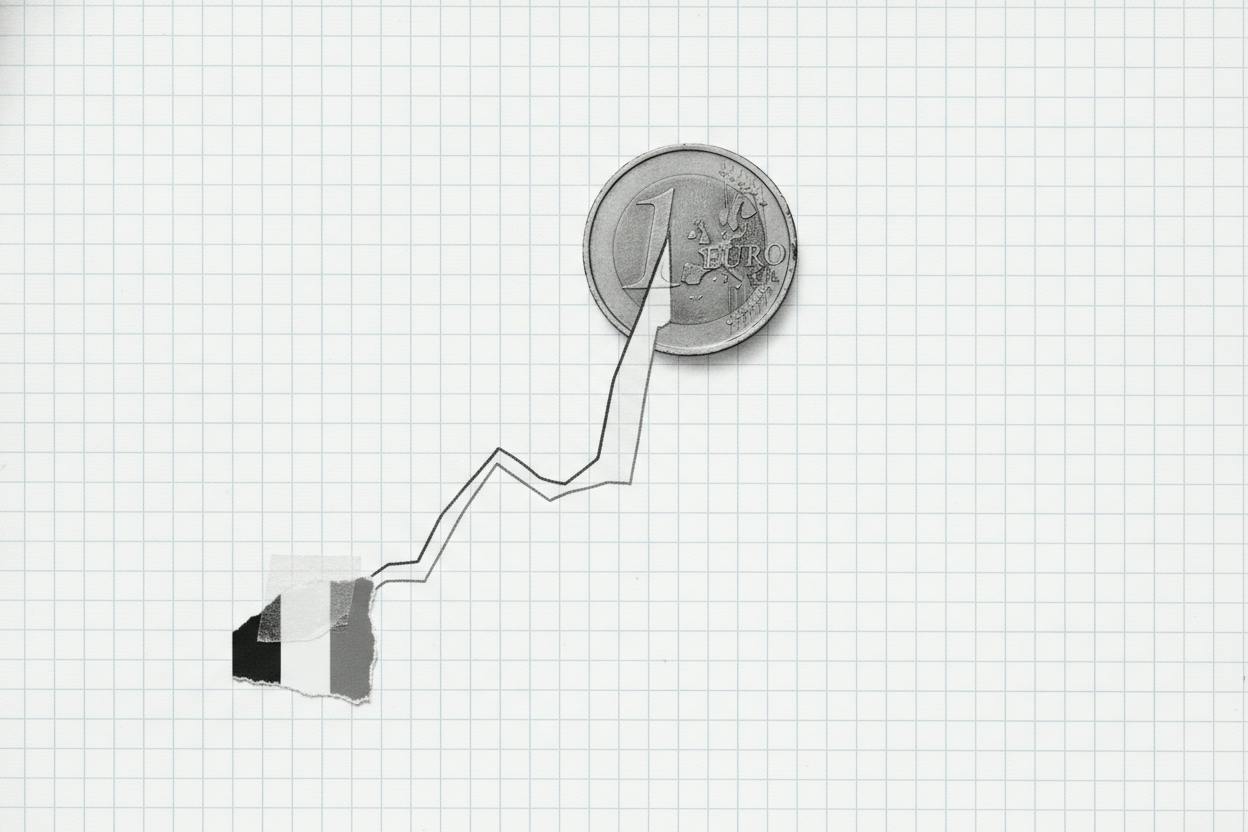
The euro held its ground near $1.1211 on Tuesday, as a calmer political mood in France offered some support, but persistent worries about French government borrowing costs kept the currency's rebound in check. The single currency had dipped to a low of $1.1113 last week before recovering, and traders are now watching whether it can hold above the $1.12 mark.
France remains the market's pressure point
France has been the focal point for currency and bond markets in recent weeks. After several cities introduced curfews to address unrest, attention has shifted back to the country's political and fiscal situation. Lawmakers are preparing to vote on the revenue section of the proposed 2027 budget, a key test of the government's ability to manage public finances.
Reuters reported that worries about France's long-term deficit and debt trajectory have been pushing government borrowing costs higher since early September. That has limited the euro's upside even as it lifted off last week's low. Higher bond yields typically reflect increased risk perceptions, and for France, they signal investor concerns about the country's fiscal health.
Handelsbanken, a Nordic bank, described the concern as a lingering shadow over the euro. The bank noted that while the immediate political tension may have eased, the underlying fiscal issues remain unresolved, keeping a cap on the currency's gains.
What rising French yields mean
When a government's borrowing costs rise, it becomes more expensive for that country to service its debt. For France, which already carries a high debt load relative to its economy, this can feed into broader market sentiment. Higher yields can also make French bonds less attractive relative to other safe-haven assets, potentially leading to capital outflows.
For the euro, the impact is twofold. On one hand, higher yields can attract foreign investors seeking better returns, which might support the currency. On the other, if the rise is driven by fiscal worries, it can undermine confidence in the eurozone's second-largest economy, weighing on the currency.
This dynamic is playing out in the currency markets, where the euro has struggled to make sustained gains despite the recent calm in France. The currency's resilience near $1.12 suggests that traders are not pricing in a full-blown crisis, but they are also not willing to bet heavily on a stronger euro.
What it means for investors
For everyday investors, the euro's movements and French bond yields are more than just numbers on a screen. A weaker euro can affect the cost of imported goods in the eurozone, potentially feeding into inflation. It also impacts European companies that export or import, and it can influence the returns on international investments.
If you hold assets denominated in euros or have exposure to European markets, currency swings can add volatility to your portfolio. A stable euro, as we're seeing now, provides some predictability, but the underlying fiscal concerns in France could lead to sudden shifts.
Investors should also keep an eye on the broader bond market. Rising yields in one major economy can spill over into others, as seen in recent weeks when Treasury yields edged up amid shifting sentiment. Similarly, European shares slipped earlier on France worries and bank probes, showing how interconnected these markets are.
What to watch next
The immediate focus is on the French budget vote. If the revenue section passes smoothly, it could ease some concerns and give the euro a modest boost. However, the longer-term issue of France's debt path is unlikely to disappear quickly.
Traders will also be monitoring any comments from European Central Bank officials, as well as economic data from the eurozone. The upcoming rate and inflation events in other regions could also influence the dollar's strength, indirectly affecting the euro.
For now, the euro appears to be in a holding pattern, with the $1.12 level acting as a psychological barrier. A break above could signal renewed confidence, while a drop below might reignite concerns. As always, investors should focus on the underlying fundamentals rather than short-term noise.