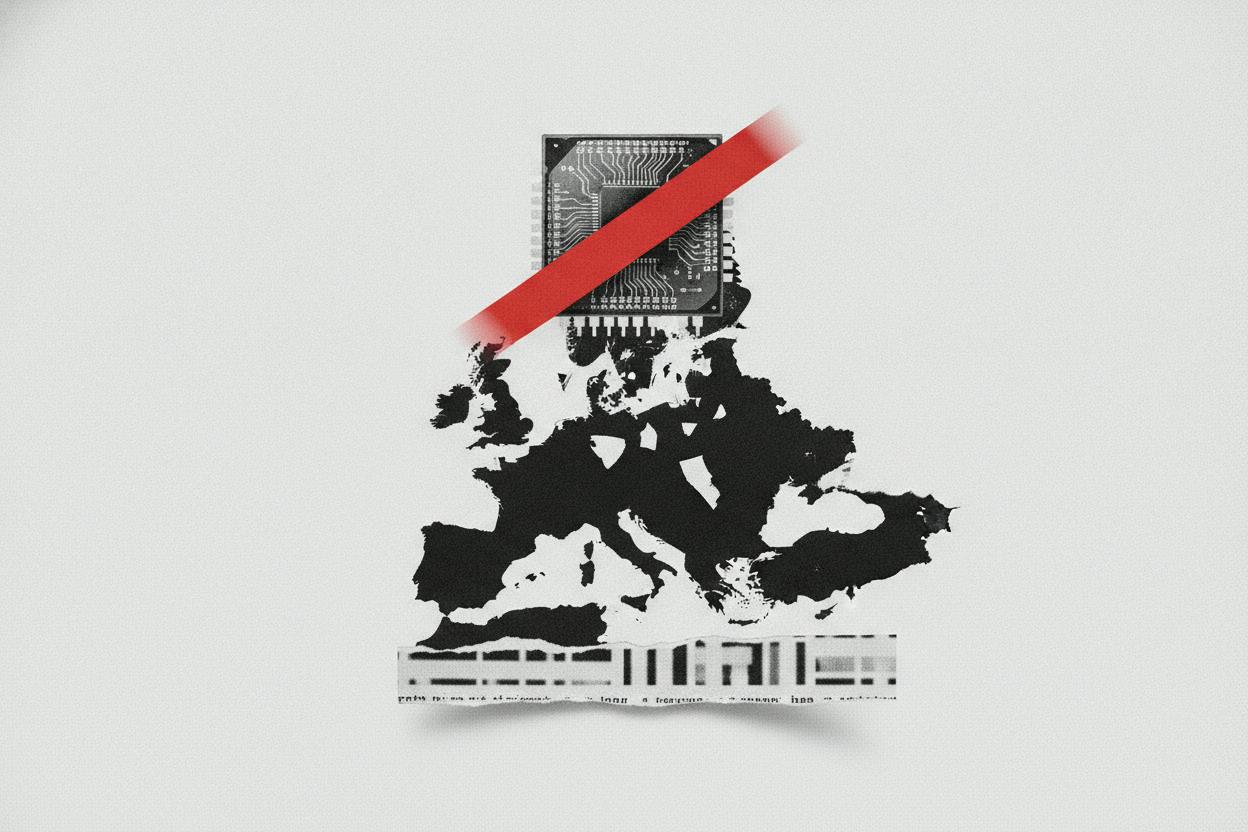
European stocks ended lower on [day] as investors weighed a fresh escalation in Washington's effort to keep advanced artificial intelligence chips out of Chinese hands. The STOXX Europe 600, the region's broad benchmark, slipped 0.64%, with technology and semiconductor-related shares bearing the brunt of the selling.
The move follows a Reuters report that the United States has widened its export controls to restrict shipments of advanced chips to data centers in Thailand and Malaysia. Those countries have become a backdoor for some Chinese companies, which rent computing power there to train AI models without importing the hardware directly.
Closing the 'compute-by-proxy' loophole
The new restrictions go beyond blocking direct sales to China. They target what analysts call "compute-by-proxy" — a setup where the physical chips sit outside China, but the processing power they generate still flows back to Chinese users. By cutting off data centers in Southeast Asia, Washington is trying to close a workaround that has helped Chinese firms access cutting-edge computing capacity.
For Europe's chip supply chain, the immediate problem is visibility. When export rules change, orders can get delayed, rerouted, or canceled while companies check whether they are compliant. That uncertainty often shows up in lower valuations for firms tied to high-end chip demand, because investors struggle to price in how much future revenue might be affected.
Those concerns weighed on two of Europe's biggest semiconductor names. ASML, the Dutch maker of lithography machines used to produce advanced chips, fell 1.32%. Infineon, a German chipmaker that supplies the automotive and industrial sectors, also declined. Both companies are sensitive to shifts in global chip demand, and any threat to the AI-driven boom is felt quickly in their share prices.
Deutsche Bank drops on renewed scrutiny
Separately, Deutsche Bank sank 5% after new media reports revisited the German lender's past client relationships. The bank responded by saying the incidents in question date back years and that its controls have since been strengthened. Still, the news revived concerns about governance and compliance, which have dogged the bank in the past.
The drop in Deutsche Bank added to the broader market's losses, though the main driver of the STOXX's decline was clearly the chip-related selling.
What it means for investors
For everyday investors, the key takeaway is that export controls are no longer just a US-China issue. They are a global market event. The widening of restrictions to Southeast Asia shows that Washington is willing to chase the hardware wherever it goes, which raises the regulatory risk for the entire advanced-chip ecosystem — from chip designers to equipment suppliers.
Markets tend to price this kind of uncertainty as a higher risk premium. That means investors become less willing to pay a high multiple for each dollar of future profit, because the range of possible outcomes has widened. The result can be choppier trading for Europe's chip-linked stocks, and a bigger sensitivity for the STOXX Europe 600 when the next big AI milestones hit.
One such milestone is Nvidia's earnings report, which is closely watched because it sets expectations for the whole AI supply chain. If Nvidia signals strong demand, it can lift the entire sector; if it warns about export-related headwinds, the selling could intensify. Similar dynamics have already played out in Asia, where AI stocks slid on chip curbs and Nvidia nerves, and in the US, where export curbs hit tech stocks ahead of Nvidia's report.
For now, investors in European chip names should expect more volatility. The rules are still being digested, and companies may need time to figure out how the new restrictions affect their order books. The broader lesson is that regulatory policy can move markets just as much as earnings or interest rates — and in today's interconnected chip industry, a rule change in Washington can ripple through Amsterdam, Munich, and beyond.
As the situation evolves, keep an eye on how companies like ASML and Infineon describe the impact in their next earnings calls. Their comments will give a clearer picture of whether the new curbs are a temporary hiccup or a lasting drag on demand.