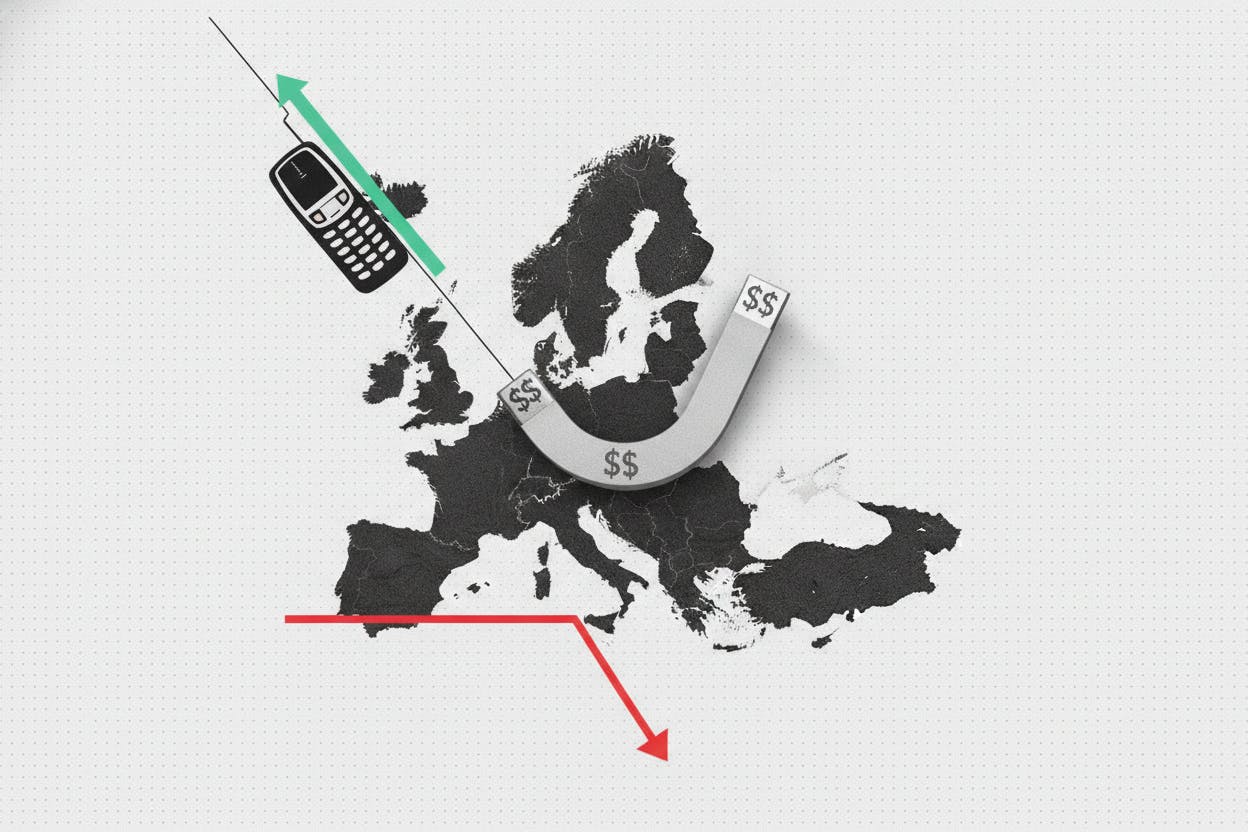
US-listed shares of European companies edged lower late Tuesday morning, with the S&P Europe Select ADR Index slipping 0.46%. The modest decline masked sharp divergences among individual stocks: Nokia's US-listed shares jumped 6.5%, while Endava's fell 6.2%.
What are ADRs and why do they matter?
ADRs, or American Depositary Receipts, are a way for US investors to buy shares of foreign companies without dealing with overseas exchanges. Each ADR represents a certain number of shares in the underlying company, and they trade on US exchanges just like domestic stocks. The S&P Europe Select ADR Index tracks a basket of these instruments, giving a snapshot of how European equities are performing in the US market.
Tuesday's move was relatively small, but the divergence between Nokia and Endava highlights how company-specific news can drive individual ADRs even when the broader index is flat.
Nokia's surge and Endava's slide
Nokia, the Finnish telecommunications equipment maker, saw its US-listed shares climb 6.5%. While the brief doesn't specify a reason, such a jump often follows positive company announcements, strong earnings, or favorable industry developments. For investors, a move of this size suggests significant market-moving news.
On the other end, Endava, a UK-based IT services company, fell 6.2%. That kind of decline typically reflects disappointing results or guidance, though the brief doesn't provide details. Endava is a smaller, growth-oriented firm, and its stock can be more volatile than larger, established companies.
What this means for investors
For everyday investors, the takeaway is that European ADRs can be a convenient way to diversify internationally, but they come with their own risks. Currency fluctuations, different accounting standards, and geopolitical factors can all affect performance. The mixed moves on Tuesday underscore that even within a single index, individual stocks can react very differently based on their own circumstances.
Investors should also note that ADR prices can be influenced by the US market's overall sentiment, as well as by what's happening in the home market. For example, if European markets are closed or have already traded, the ADR might reflect that activity.
Looking at the broader picture, European stocks have been navigating a range of pressures, from oil price movements to sector-specific news. Recent sessions have seen European stocks slip as oil nears $98.50, and energy stocks have rallied as oil approaches $100. These trends can spill over into ADR trading.
How to interpret index moves
A 0.46% decline in the S&P Europe Select ADR Index is relatively minor, and investors shouldn't overreact. Index moves of less than 1% are common and often reflect routine trading. What matters more is the underlying trend and whether individual holdings are moving for fundamental reasons.
For those considering European exposure, it's worth watching how the index responds to economic data, central bank policy, and geopolitical events. The European Central Bank's interest rate decisions, for instance, can have a significant impact on European equities and, by extension, ADRs.
What to watch next
Investors will likely keep an eye on Nokia and Endava for further announcements that could explain their moves. They'll also watch the broader European market for signs of whether Tuesday's dip is a blip or the start of a larger pullback. With oil prices hovering near $100, traders remain on edge, and any major shift in energy costs could ripple through European equities.
For now, the key message is that European ADRs offer diversification but require attention to both company-specific news and macro trends. As always, a balanced portfolio and a long-term perspective are the best defenses against short-term volatility.