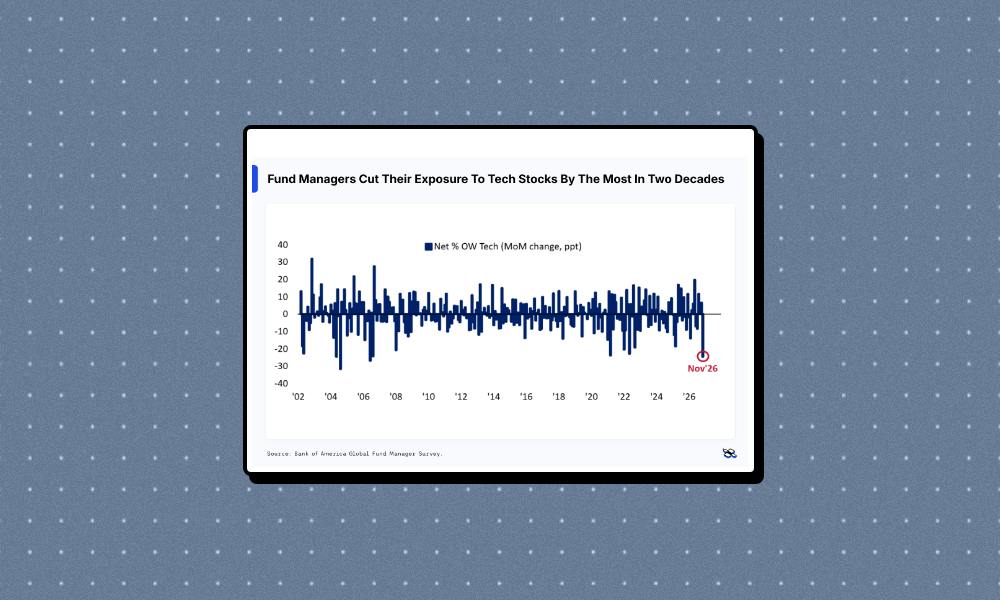
Wall Street's enthusiasm for technology stocks is cooling at a pace not seen in two decades. According to Bank of America's latest fund manager survey, investors slashed their exposure to technology stocks by the most in 20 years, as skepticism grows over whether the massive spending on artificial intelligence will actually deliver returns.
The survey, which polls fund managers around the world, showed the proportion of managers who are overweight tech—meaning they hold more tech stocks than their benchmark suggests—plunged from a net 37% in October to just 12% in November. That's a dramatic shift in sentiment in just one month.
Why the sudden chill?
The main driver appears to be a growing belief that the AI spending frenzy may be overdone. A record net 38% of fund managers now think companies are overspending on AI, according to the survey. That's the highest level of concern ever recorded on this question.
Even more striking, 52% of managers expect a major tech company to announce spending cuts within the next six months. That kind of expectation can weigh on stock prices, as investors start to price in the possibility that the AI boom might slow down.
This isn't just about sentiment. Markets are already reacting. The Nasdaq 100, which is heavily weighted toward big tech names, has dropped more than 4% this month. If that holds, it would be the index's worst November since 2008—a year marked by the global financial crisis.
What's behind the AI spending boom?
Over the past couple of years, tech giants and other companies have poured billions into AI infrastructure—data centers, chips, and software. The hope is that AI will transform industries and create huge new revenue streams. But the costs are enormous, and so far, the payoff isn't guaranteed.
For everyday investors, this is a reminder that even the most exciting technologies can go through rough patches. When expectations get too high, any sign of trouble can trigger a sharp selloff. As we've seen, the fear that AI spending won't pay off is enough to spook even the most seasoned fund managers.
Some analysts argue that Wall Street's AI spending fears may be overblown, pointing out that transformative technologies often take time to show profits. But the survey suggests that many investors are not willing to wait.
What it means for investors
For individual investors, this shift in sentiment is worth paying attention to, but it's not necessarily a signal to panic. Fund manager surveys are a snapshot of what professional investors are thinking, and they can be contrarian indicators—when everyone is bearish, sometimes it's a buying opportunity.
However, the fact that the Nasdaq 100 is on track for its worst November in over a decade shows that the selling is real. If you hold tech stocks or tech-heavy index funds, you may see more volatility in the coming weeks.
It's also worth noting that the survey's findings align with other signs of caution. Wall Street is scrambling to map hidden AI risk after the recent selloff, which suggests that even the pros are unsure how deep the damage could go.
For those who are heavily invested in tech, it might be a good time to review your portfolio and make sure you're comfortable with the level of risk. Diversification—spreading your money across different sectors and asset classes—can help cushion the blow if tech continues to slide.
On the other hand, if you're a long-term investor, short-term market moves like this are often just noise. History shows that markets tend to recover over time, and technology has been a major driver of growth for decades. But that doesn't mean every tech stock will be a winner.
What to watch next
Investors will be watching for any signs that tech companies are actually cutting their AI budgets. If a major player announces spending cuts, it could confirm the fears and lead to further declines. Conversely, if companies report strong earnings from AI investments, sentiment could quickly shift back.
Also on the horizon are economic data releases, such as US retail sales for October, which could give clues about consumer health and the broader economy. And with the Federal Reserve's interest rate decisions still in play, any surprises could affect all stocks, not just tech.
For now, the message from fund managers is clear: the love affair with tech is cooling. Whether that's a temporary blip or the start of a longer trend remains to be seen.



