Wall Street's anxiety over Big Tech's artificial intelligence spending is understandable. This year, five major US hyperscalers—the tech giants that operate massive cloud and data center networks—are on track to spend roughly $800 billion on capital expenditures, with trillions more planned in the coming years. As free cash flow shrinks and debt piles up, investors are questioning whether these hefty bets will pay off.
But JPMorgan Private Bank thinks the pessimism has gone too far. In a recent note, the firm argues that several factors could make these investments more profitable than the market fears.
The spending slowdown
For starters, while AI spending is still growing, the pace is cooling. After a surge in capital expenditures over the past two years, growth rates are beginning to moderate. This could ease concerns about runaway costs and give companies time to generate returns on their investments.
Slower spending growth doesn't mean AI investment is collapsing—it just means the rate of increase is decelerating. For investors, that could be a positive sign: it suggests companies are becoming more disciplined about their AI budgets, potentially protecting profit margins.
Data center bottlenecks
Another factor working in hyperscalers' favor is political opposition to new data centers. As communities and regulators push back on the environmental and infrastructure demands of these facilities, new projects face delays and restrictions. While that might seem like a headwind, JPMorgan argues it could actually make existing data centers more valuable.
If it becomes harder to build new capacity, the infrastructure already in place becomes a scarce asset. That could give hyperscalers pricing power and improve the economics of their AI investments. It also raises the barrier to entry for smaller competitors, potentially strengthening the market position of the largest players.
Cloud demand remains strong
Underlying all this is booming cloud demand. Businesses and governments continue to migrate their operations to the cloud, and AI services are adding a new layer of demand on top of that. Even as spending growth cools, the revenue side of the equation looks robust.
This is a key point for investors to consider. The bear case for AI spending often focuses on the cost side—the billions being poured into chips, data centers, and energy. But the demand side is equally important. If cloud revenue keeps growing, the return on those investments could be higher than the market currently expects.
Valuations still relatively cheap
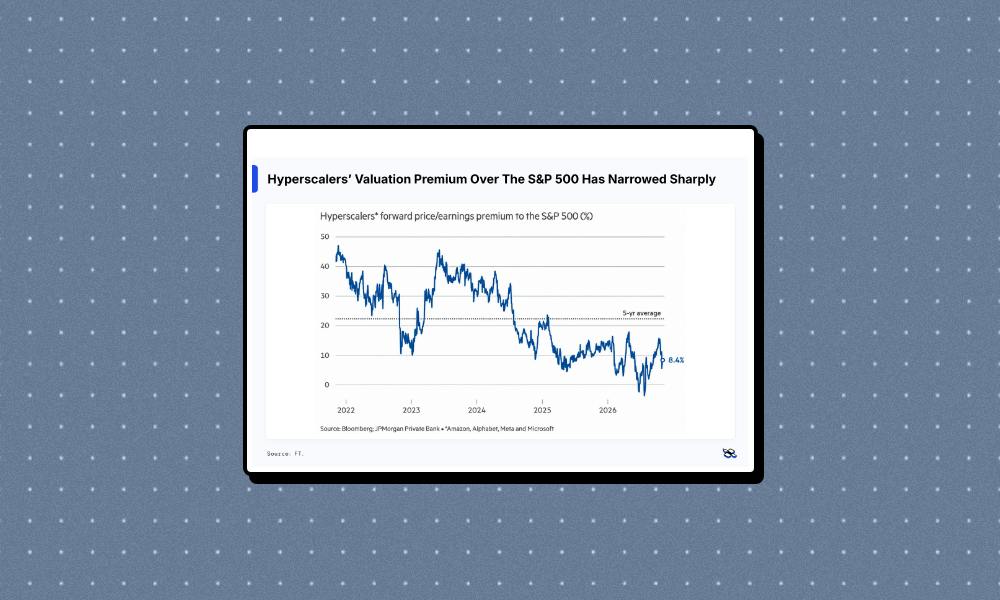
Despite the massive spending, valuations for many of these tech giants still look relatively cheap compared to their historical averages. That's surprising given the scale of their AI ambitions. JPMorgan suggests this could be a sign that the market has already priced in a lot of pessimism.
For everyday investors, this is worth noting. When a stock's price already reflects a worst-case scenario, the actual outcome often beats expectations. That doesn't mean these stocks are guaranteed winners, but it does suggest the risk-reward may be more balanced than the headlines suggest.
What it means for investors
For investors, the key takeaway is that the AI trade isn't just about hype—it's about fundamentals. The companies making these massive bets are doing so because they see a clear path to revenue growth. The question is whether that growth will justify the spending.
JPMorgan's view is that it will, at least for the largest players. But that doesn't mean every AI-related stock will thrive. Smaller companies with less financial firepower could struggle if the spending race intensifies or if returns take longer to materialize.
Investors should also keep an eye on the broader economic backdrop. If interest rates stay high, the cost of financing all that debt could weigh on earnings. And if the economy slows, cloud demand could soften, making it harder for companies to recoup their investments.
Still, for those worried that Big Tech is overdoing it on AI, JPMorgan's analysis offers a counterpoint. The spending may be huge, but so is the opportunity. And with growth cooling, bottlenecks emerging, and valuations reasonable, the pessimism may indeed be overdone.
As always, it's important to remember that markets can stay irrational longer than you can stay solvent. But for long-term investors, the current skepticism could be an opportunity rather than a warning.