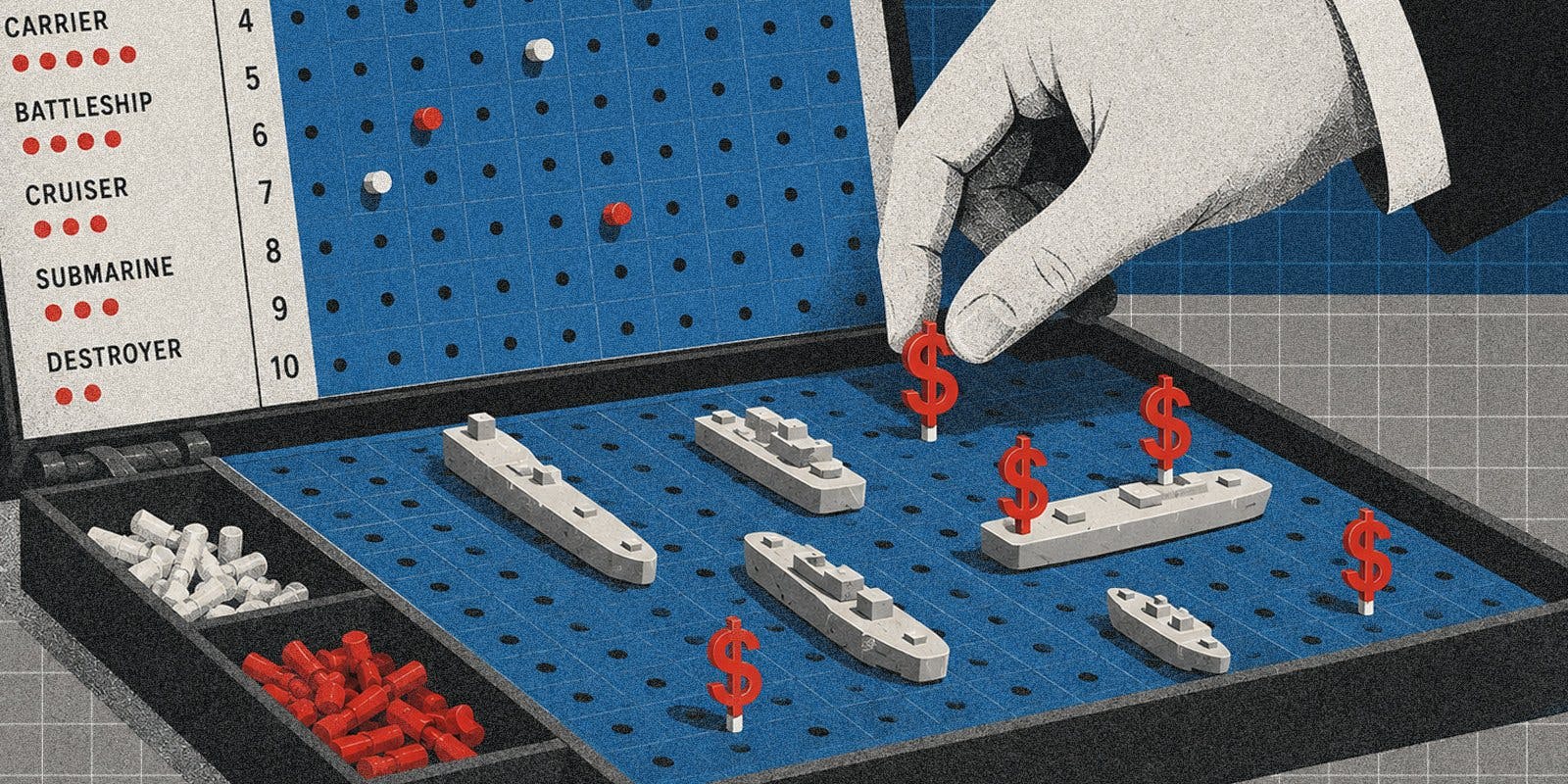
Germany wants to build the strongest conventional army in Europe by 2039, and defense contractors are jostling for a piece of that spending. But Wednesday's news that the country scrapped plans to buy six large warships showed that rising budgets don't lift all boats equally.
Shares of Rheinmetall, Germany's top defense firm and the expected winner of that contract, slumped 19%. Meanwhile, domestic competitor TKMS saw its stock jump 16% after the government doubled an existing order for smaller warships.
What happened with the warship contract?
Germany had been planning to purchase six large warships, a contract that Rheinmetall was widely expected to win. But the government reversed course, canceling that procurement entirely. Instead, it expanded an existing order with TKMS for four smaller warships, doubling the number to eight.
The shift reflects a broader strategic rethink in European defense. Countries are balancing the need for rapid modernization with budget constraints and industrial capacity. Building large warships takes years and billions of euros, while smaller vessels can be delivered faster and more flexibly.
Why defense stocks moved in opposite directions
Rheinmetall's 19% drop shows how dependent defense stocks can be on specific contract wins. The company had likely priced in expectations of the large warship deal, and its cancellation left a hole in its order book. Investors reacted by marking down the stock sharply.
TKMS, on the other hand, benefited directly. The company was already supplying Germany with four smaller warships, and the doubling of that order provides clear revenue visibility. Its 16% gain reflects the market's positive view of a confirmed, expanded contract.
This divergence is a reminder that defense spending is not a rising tide that lifts all stocks equally. Contract winners benefit; losers can suffer even in a growing budget environment.
What it means for investors
For everyday investors, the key takeaway is that broad trends like rising defense budgets don't guarantee returns. Individual companies' fortunes depend on specific contracts, competitive positioning, and government procurement decisions.
Investors should look beyond headline budget numbers and examine which companies are likely to win contracts. Factors like existing relationships, production capacity, and technological fit matter more than the overall spending envelope.
The defense sector also carries political risk. Governments can change priorities, cancel programs, or shift spending to different types of equipment. Diversification across multiple defense contractors or using a defense-focused exchange-traded fund (ETF) can help manage that risk.
Broader context: Global defense spending on the rise
Germany isn't alone in boosting military budgets. Across Europe, NATO members are increasing spending in response to geopolitical tensions. Canada is also close to deciding who will win a contract to build a new fleet of submarines, a deal potentially worth more than $70 billion.
That contract has two remaining contenders: a South Korean consortium led by shipbuilder Hanwha Ocean, and a German-Norwegian group fronted by TKMS. With a trade war brewing between Canada and the US, Ottawa is pushing both suitors for sweeteners like promises to boost local manufacturing and create jobs. The winner is expected to be announced ahead of NATO's next meeting on July 7th.
This global spending wave creates opportunities, but also competition. Companies that win contracts can see significant stock gains, while those that lose out may underperform even in a rising market.
Looking ahead
Investors should watch for upcoming defense contract decisions in Europe and North America. The Canadian submarine deal is a major near-term catalyst. Beyond that, NATO's spending targets and individual countries' procurement plans will shape the sector's outlook.
For now, the Germany warship story is a clear example of how defense spending growth doesn't automatically translate into stock market gains. Winners and losers are determined by contract awards, not just budget totals.