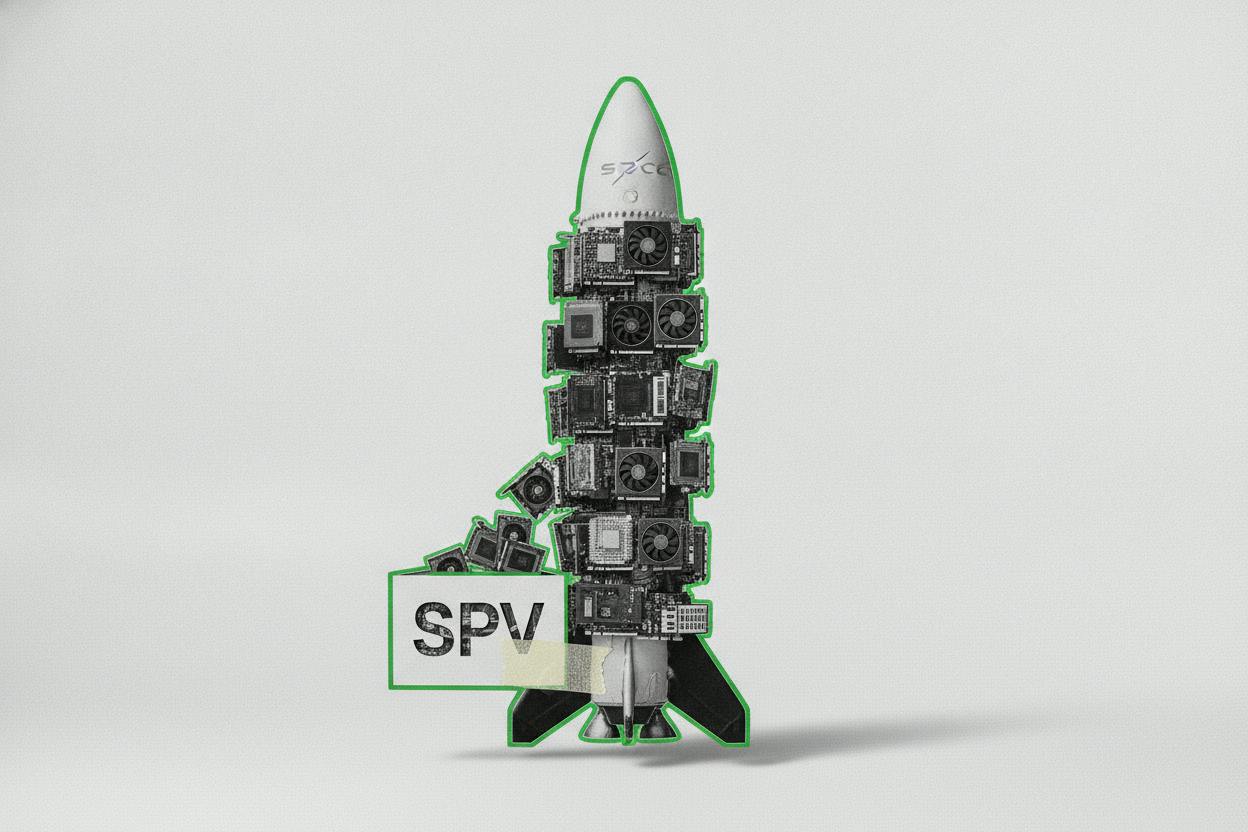
Wall Street heavyweights Goldman Sachs and Apollo are pitching a roughly $40 billion financing package to help SpaceX pay for a massive order of Nvidia graphics processing units (GPUs), according to a Bloomberg report. The structure is notable because the debt would not sit on SpaceX's own books, a move that could reshape how big tech and AI players fund their computing buildouts.
Bloomberg said the package would help fund about $47.3 billion of Nvidia chips, with deliveries expected in 2027. The financing reportedly includes an $8.3 billion senior-secured loan—debt backed by specific assets—plus several bond tranches. The key twist is who actually borrows: an Apollo-run special purpose vehicle (SPV), managed by Apollo-backed Atlas SP, would buy the GPUs and issue the debt.
In plain English, investors would be lending against expensive computing equipment rather than making SpaceX load up more corporate debt. That matters for leverage optics and any loan terms that limit additional borrowing. For a company like SpaceX, which already carries significant debt from its satellite and rocket programs, keeping this financing off-balance-sheet could preserve its ability to raise funds elsewhere.
Why structure it this way?
Special purpose vehicles are a common tool in finance. They are separate legal entities created for a specific purpose—here, owning the GPUs and issuing debt. By using an SPV, the borrowing is tied to the equipment itself, not to SpaceX's overall credit profile. If SpaceX were to borrow directly, the debt would appear on its balance sheet and could trigger covenants in existing loan agreements that limit how much more it can borrow.
This approach is similar to how some companies finance aircraft or ships, where the asset itself serves as collateral and the loan is repaid from the asset's cash flows or resale value. In this case, the GPUs are the collateral. The bet is that Nvidia chips will retain enough value—or generate enough computing power for AI workloads—to repay the debt.
The deal also highlights the growing importance of AI infrastructure. Nvidia GPUs are the backbone of the AI boom, used to train and run large language models and other machine-learning systems. SpaceX, best known for rockets and Starlink satellite internet, may be expanding into AI computing services, a move that could complement its existing Starlink mobile ambitions.
What it means for investors
For bond investors, this deal shifts the risk calculus. Instead of assessing SpaceX's entire business—its rocket launches, Starlink subscriber growth, and competitive position—lenders would focus on the value and usefulness of the GPUs themselves. In a fast-moving AI market, that could be a double-edged sword. If demand for AI chips stays strong, the GPUs could hold their value well. But if the AI bubble deflates or newer chips make these obsolete, resale values could plummet.
For the broader credit market, the deal could signal a new asset class. If it finds enough buyers, it strengthens a growing corner of credit where "real" assets like data-center hardware back loans and bonds. That could pull some institutional credit budgets toward AI-hardware-backed paper and away from more traditional corporate borrowing. It's a trend that has been building as investors look for yield in a low-rate environment, and it could accelerate if this deal succeeds.
For everyday investors, the takeaway is more about understanding the mechanics than about any direct exposure. Most people won't be able to buy into this specific deal, but it's a sign of how creative financing is becoming in the AI era. Companies are finding ways to fund massive capital expenditures without bloating their balance sheets, which can be good for shareholders but also adds complexity and risk.
The deal also underscores the growing financial firepower behind AI. Nvidia's chips are in huge demand, and companies are willing to go to great lengths to secure them. This could have implications for Nvidia's revenue visibility and for the broader tech sector, as more players look to finance AI infrastructure off-balance-sheet.
It's worth noting that this is not the first time Apollo has been involved in such structures. The firm has been a pioneer in asset-backed lending, and its Apollo Hospitals business (unrelated to the finance firm) shows the name's reach. But this deal, if completed, would be one of the largest of its kind.
For now, the deal is still being marketed, and there's no guarantee it will close. But if it does, it could set a template for how other companies finance their AI hardware needs. Investors should watch for similar structures in the coming months, as the demand for GPUs shows no sign of slowing.