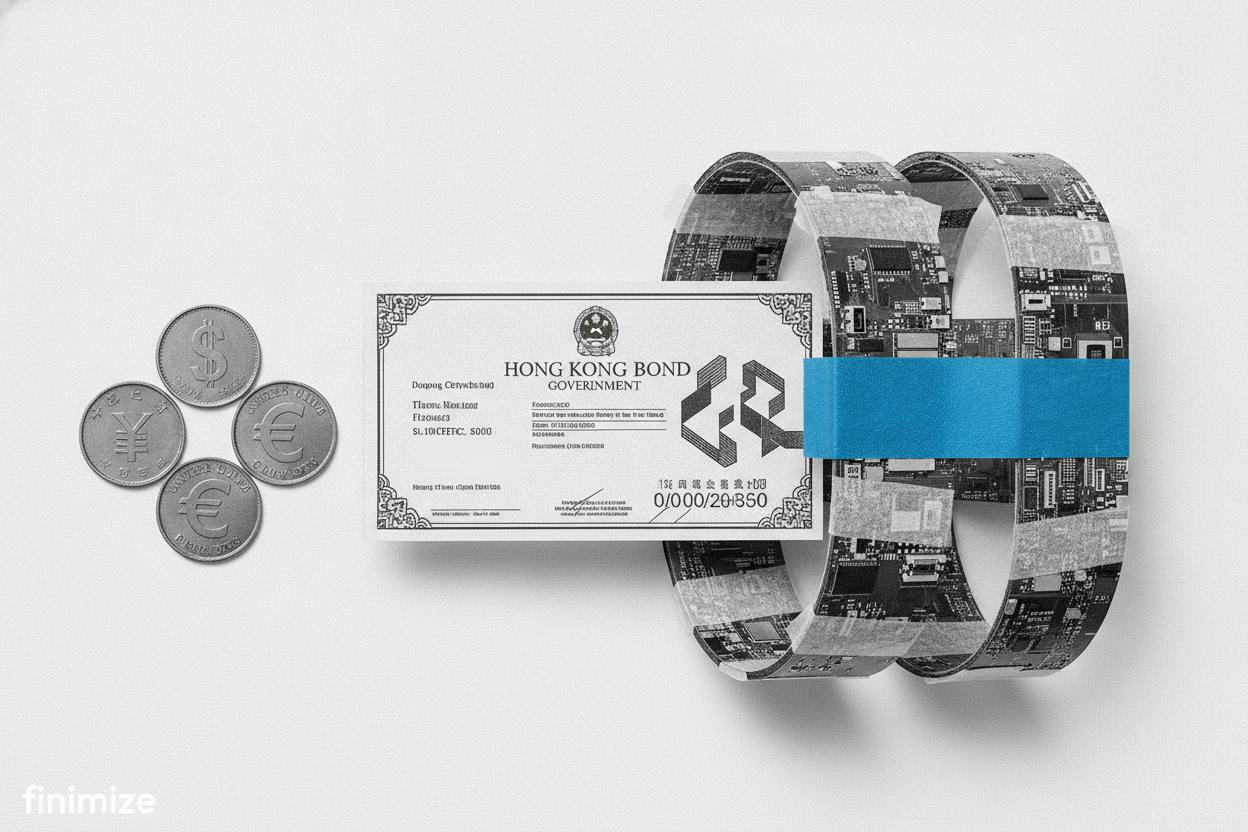
Hong Kong's government has priced about HK$20 billion of digital green bonds, with investor demand running as high as 11.3 times the amount on offer, according to the Hong Kong Monetary Authority. The sale was split across four currencies and several maturities, making it one of the territory's most ambitious exercises yet in issuing debt using blockchain-based digital infrastructure.
The HKMA said the deal was divided into HK$5.5 billion of two-year notes, 7.5 billion yuan of five-year notes, $200 million of three-year notes and 450 million euros of four-year notes. Subscription levels varied by currency, but the strongest order book was covered 11.3 times, a sign that at least some segments of the global investor base remain keen to hold Hong Kong paper.
What makes these bonds 'digital'
The word "digital" here does not mean the bonds are a cryptocurrency or a speculative token. It means the issuance, settlement and record-keeping are handled on a distributed ledger — a shared, tamper-resistant database — rather than through traditional back-office systems. In practice, that can shorten settlement times, reduce administrative costs and make it easier to track ownership.
Governments and large financial institutions have been experimenting with this format for several years, but most deals have been small pilot programmes. Hong Kong's latest sale is notable because of its size and because it spans multiple currencies, suggesting the technology is being tested at a scale closer to routine sovereign borrowing.
The bonds also carry a green label, meaning proceeds are earmarked for projects with environmental benefits. They sit under Hong Kong's Government Sustainable Bond Programme, the framework the territory uses to fund climate-related and sustainable infrastructure. Green bonds have become a standard part of many governments' funding toolkits, and pairing them with digital issuance lets authorities showcase two priorities at once.
Why the demand matters
A subscription book covered 11.3 times means investors placed orders worth more than eleven times the amount of bonds available in that tranche. For a sovereign issuer, that is a strong result. It implies the borrower could have raised more money, or priced the debt at a lower yield, had it chosen to.
Demand was not uniform across the four currencies, which is typical for a multi-currency deal. Different investor bases — local Hong Kong funds, mainland Chinese institutions, European asset managers and dollar-based buyers — each have their own appetite, currency hedging costs and yield expectations. The fact that the strongest book was so heavily oversubscribed suggests at least one currency tranche tapped a deep pool of buyers.
The broader backdrop matters too. Global bond markets have been volatile as investors weigh the path of interest rates in the US, Europe and Asia. When rate uncertainty is high, high-quality government paper often becomes more attractive because it offers a known return and low default risk. Hong Kong, with its large foreign reserves and peg to the US dollar, is generally viewed as a very safe borrower.
There is also a regional dimension. Hong Kong has been positioning itself as a hub for both green finance and financial technology, and this deal supports both narratives. It follows a period in which Asian stocks and bonds have wobbled amid shifting global yields, making a well-subscribed sovereign sale a useful signal of confidence.
What it means for investors
For ordinary investors, the direct takeaway is limited: these are institutional bonds, not products most individuals can buy. But the deal carries a few broader implications worth noting.
- Digital bonds are moving toward the mainstream. Each successful large issuance makes it more likely that companies and governments will use this format again, which over time could change how bond markets operate and settle.
- Green finance keeps growing. Sovereign green bonds help set pricing benchmarks that corporations then follow when they issue their own sustainable debt. That can affect the cost of capital for companies in energy, utilities and heavy industry.
- Hong Kong remains a key funding hub. Strong demand for its paper is a reminder that the territory still attracts global capital, even as investors debate China's economic outlook and regional market volatility.
Investors watching the space will want to see whether future digital bond deals grow larger and whether secondary trading in these instruments becomes more liquid. Liquidity — the ease of buying and selling — is often the missing piece in tokenised debt markets. If that improves, the format could shift from a showcase into a genuine alternative to conventional issuance.
For now, the message from the order books is straightforward: when a high-quality government offers green bonds in a familiar currency, plenty of investors are willing to buy. The digital wrapper is a bonus, not a barrier.