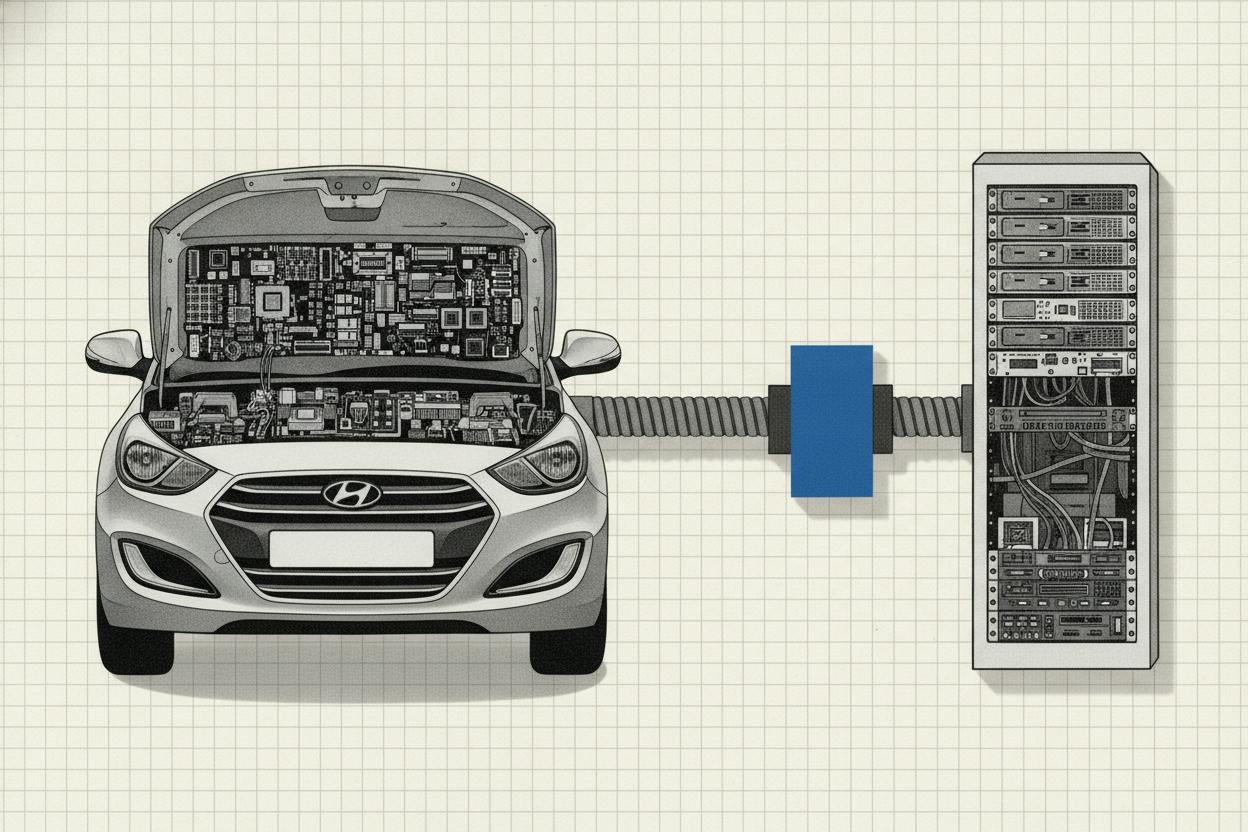
Hyundai Motor Group is pushing back the launch of its in-house driver-assist software platform, Atria, to late 2029 — about two years later than originally planned. To fill the gap, the automaker will co-develop advanced driver-assistance systems with chipmaker Nvidia, targeting 2028 for vehicles equipped with so-called “Level 2+” and “Level 2++” features.
The news, first reported by Reuters, highlights how quickly the race for smarter driving technology is accelerating. Hyundai had previously aimed to roll out Atria in late 2027, but the competitive pressure from Tesla and fast-moving Chinese automakers has forced a rethink.
What are Level 2+ and Level 2++?
For everyday drivers, “Level 2” refers to systems that can control both steering and acceleration/deceleration simultaneously, but the driver must remain fully engaged and supervise at all times. That’s the category most current “hands-on” driver-assist features fall into, like Tesla’s Autopilot or GM’s Super Cruise.
“Level 2+” and “Level 2++” are not official SAE levels — they’re industry shorthand for systems that go beyond basic Level 2, often allowing hands-off driving on highways or adding more sophisticated lane-changing and traffic-light handling. They still require the driver to pay attention, but they represent a meaningful step toward the fully autonomous “Level 4” and “Level 5” that many companies are chasing.
Hyundai’s plan is to use Nvidia’s Hyperion 10 platform as the foundation for these systems. Hyperion 10 is a full hardware-and-software stack that includes sensors, computing power, and AI software. By co-designing with Nvidia, Hyundai gets access to cutting-edge technology without having to build everything from scratch.
Why the delay?
Developing a robust, safe, and reliable driver-assist system is enormously complex. It requires massive amounts of data, sophisticated AI models, and rigorous testing. Hyundai’s original timeline for Atria — late 2027 — may have been too ambitious given the technical hurdles and the need to match or beat competitors.
Meanwhile, Tesla continues to push its Full Self-Driving (FSD) beta, and Chinese brands like BYD, Xpeng, and Nio are rolling out increasingly capable systems at aggressive price points. To stay competitive, Hyundai needs to offer comparable features sooner rather than later. The Nvidia partnership is a bridge: it lets Hyundai bring competitive driver-assist features to market in 2028 while it continues developing Atria in the background.
Importantly, Hyundai says it will use data generated by the Nvidia-based vehicles to train and refine Atria. That means the 2028 models won’t just be a stopgap — they’ll feed the development of Hyundai’s own software, potentially giving Atria a head start when it finally arrives.
What it means for investors
For investors, this is a story about execution and partnerships in the auto-tech space. Hyundai’s decision to lean on Nvidia is a pragmatic move, but it also signals that in-house software development is harder than some automakers hoped. That’s not unique to Hyundai — many traditional automakers have struggled to match Tesla’s software prowess.
From a stock perspective, the news is a modest positive for Nvidia, which continues to expand its automotive business. Nvidia already supplies chips to many automakers, and this deal deepens that relationship. For Hyundai, the delay could be seen as a negative if investors were expecting Atria to be a differentiator, but the Nvidia partnership may mitigate that concern by ensuring Hyundai doesn’t fall behind in the near term.
Investors should also watch how this plays out in the broader context of the driver-assist technology race. The industry is moving fast, and companies that can deliver safe, reliable, and affordable systems will have a competitive edge. Hyundai’s approach — using Nvidia’s platform as a bridge while building its own — is a common strategy in tech-heavy industries, but it’s not without risks. If Atria continues to slip, Hyundai could become overly dependent on Nvidia, which would raise questions about long-term differentiation.
For now, the key dates to watch are 2028, when the Nvidia-based systems are expected to launch, and late 2029, when Atria is slated to debut. Any further delays could shake investor confidence, while successful launches could position Hyundai as a leader in the next wave of driving technology.
In the meantime, investors might also keep an eye on Nvidia’s broader moves in the AI and automotive space, including its potential stake in Anthropic and its push into AI inference chips. These developments show that Nvidia is aggressively expanding beyond its core GPU business, and automotive is a key part of that strategy.
Ultimately, Hyundai’s decision is a reminder that even the biggest automakers can’t go it alone in software. Partnerships like this one are likely to become more common as the industry converges on AI-driven driving features. For investors, that means paying attention not just to the car companies, but to the tech suppliers that power them.