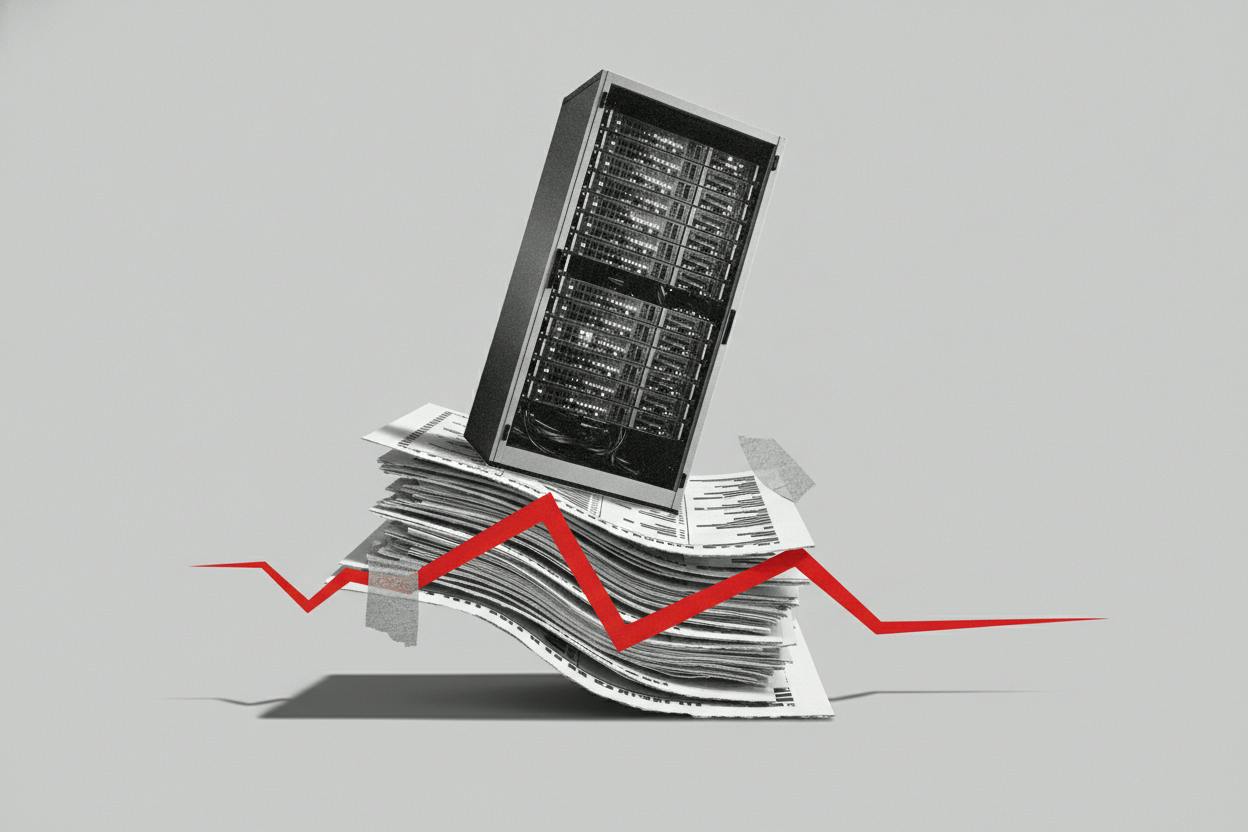
The International Monetary Fund is flagging a risk that has been building quietly beneath the market's AI enthusiasm: a lot of the money pouring into artificial intelligence is borrowed, and the profits meant to justify it haven't shown up yet.
In its annual report, the fund said outside estimates put global private-sector AI investment at more than $2 trillion this year. That spending — on data centers, specialized chips and software — can lift economic growth in the near term. But it also embeds a large assumption: that today's costly buildout will eventually convert into earnings. If those returns take longer than expected, the IMF warned, stock valuations could fall quickly, and companies could respond by cutting costs, including jobs, to protect margins.
Why the IMF is worried
The concern isn't that AI spending is wasteful. It's that the spending is increasingly financed with debt rather than cash flow, which raises the stakes if the payoff is delayed. When companies borrow to fund capital projects, they commit to interest payments regardless of whether those projects generate revenue on schedule. That structure works fine when growth arrives on time. It becomes a problem when it doesn't.
The IMF's warning lands in a market that has already priced in a lot of optimism. AI-linked companies — chipmakers, cloud providers, and the utilities and infrastructure firms that supply them — have commanded premium valuations on the expectation of years of rapid growth. Those valuations leave little room for disappointment. A shortfall in AI revenue wouldn't just hit the companies doing the spending; it would ripple through supply chains and the broader indices that have come to rely on a handful of large tech names for their gains.
This isn't the first time the fund has raised the issue. The IMF has been consistent in noting that AI investment is propping up global growth even as other drivers, from trade to consumer demand, look softer. That makes the AI trade both a source of strength and a concentration risk. If the engine stalls, there isn't an obvious replacement.
The debt angle matters
Debt-fueled investment cycles have a familiar pattern. Spending accelerates, asset prices rise, and lenders extend credit against the expectation that the cycle continues. When returns lag, the adjustment can be abrupt rather than gradual, because valuations are marked to market and credit conditions can tighten quickly. The IMF's language — a "fast reset" in equity valuations — points to exactly that kind of sharp move rather than a slow drift lower.
For everyday investors, the practical takeaway is about concentration. If a large share of your portfolio's recent gains came from AI-adjacent names, you are exposed to this risk whether or not you bought the story deliberately. Index funds are not immune either, since the largest AI players carry outsized weights in major benchmarks.
What it means for investors
The IMF isn't predicting a crash, and it isn't telling anyone to sell. Its role is to flag systemic risks before they materialize. But the warning is a useful prompt to check assumptions.
- Watch the earnings, not the announcements. Capital expenditure headlines are easy to produce. The number that matters is whether AI products are generating revenue that justifies the spending.
- Pay attention to how the buildout is financed. Companies funding AI projects from cash flow are in a different position from those leaning on debt. Rising interest costs change the math.
- Expect volatility in concentrated positions. When valuations rest on future profits, any sign of delay can trigger outsized price moves.
- Consider the second-order effects. Layoffs aimed at protecting margins would hit consumer spending, which feeds back into the broader economy.
The backdrop makes the warning more pointed. Investors have already shown they will reprice AI names quickly when the narrative shifts — as seen when cheaper, more efficient AI models from overseas players raised questions about the scale of spending required by the largest US firms. That episode showed how fast sentiment can turn when the assumed payoff looks less certain.
What happens next depends largely on the coming quarters of earnings. If AI revenue accelerates, the debt-funded buildout will look prescient. If it doesn't, the IMF's warning may read less like a caution and more like a preview. For now, the fund's message is simple: the AI trade is a bet, and a growing share of it is being made with borrowed money.