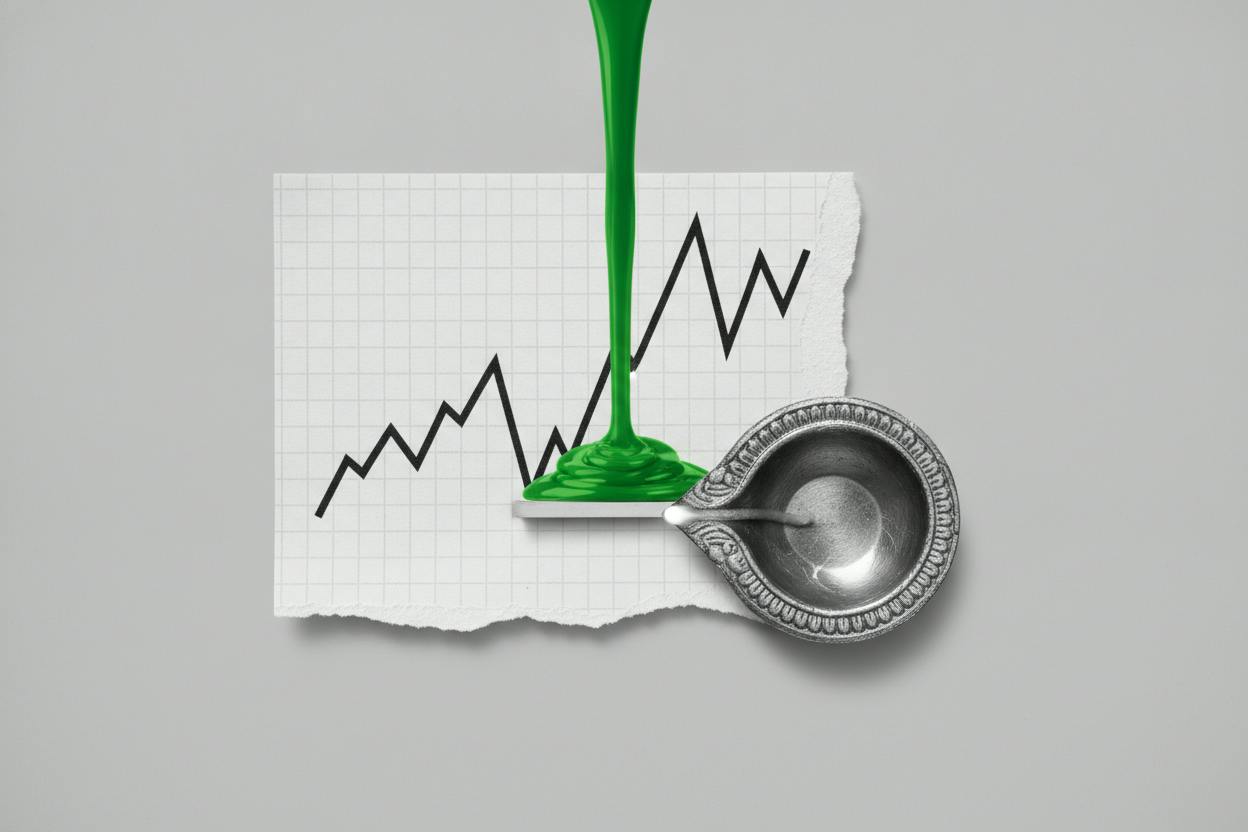
India's stock market took a breather on Sunday, with the Nifty 50 slipping 0.18% in a special one-hour trading session held to mark Diwali. The modest dip came after a powerful rally that had pushed benchmarks up more than 10% into Friday, driven largely by a surge in foreign investment.
The Nifty 50 closed at 24,986.4, while the Sensex edged down 0.04% to 80,999.4. The small pullback was a pause rather than a reversal, as two key forces helped keep sentiment steady: falling oil prices and a wave of overseas buying.
Why oil prices matter for India
India is one of the world's largest importers of crude oil, so the recent drop in global oil prices is a significant tailwind for the economy. Cheaper oil can cool inflation, reduce the country's import bill, and ease pressure on the rupee. For investors, that combination often supports corporate margins and consumer spending, making it a positive backdrop for equities.
The rupee has also been strengthening, recently moving past 94 per dollar as oil slid and foreign money returned. A firmer rupee can help attract more foreign investment, though it can also pinch exporters who earn in dollars.
Foreign buying fuels the rally
The bigger driver of the recent run-up has been foreign portfolio investors (FPIs). Last week, they bought 459.61 billion rupees (about $4.89 billion) of Indian shares across five sessions, including their largest single-day purchase in months. That influx of overseas capital helped lift the Nifty and Sensex from a period of relative weakness earlier in the year.
Foreign flows are often seen as a vote of confidence in a market's long-term prospects. When FPIs buy heavily, it can signal that global investors see value in Indian equities, especially against a backdrop of steady economic growth and corporate earnings.
What the Diwali session tells us
Diwali, the festival of lights, is traditionally considered an auspicious time for new beginnings, and the stock market holds a symbolic one-hour session on the day. While the session is short and often low-volume, it can offer a glimpse into investor sentiment heading into the new year.
Sunday's session was no exception. The fact that the market barely moved, rather than giving back some of the recent gains, suggests that investors are holding their positions with confidence. The 10% run-up into Friday had been rapid, so a small consolidation is not unusual.
What it means for investors
For everyday investors, the key takeaway is that the Indian market remains in a strong uptrend, supported by both domestic and global factors. Falling oil prices are a broad positive for the economy, and the return of foreign buying adds momentum.
However, it's worth remembering that markets rarely move in a straight line. After a 10% gain, some volatility is normal, and investors should be prepared for pullbacks. The Diwali session's calm could be a sign that the rally has more room to run, but it's also a reminder that short-term moves are hard to predict.
Investors might also want to keep an eye on how the broader emerging-market picture evolves. As emerging market stocks slide in some regions, India's relative resilience has been notable. That strength, combined with a stronger rupee, could continue to attract foreign capital.
For those looking at individual companies, the festive season has brought mixed results. Bosch India's profit jumped 22% on festive demand, though it warned of softer output ahead. Meanwhile, 3M India's profit fell 17% as the rupee and material costs bit. These examples highlight that even in a rising market, company-specific factors matter.
As the new year begins, investors will be watching whether foreign buying continues, how oil prices evolve, and whether corporate earnings can justify the recent run-up. The Diwali session offered a moment of calm, but the underlying trends remain firmly in focus.