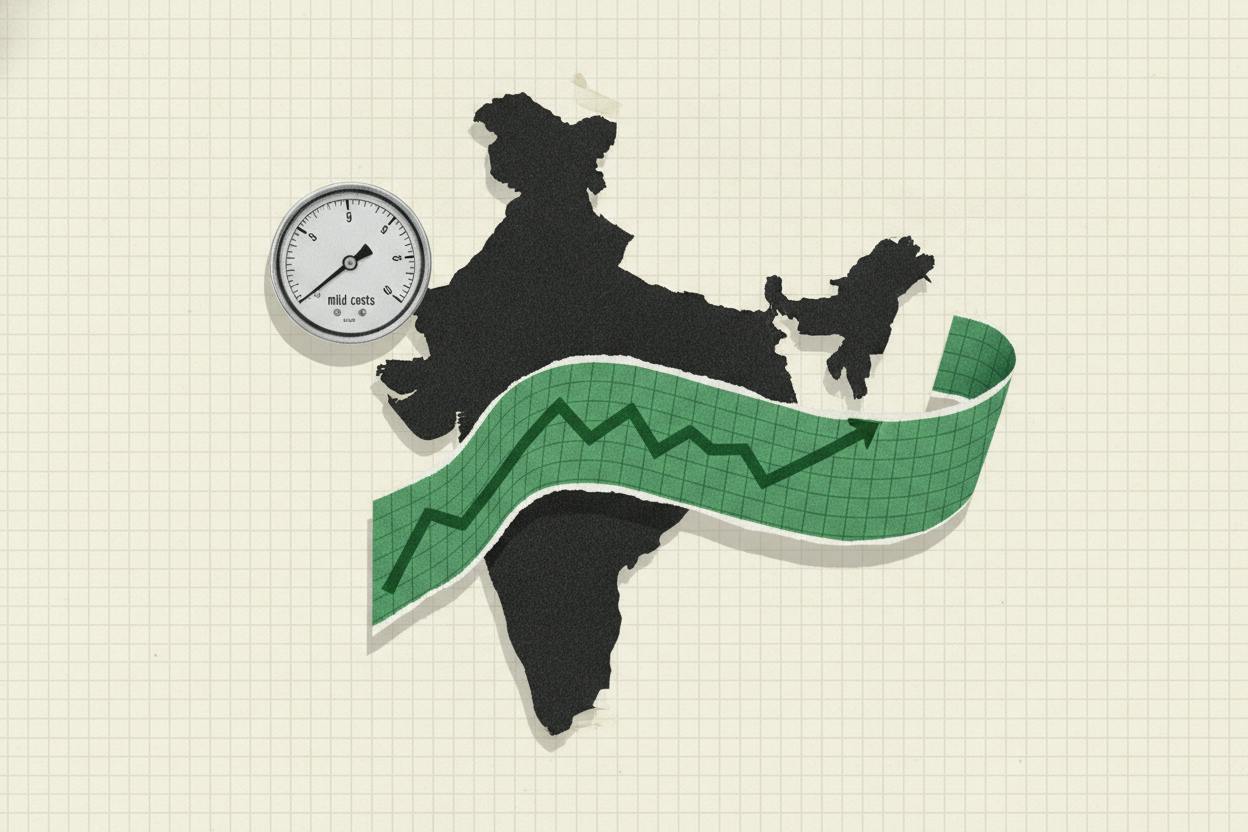
India's private sector continued to expand at a solid pace in November, according to a closely watched survey. The flash composite Purchasing Managers' Index (PMI) from S&P Global ticked up to 56.3, up from the previous month's reading, as companies reported the strongest improvement in demand since June.
The PMI is a gauge of business activity, with readings above 50 indicating expansion and below 50 signaling contraction. A reading of 56.3 points to a robust rate of growth, well above the threshold that separates expansion from contraction.
Broad-based growth, with manufacturing leading
The latest survey suggests that India's economic expansion remains broad-based. Manufacturing was the main driver, with output and new orders accelerating at a faster pace. Services activity also grew, though at a slightly slower rate than in the previous month, but still comfortably above the 50 mark.
This resilience in the private sector comes against a backdrop of global uncertainty, with other economies in the region showing signs of strain. For instance, Australia's private sector contraction deepened in a separate PMI release, highlighting the divergence in economic fortunes across the region.
The fact that India's growth is holding up, and even accelerating, is a positive signal for the broader economy. It suggests that domestic demand remains resilient, which is crucial for sustaining the country's growth momentum.
Benign cost pressures: a key detail for policymakers
Perhaps the most important detail in the survey for policymakers is the behavior of costs. S&P Global described cost pressures as "benign," with operating expenses rising only slightly. Even as some companies raised selling prices, the overall input-cost inflation remained muted.
This is the kind of mix that central banks like to see: demand strong enough to keep activity humming, but without the kind of input-cost pressures that can feed into persistent inflation. It also helps explain why business confidence about the year ahead improved, as firms feel less squeezed by rising expenses.
For the Reserve Bank of India (RBI), which has been focused on bringing inflation down to its target, this is a reassuring sign. It suggests that the economy can continue to grow without reigniting inflationary pressures, which could reduce the need for further policy tightening.
What it means for investors
For markets, the PMI reading is more than just a growth indicator. It has direct implications for interest rates and, by extension, for bond yields and the currency.
When activity is clearly expanding and companies report only mild cost increases, it hints that growth is not immediately translating into higher inflation. That can lower the perceived pressure on the RBI to keep tightening monetary policy. As a result, Indian government bond yields, known as G-Secs, could see some relief, as investors scale back expectations of aggressive rate hikes.
Currency traders also watch the interest-rate outlook closely. If the RBI is seen as less likely to hike rates, the rupee could come under some pressure, as higher rates typically attract foreign capital. However, the overall improvement in business confidence and the resilience of the economy could provide some support.
For everyday investors, the key takeaway is that India's economic fundamentals remain solid. The combination of strong growth and benign inflation is a favorable backdrop for equities, as corporate earnings are likely to benefit from sustained demand. However, investors should keep an eye on global developments, as global risk-off sentiment can spill over into Indian markets, as seen in recent sessions.
It's also worth noting that the PMI is a flash estimate, based on a preliminary survey of purchasing managers. The final reading, due later in the month, could be revised. Still, the flash number provides an early and reliable signal of the economy's direction.
In the broader context, India's resilience stands out. While other major economies are grappling with slowdowns, India's private sector continues to expand at a healthy clip. This divergence is one reason why investors are increasingly looking at India as a bright spot in the global economy.
As always, it's important to remember that PMI data is just one piece of the puzzle. Investors should consider a range of indicators, including inflation data, corporate earnings, and global trends, when making decisions. But for now, the November PMI reading offers a reassuring picture of an economy that is growing steadily, with costs under control.