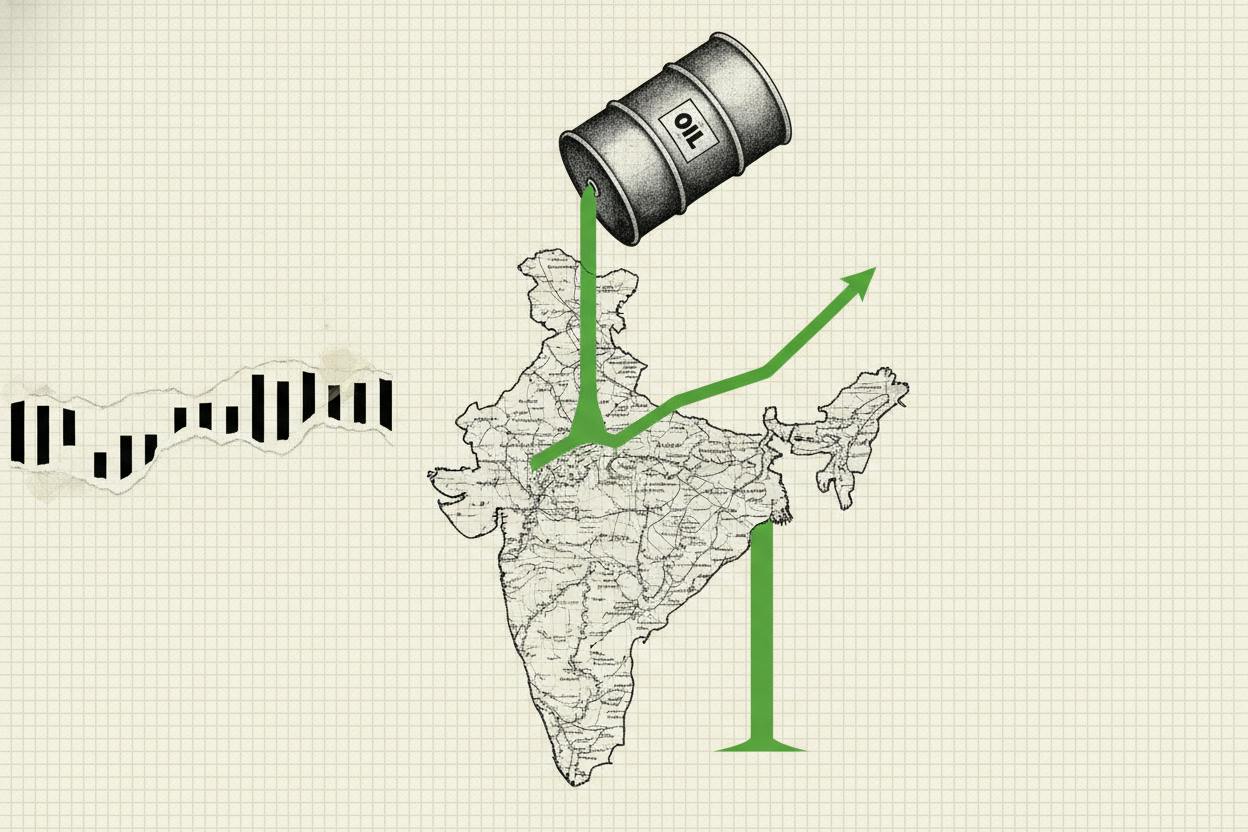
Indian stocks ticked higher in early trading Thursday, extending a strong month as a dip in global oil prices and continued buying by foreign investors offset some profit-taking. The benchmark indices edged up as traders weighed the positive drivers against a recent run-up that has left some valuations looking stretched.
Oil's slide is a tailwind for India
Brent crude, the international benchmark, fell more than 1% to around $91.8 a barrel, slipping below the $92 level. For India, which imports the vast majority of its crude oil, lower prices are a meaningful positive. A cheaper oil bill directly reduces the country's import costs, which can help cool inflation and narrow the current account deficit—the gap between what the country earns from abroad and what it spends.
This week's price move has helped lift sentiment across Indian markets. When oil prices fall, it eases concerns about domestic inflation and the government's fiscal position, as fuel subsidies and energy costs become less burdensome. It also supports corporate margins in sectors that rely heavily on energy inputs, such as airlines, logistics, and chemicals.
The decline in oil prices comes amid broader global trends. Oil slipped to $91.62 as ceasefire hopes outweighed a supply jump, reflecting how geopolitical developments and supply dynamics are influencing the commodity. For Indian investors, the direction of crude remains a key variable to watch.
Foreign investors keep piling in
At the same time, foreign portfolio investors (FPIs) have been steady buyers of Indian shares. In November alone, they have purchased $6.43 billion worth of Indian equities, according to data cited in the brief. That sustained inflow has provided a solid undercurrent of demand, helping the market absorb profit-taking and maintain its upward bias.
FPI flows are closely tracked by market participants because they can move markets, especially in a country like India where foreign ownership of listed companies is significant. When global investors are bullish on India's growth story, they tend to allocate more capital to Indian stocks, which can lift valuations and support the rupee.
The buying spree this month suggests that global investors remain confident in India's economic fundamentals, despite concerns about high valuations and potential headwinds from global interest rates. Rising rates could ground stocks despite strong earnings, a risk that investors are monitoring, but so far the inflows have continued.
What it means for investors
For everyday investors, the combination of lower oil prices and steady foreign inflows is generally supportive for Indian equities. Lower oil can translate into better corporate earnings, especially for companies that are heavy energy users, and can also ease inflationary pressures, which might influence the central bank's policy stance.
However, it's important to remember that markets don't move in a straight line. After a strong month, some profit-taking is natural, and Thursday's early gains were modest as traders locked in gains. Investors should focus on the long-term fundamentals rather than short-term fluctuations.
Oil prices remain volatile, and any sharp rebound could reverse the current tailwind. Similarly, foreign flows can turn quickly if global risk sentiment deteriorates. Energy stocks climb as oil prices firm, oilfield services lead gains—a reminder that oil's impact cuts both ways, benefiting some sectors while hurting others.
For those with a diversified portfolio, the current environment is a reminder of why diversification matters. While Indian stocks have benefited from these trends, other markets and asset classes may react differently. German stocks climbed as inflation cooled and Siemens Energy surged, showing that global markets are also responding to their own dynamics.
Looking ahead
Investors will be watching several factors in the coming days. Oil prices will remain a focus, with any sustained move below $90 potentially adding further support to Indian markets. The pace of FPI inflows will also be closely monitored, as a slowdown could signal a shift in sentiment.
Additionally, global cues such as US interest rate expectations and geopolitical developments will play a role. An oil rally lifted the US dollar past CA$1.42 and gold slipped, illustrating how interconnected global markets are.
For now, the Indian market's resilience in the face of profit-taking is a positive sign. But as always, investors should stay informed and avoid making impulsive decisions based on short-term moves.