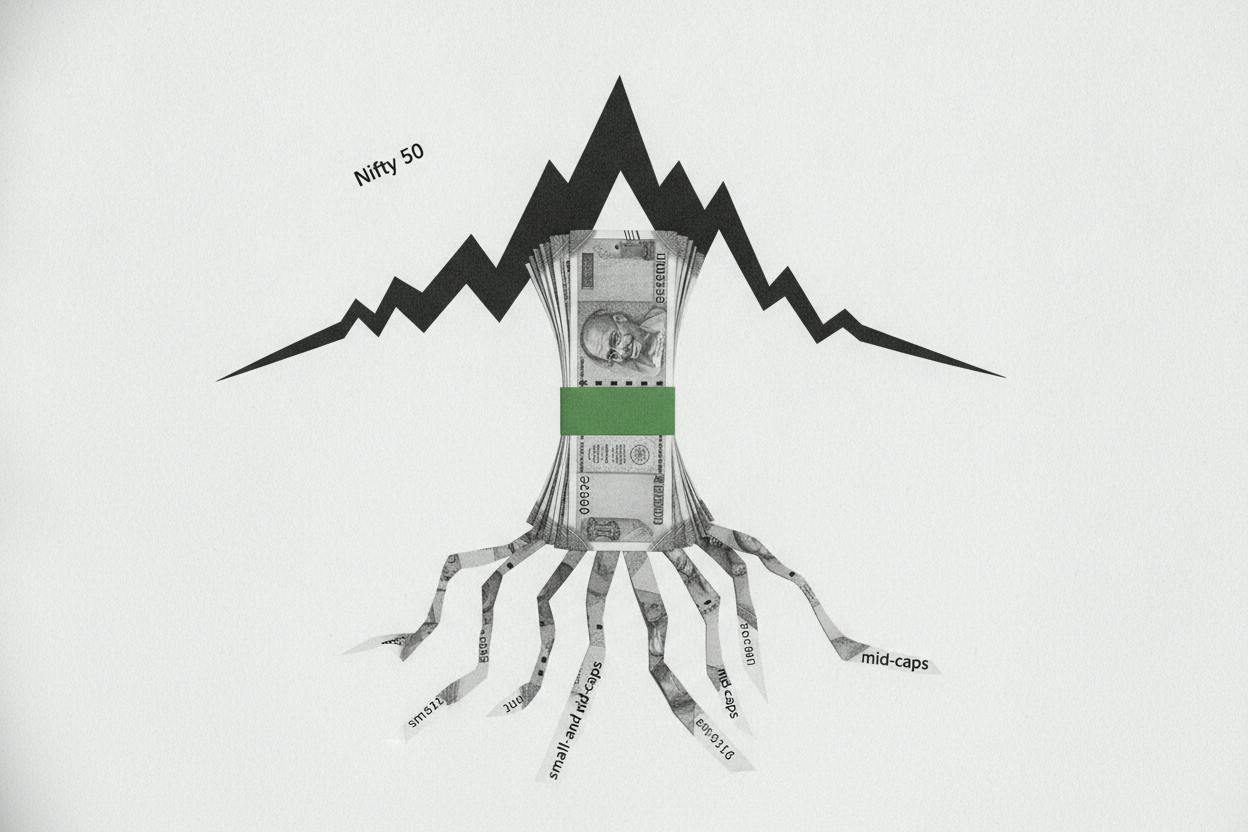
Indian shares edged lower at Friday's open, retreating from nine-month highs as the global artificial-intelligence rally lost some steam and investors turned cautious. The NSE Nifty 50 slipped 0.21% in early trading, while the BSE Sensex fell 0.19%, with most major sectors in the red.
The pullback mirrors a broader regional trend, as AI-related stocks across Asia have wobbled in recent sessions. A firmer US dollar and growing doubts about near-term AI demand have weighed on sentiment, hitting sectors like metals particularly hard—the metal index dropped about 2%.
Small- and mid-cap shares also felt the pressure, falling 0.5% and 0.4% respectively, as investors trimmed riskier positions.
Why the AI trade is cooling
The AI trade—the surge in stocks tied to artificial intelligence infrastructure, chips, and data centers—has been a major driver of global markets this year. But recent sessions have seen that enthusiasm fade. A stronger dollar makes commodities and emerging-market assets less attractive, while softer expectations for AI-driven demand have hit everything from copper to tech stocks.
This isn't just an Indian story. Regional markets have been hit by similar waves, as seen in Taiwan's sharp selloff and Japan's Nikkei sliding to a seven-month low. Even Korean stocks have hit multi-month lows as the AI trade unwinds.
For Indian investors, the cooling AI trade means that sectors with heavy exposure to global tech cycles—like metals, which depend on industrial demand—can be volatile. But it's important to remember that India's market is also driven by domestic factors, including corporate earnings, crude oil prices, and foreign investment flows.
Record foreign inflows provide a cushion
Despite Friday's dip, the broader picture remains positive. Foreign institutional investors have poured a record $12.21 billion into Indian equities this month, a sign of strong confidence in the country's growth story. That influx has helped push benchmarks to nine-month highs and kept them on track for weekly gains.
Supporting factors include easing crude oil prices, which reduce import costs and inflation pressure, and generally solid corporate earnings. These tailwinds have helped offset concerns about valuations and the global AI slowdown.
The record inflows also highlight a key difference between India and other Asian markets. While some regional bourses have been hit hard by the AI unwind, India's diversified economy and domestic investor base provide a buffer. As noted earlier, the regional selloff was expected to cool India's rally, but the underlying strength remains.
What it means for investors
For everyday investors, Friday's dip is a reminder that markets don't move in a straight line. Even after a strong run, pullbacks are normal—especially when a hot theme like AI takes a breather. The key is to focus on the fundamentals: earnings growth, economic resilience, and the direction of foreign flows.
The record foreign inflows suggest that global investors still see value in Indian equities, despite the recent wobble. However, the cooling AI trade could continue to create volatility in sectors tied to global tech and commodity cycles. Investors with a long-term horizon might view such dips as part of the normal ebb and flow, rather than a reason to panic.
As always, diversification remains a prudent strategy. While AI and tech stocks have been stars, having exposure to other sectors—like financials, consumer goods, or healthcare—can help smooth out the ride when a single theme loses momentum.
Looking ahead, market watchers will be keeping an eye on global cues, including the dollar's strength and any further signs of AI demand softening. Domestically, the focus will be on corporate earnings and any policy signals from the central bank. For now, the Indian market's resilience, backed by record inflows, suggests that the bull case remains intact—even if Friday's open shows a bit of caution.