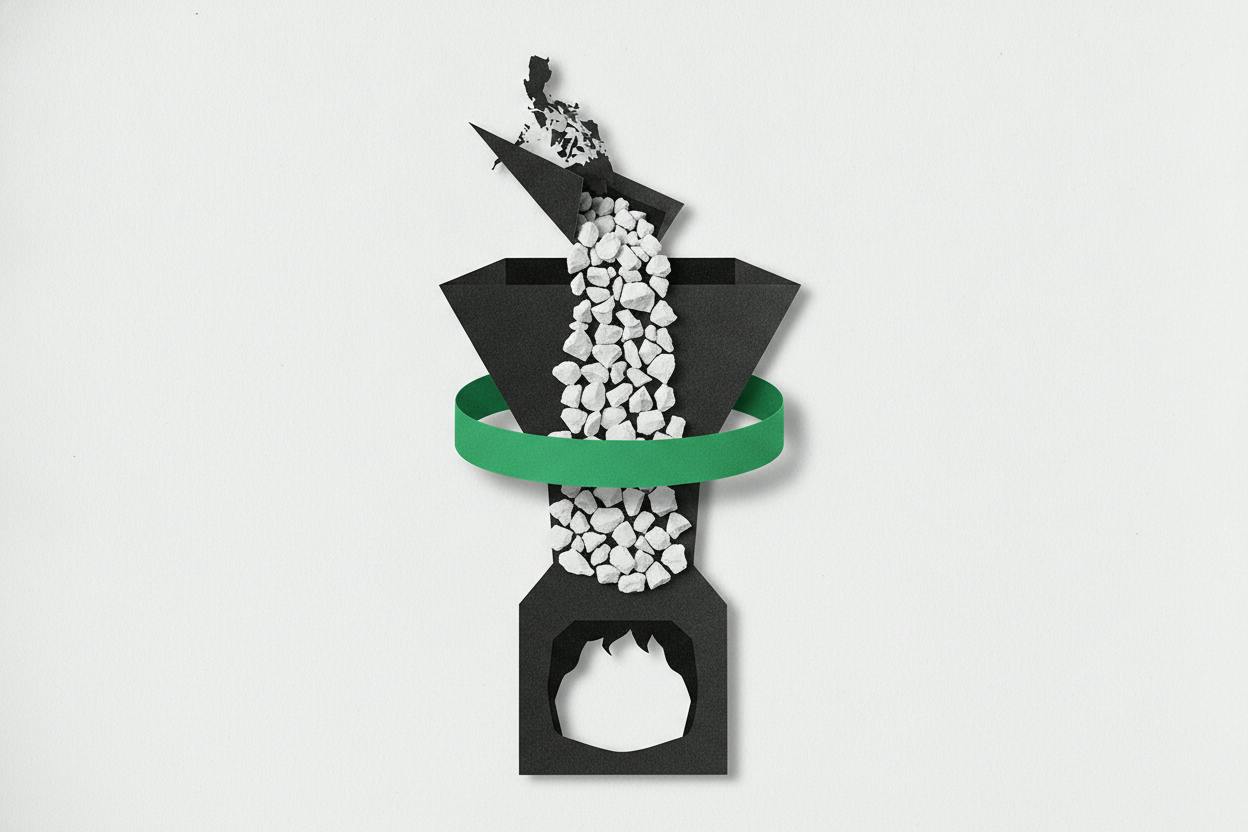
Indonesia, the world's largest nickel producer, is doing something unusual: importing raw ore. According to analysts and traders cited by Reuters, Indonesian smelters could bring in a record 20-25 million tons of nickel ore from the Philippines in 2026, as stricter domestic mining quotas leave local supply short.
The move marks a significant shift for a country that has dominated global nickel production for years. It also carries implications for the price of nickel worldwide, and for the companies that process the metal into the material used in stainless steel and electric vehicle batteries.
Why is Indonesia importing ore?
Indonesia's government has tightened the approval process for mining through its RKAB system, a work plan and budget mechanism that controls how much ore miners are allowed to extract each year. The Indonesian miners association APNI has estimated this year's cap at roughly 260-270 million tons, a level that smelters say is not enough to keep their plants running at full capacity.
At the same time, ore grades are declining. Tom Fan, an analyst at Mysteel, told Reuters that lower-grade ore means more rock must be processed to produce the same amount of metal, which further increases demand for ore. Together, the quota squeeze and falling grades have created a shortfall of what the industry calls "feedstock" — the raw material that smelters need to operate.
Because Indonesia's own mines cannot supply enough, smelters are looking across the sea to the Philippines, a major nickel ore exporter that has historically shipped most of its output to China. That rerouting of regional trade is a notable development in the global nickel market.
What it means for nickel prices
For investors, the most important consequence is what this does to the cost of producing nickel. When Indonesian smelters rely on imported ore, the extra shipping and handling costs become part of the break-even price for the next ton of nickel. Analysts say this could reset the "floor" for nickel prices on the London Metal Exchange (LME), the global benchmark.
Indonesia now supplies such a large share of the world's nickel that its input costs have an outsized influence on global prices. If benchmark prices do not rise enough to cover the imported-ore premium, the first pressure point is usually smelter margins. Producers may respond by slowing output growth or cutting production runs, which could eventually tighten supply and support prices.
Han Jianbiao, an analyst quoted by Reuters, said the shift in trade patterns could persist unless Indonesia loosens its mining controls or the Philippines restricts exports — neither of which he expects in the near term. That suggests the imported-ore dynamic could be more than a temporary blip.
Broader context for Indonesia's markets
The nickel story is unfolding against a backdrop of broader concerns about Indonesia's investment climate. The country's stock market has been volatile, and index provider MSCI has warned it may strip Indonesia of its emerging market status due to market structure issues. That warning has kept investors on edge, and Jakarta stocks have seen sharp swings. The rupiah has also faced pressure, with analysts split on how the central bank will respond.
For everyday investors, the nickel import story is a reminder that commodity markets are shaped by policy decisions as much as by supply and demand. Indonesia's quota system is a deliberate attempt to manage its resources, but it has created an unintended consequence: the world's top nickel producer now depends on imports to feed its own smelters.
That dependency could make nickel prices more sensitive to Indonesian policy changes and to shipping costs, which are influenced by fuel prices and freight rates. It also highlights the interconnectedness of global supply chains — a change in Jakarta's mining rules can ripple through to the cost of a battery in an electric vehicle sold in Europe or North America.
What to watch next
Investors will be watching several signals in the coming months. First, whether Indonesia adjusts its RKAB quotas to ease the supply squeeze. Second, whether Philippine exporters ramp up shipments and at what price. Third, how nickel prices on the LME respond to the higher cost structure.
For now, the key takeaway is that Indonesia's nickel industry is entering a new phase, one where imported ore plays a bigger role. That shift has the potential to raise the global cost of nickel, squeeze smelter margins, and reshape trade flows in Southeast Asia. For investors in nickel producers, battery makers, or stainless steel companies, it is a development worth tracking.