When investors sift through Indra Sistemas' latest half-year results, the headline numbers—revenue and profits—were certainly solid. But the figure that truly captures the company's trajectory is its order book. The Spanish defense and aerospace firm now holds a €20.5 billion ($24 billion) backlog, double what it had a year ago and equivalent to almost triple this year's expected revenue. In plain terms, Indra has years of contracted work already locked in.
Why the backlog matters
For a company like Indra, the order book is a forward-looking indicator. It represents the value of contracts that have been signed but not yet delivered. A growing backlog means future revenue is more predictable, reducing the uncertainty that often weighs on industrial stocks. When a backlog reaches nearly three times expected annual revenue, it suggests that the company can plan production, hiring, and investment with a high degree of confidence.
This is particularly significant in the defense sector, where contracts are often long-term and involve complex, multi-year programs. A robust backlog not only provides revenue visibility but also acts as a buffer against economic downturns or short-term budget fluctuations. For investors, it's a sign that the company's growth is not just a one-off quarter but a sustained trend.
Europe's defense spending shift
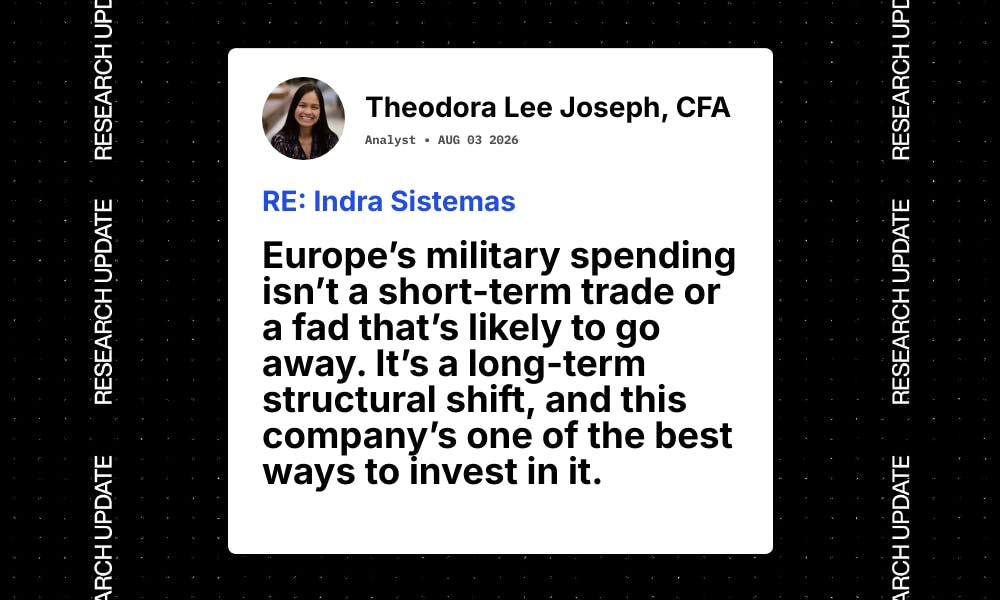
The surge in Indra's backlog is not an isolated event. It reflects a broader, structural change in European defense policy. Following geopolitical tensions and the war in Ukraine, European nations have pledged to increase military budgets significantly. This isn't a short-term trade or a passing fad; it's a long-term commitment to rearm and modernize. As a result, defense contractors across the continent are seeing a steady stream of orders.
Indra, with its focus on defense and aerospace, is well-positioned to benefit from this shift. The company's order book growth is a direct consequence of this increased spending. For investors, this means that Indra's prospects are tied to a durable trend rather than a cyclical uptick. The company is not just a beneficiary of a temporary spike but a key player in a multi-year investment cycle.
New leadership and execution focus
Indra has also brought in a new CEO with a clear focus on execution. While the brief doesn't name the executive, the emphasis on execution is crucial. A strong order book is only valuable if the company can deliver on its contracts efficiently and profitably. The new leadership's focus suggests that Indra is not just accumulating orders but also working to improve operational performance, which could translate into better margins and higher returns for shareholders.
This combination—a massive backlog and a management team focused on delivery—makes Indra an attractive proposition. The company is not just a story of top-line growth; it's also about converting that growth into bottom-line results. Investors will be watching closely to see how the new CEO navigates the challenges of scaling up production and managing complex defense projects.
What it means for investors
For everyday investors, Indra's order book is a powerful signal. It suggests that the company's revenue is not only secure but also likely to grow over the next several years. This reduces the risk associated with investing in the stock, as the company has a clear line of sight into its future earnings.
Moreover, the defense sector's structural tailwinds mean that Indra is not dependent on a single government's budget cycle. Multiple European nations are increasing their defense spending, providing a diversified source of demand. This diversification adds another layer of resilience to Indra's business model.
That said, defense stocks are not without risks. They can be sensitive to geopolitical developments, and any easing of tensions could lead to a slowdown in orders. Additionally, execution risks remain—delivering on large, complex contracts is never easy. But for investors looking to gain exposure to Europe's defense build-up, Indra's order book is a compelling reason to take notice.
Looking ahead
Indra's half-year results are a clear indication that the company is on a strong footing. The order book is not just a number; it's a testament to the company's strategic position in a sector that is undergoing a fundamental shift. As Europe continues to prioritize defense, Indra is likely to remain a key beneficiary.
Investors will be watching the company's next moves—how it manages its backlog, whether it can improve margins, and how it navigates the complexities of the defense industry. For now, the order book says it all: Indra is well-positioned for the long haul.