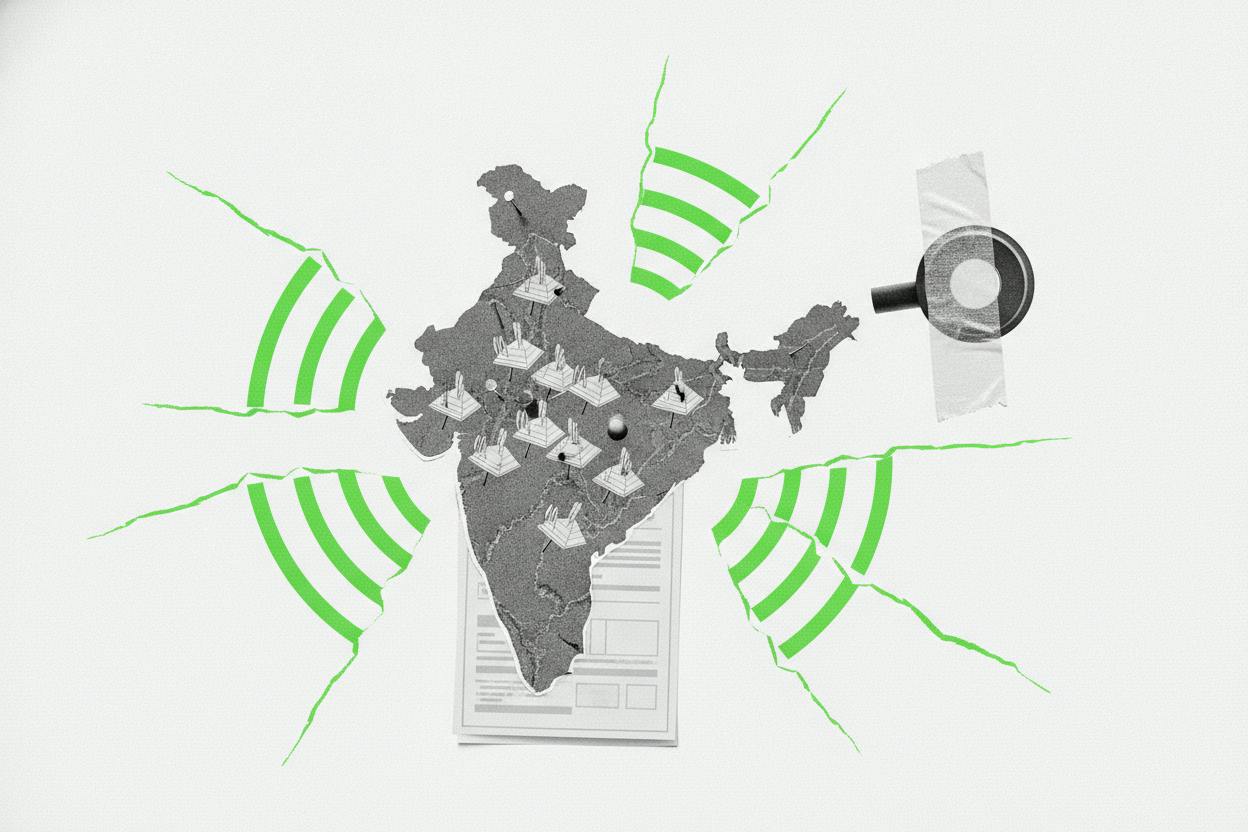
Jio Platforms is taking its home broadband technology on the road. According to Reuters, the Indian telecom and technology company — controlled by Reliance Industries and fresh off a $3.2 billion listing in Mumbai — has held talks with US cable operators Comcast and Charter about licensing its Wi-Fi-based internet system.
The pitch is unusual for a telecom company. Instead of digging fiber or stringing cable to every home, Jio's system uses small transmitters mounted on towers or rooftops to beam internet over unlicensed Wi-Fi airwaves to receivers on buildings. It is a cheaper way to reach customers, and Jio wants to sell that approach to operators in other countries rather than build networks itself.
Why the licensing model matters
Traditional telecom operators spend heavily upfront to build networks — trenching streets, laying cable, installing equipment — and only earn that money back over years of subscriptions. That is a capital-intensive business, and it tends to weigh on profit margins and returns.
Licensing flips that equation. If Jio can sell access to its technology in exchange for fees or royalties — and Reuters reports the company has discussed taking an equity stake in a partner's local broadband business — it could earn more like a software provider than a network builder. Capital-light businesses often command richer valuations from investors because they can scale without proportional spending.
Jio has told investors it is targeting 10 to 15 partners globally. That is an ambitious number, and it explains why the company is shopping the technology to some of the largest cable names in the United States.
The catch: unlicensed spectrum
There is a technical wrinkle that could shape how much partners are willing to pay. The airwaves Jio's system uses are unlicensed, meaning they are shared with everyone else — home routers, coffee shops, other devices. Mobile operators normally pay for exclusive spectrum, which lets them guarantee a certain level of speed and reliability.
Shared frequencies are harder to control. Performance can vary depending on how crowded the airwaves are, and that quality risk can cap the pricing a partner like Comcast or Charter would accept. For a cable operator whose brand depends on consistent home internet, that is a real consideration.
Reuters also reported that there is no timetable for a deal with either US company. And earlier discussions with MTN Group, a South African telecom, fell apart after the two sides disagreed on valuation and licensing terms. That failure is a useful reminder that talks do not always convert into contracts.
What it means for investors
Jio's $3.2 billion IPO now rests partly on a simple question: does licensing beat building? If Jio can show a repeatable template — a standard contract, a workable pricing structure, and partners willing to sign — the company can argue it deserves a higher valuation than a conventional telecom rollout would justify. Fees and royalties tend to translate into better margins, and markets often reward that.
But the story is still early. A signed deal with a major US cable operator would be a strong proof point. Another collapse like the MTN talks would raise doubts about whether the technology and terms are attractive enough for global partners.
For everyday investors, the takeaway is to watch the pipeline rather than the headline. Announcements of talks are common; signed agreements with clear terms are what validate a business model. Jio's post-IPO valuation is likely to be sensitive to which of those two it delivers.
The broader backdrop matters too. Indian equities have been sensitive to global risk appetite and currency moves, and the rupee's recent calm has masked some investor caution. A high-profile Indian tech listing with global ambitions sits at the intersection of those trends, and its progress will be watched as a signal of how far Indian technology can travel beyond its home market.
For now, Jio has a story to tell and a list of potential partners. The next chapter depends on whether Comcast, Charter or another operator decides the technology is worth paying for.