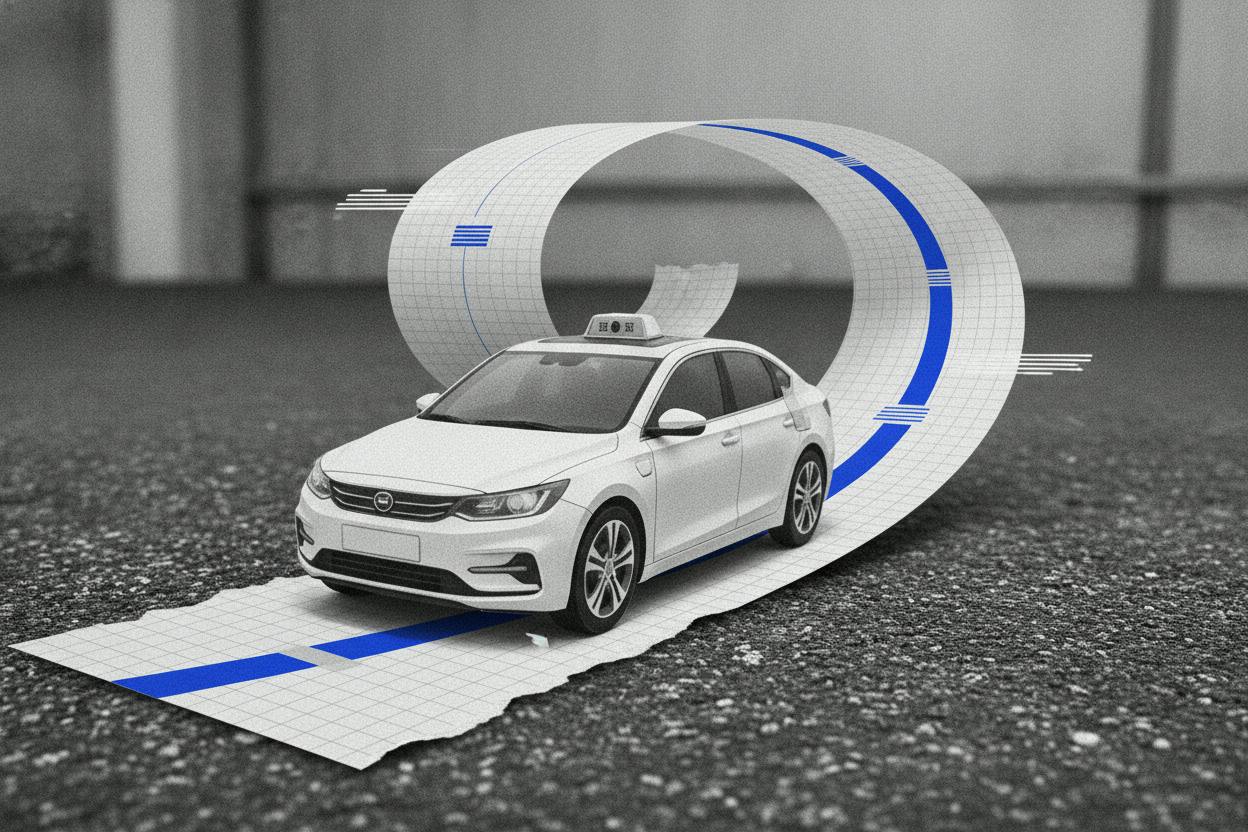
Baidu has unveiled Apollo World, an AI-powered driving simulator that can generate up to 100,000 kilometers of virtual road time per day to train its Apollo Go robotaxi fleet. The announcement signals a shift in China's self-driving race: the competitive battleground is moving from flashy demonstrations to the mundane but crucial task of cutting testing costs.
Why simulation matters
Robotaxi progress is limited less by clever demos and more by grinding through rare “edge cases”—odd merges, jaywalkers, confusing construction zones, and other unusual situations that can trip up autonomous systems. Training a fleet to handle these safely with real cars is slow and expensive. It requires safety drivers, permits, and many supervised miles on public roads.
Baidu says Apollo World produces realistic sensor feeds, including camera and LiDAR data, so its software can practice, fail, and relearn in a controlled environment. If the “up to 100,000 kilometers a day” claim holds, Baidu argues it compresses roughly three years of safety-driver road testing into a much shorter cycle, letting Apollo Go push updates faster.
This approach is not entirely new—simulation has long been a staple in autonomous vehicle development. But the scale and fidelity Baidu claims could make a meaningful difference. The more credible the synthetic miles, the fewer costly real-world miles are needed to find edge cases, verify fixes, and retrain models. That lowers the cost of each improvement while speeding up release cycles.
The cost problem in robotaxis
Even “asset-light” expansion—where a company licenses its self-driving system while partners provide vehicles and local operations—still requires heavy spending on computing power and model training. For Baidu, Apollo Go has been rolling out across Chinese cities, but each new city brings its own traffic quirks, road layouts, and local driving habits. Adapting the system city by city is a major expense.
Simulation is attractive because it turns “time on the road” into a more scalable input: compute. Instead of building ever-larger supervised fleets, a company can invest in data centers and training runs. That shift could help explain why some operators may scale faster than rivals like WeRide, Pony.ai, and Momenta Global, all of which are competing in the same crowded field.
The broader market context is also important. Morgan Stanley projects China could have 1 million robotaxis by 2035, a benchmark that suggests enormous scale is coming. If Apollo World meaningfully cuts the per-city testing burden, Apollo Go's asset-light rollout looks more plausible. Baidu could spend relatively more on computing and relatively less on physical fleets, potentially giving it a cost advantage as the market grows.
What it means for investors
For investors, the key takeaway is that Baidu is attacking one of robotaxis' biggest cost lines: testing. If simulation can reduce the need for expensive real-world miles, it could improve margins and speed up expansion. That matters because robotaxi economics are still unproven at scale, and any edge in cost or speed could be decisive.
However, investors should be cautious. The “up to 100,000 kilometers a day” figure is a claim, not a verified result. Simulation quality is hard to assess from the outside, and even the best simulator cannot fully replace real-world validation. Regulators may also require physical testing regardless of how much synthetic training a company does.
Baidu's move also highlights a broader trend in the autonomous vehicle industry: the shift from hardware-heavy testing to software and compute. That is similar to how other tech companies are swapping pricey AI models for cheaper ones to protect margins. The same logic applies here—using simulation to cut costs is a way to make the business model more sustainable.
For everyday investors, the story is less about Baidu's stock specifically and more about the economics of self-driving. If simulation can make robotaxis cheaper to deploy, it could accelerate the timeline for widespread adoption. That would have implications for ride-hailing, logistics, and even car ownership. But it is still early, and the technology must prove itself in the real world.
In the meantime, Baidu's Apollo World is a reminder that the race to autonomous driving is as much about cost control as it is about technology. As the industry matures, the companies that can train their systems efficiently may be the ones that survive the long haul.