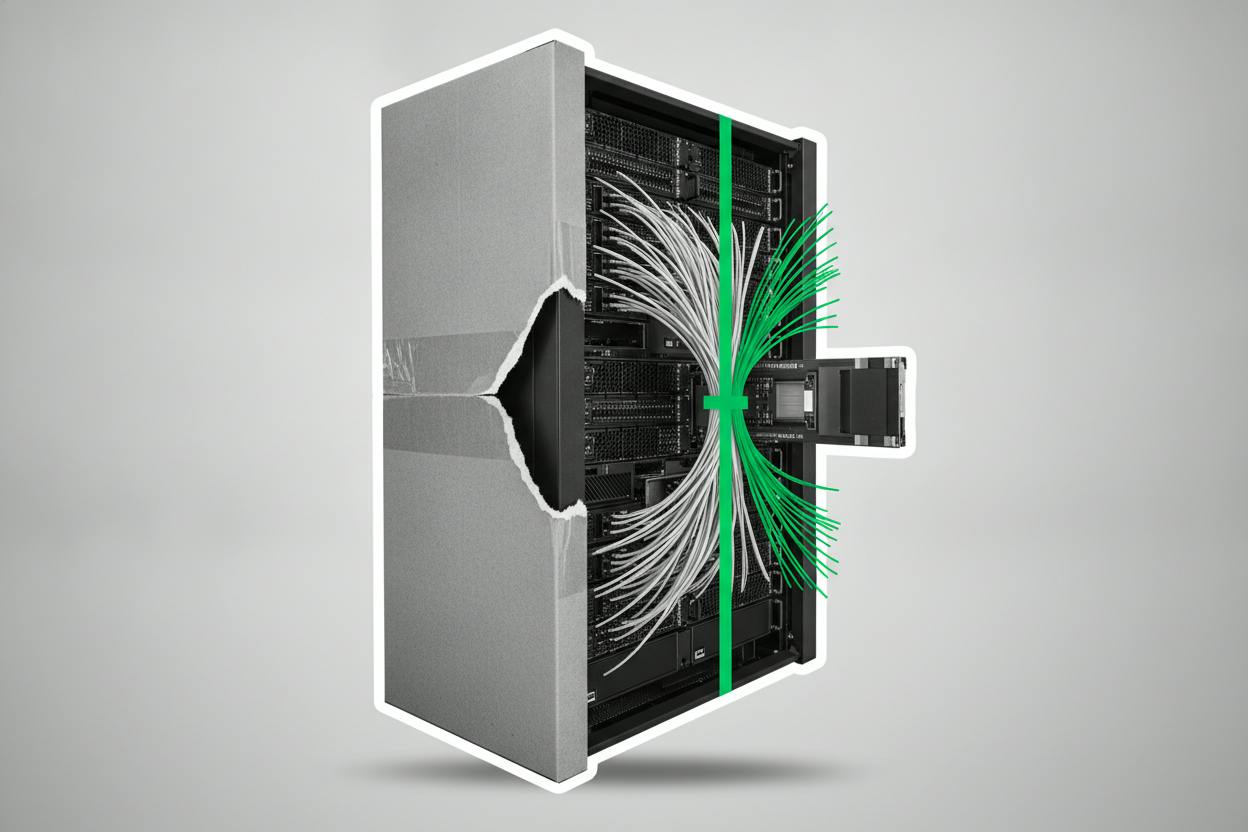
Marvell Technology has announced a blockbuster $115 billion deal to acquire Lumentum, a leading supplier of optical components. Reuters reports the acquisition is one of 2026's largest transactions and a direct challenge to Broadcom in the race to dominate AI data center hardware.
The deal underscores a critical reality of the AI boom: building powerful chips is only half the battle. Data centers also need the high-speed optical links that move data between servers and racks, enabling thousands of processors to work in concert. Lumentum makes these optical transceivers and related components, which are increasingly the bottleneck in AI infrastructure buildouts.
Why optics matter in AI
AI models like large language models require massive parallel processing. When thousands of GPUs or custom AI chips are training a model, they constantly exchange data. If that data can't move fast enough, the entire system slows down, wasting expensive compute time. Optical components use lasers to transmit data at high speeds over fiber, far faster than traditional electrical cables.
Marvell's strategy is to pair its custom chips and networking gear with Lumentum's optical technology, offering data center operators a more complete package. This mirrors Broadcom's approach, which already sells many AI data center building blocks under one roof. By pulling optics in-house, Marvell narrows the gap with its larger rival and makes it harder for competitors to win piece-by-piece contracts.
Marvell has been growing rapidly in the AI space. In August, it agreed to supply companion chips for Google's AI processors, a deal that could be worth up to $120 billion in sales through fiscal 2033. This new acquisition builds on that momentum, positioning Marvell as a one-stop shop for AI infrastructure.
Supply constraints and geopolitical shifts
The deal comes amid expectations that AI-driven demand for optical links will outstrip supply for years. Executives in the industry have warned that production capacity for these components is limited, and building new factories takes time. Owning that capacity gives Marvell pricing power and preferential access to scarce parts.
Geopolitics could also play a role. The US has proposed banning new Chinese optical transceivers, which would shift demand toward domestic suppliers like Lumentum. If that ban takes effect, control of US-based optical capacity becomes even more valuable, potentially reshaping the competitive landscape.
What it means for investors
For markets, the $115 billion price tag signals that optics are seen as a choke point for AI expansion. If optical gear limits how quickly hyperscalers—Big Tech companies running massive cloud data centers—can grow, then owning that bottleneck translates into pricing power and strategic advantage.
For Lumentum's closest listed peer, Coherent, the deal means tougher competition for US orders. Marvell's scale and integration could pressure Coherent's market position. Meanwhile, China's Zhongji Innolight, another optical component maker, could lose share in US-facing demand if restrictions tighten.
For Marvell shareholders, the deal is a bold bet on long-term AI infrastructure spending. The company is essentially saying that the AI buildout will continue for years, and that owning the full stack—chips, networking, and optics—is the winning strategy. The risk is that the deal is expensive and may face regulatory scrutiny, but the potential payoff is significant.
For everyday investors, this deal highlights the importance of looking beyond the most famous AI chipmakers. The infrastructure that supports AI—networking, memory, power, and optics—is just as critical. Companies that control these bottlenecks could see sustained demand and pricing power.
As the AI race intensifies, expect more consolidation in the supply chain. Marvell's move is a clear signal that the next battleground is not just in silicon, but in the invisible threads that connect it all.