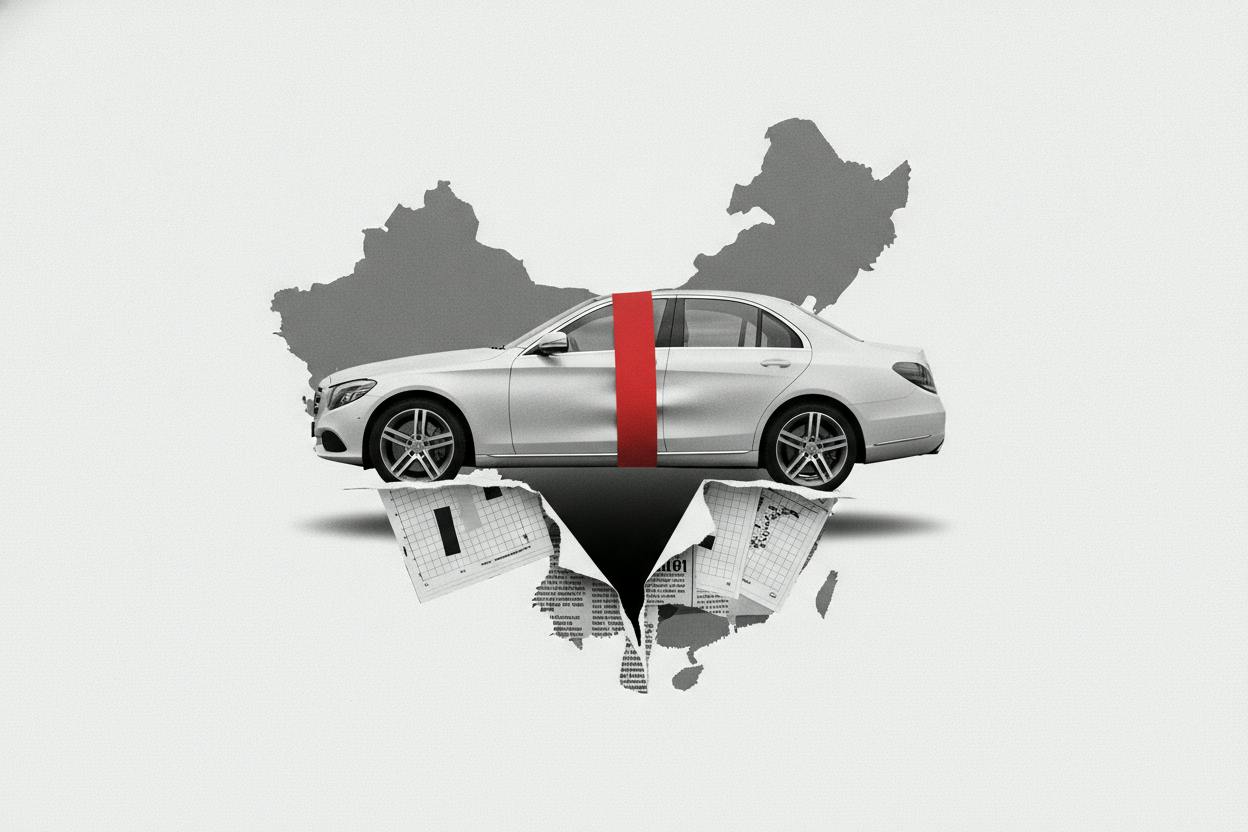
Mercedes-Benz is heading into its third-quarter earnings report on October 28 with one big question hanging over it: how much is China hurting? RBC Capital Markets says the answer is a lot. The investment bank estimates the automaker's China deliveries fell 31% year over year in the quarter, making the world's largest car market the main drag on its results.
That decline matters more than a simple sales dip. China has become the pressure point for Mercedes, and fewer cars sold there means less revenue — but more importantly, weaker profitability. RBC warned that Mercedes' Q3 car margin, which measures profit on vehicles as a share of sales, could fall below the company's full-year guidance range of 3% to 5%. The bank also flagged softness in top-end models, with sales down 21% year over year to 53,900 units.
Why a sales drop hits profits harder than it looks
Automaking is a capital-intensive business with large fixed costs — factories, tooling, supply chains and labor that must be paid for whether plants run at full speed or not. When volumes fall, each vehicle has to carry a bigger share of those fixed costs, which squeezes margins quickly. That's why a 31% delivery decline in China can do disproportionate damage to earnings, even if global sales look steadier.
RBC's call that Q3 margins may slip below the 3%-5% band is therefore less about one quarter and more about what it signals for future earnings power. The bank already reflected that risk by cutting its 2027 equity income estimate to €200 million from €300 million and lowering the EBITDA valuation multiple it uses from 1.5x to 1x. It also reduced its price target on the stock to €44 from €54, citing a tougher China outlook and higher commodity and freight costs.
The broader backdrop isn't helping. China's economy has been slowing, and the IMF recently trimmed its 2026 growth forecast for the region, with China stocks slipping as tech and consumer demand weaken. For global automakers, that means the premium segment — where Mercedes competes — is under pressure as wealthy buyers pull back and local rivals gain ground.
What it means for investors
For everyday investors, the key takeaway is that Mercedes' share reaction on October 28 may depend less on the exact margin figure and more on management's ability to convince the market that China weakness is temporary. RBC noted that expectations are already low for the quarter and that new model launches could help results improve in the fourth quarter. But the bank also said policy changes like an EU-China hybrid export cap are unlikely to meaningfully help while Mercedes shifts its lineup toward battery-electric vehicles.
That shift is expensive. Automakers transitioning to EVs face heavy research and development spending, retooling costs and pricing pressure — all of which can weigh on margins during the transition. Mercedes is not alone; rivals across Europe and the U.S. are navigating similar challenges. But the company's heavy exposure to China's luxury market makes it especially sensitive to swings in demand there.
Investors will also be watching whether the company can defend its full-year guidance. If Q3 margins come in below the 3%-5% range, management may need to either revise its outlook or explain why the weakness is contained to one quarter. RBC's lowered price target suggests the bank sees limited near-term upside, but it also implies that much of the bad news may already be priced in.
Beyond the headline numbers, the earnings call will be closely parsed for commentary on China inventory levels, pricing trends and the pace of EV adoption. Any sign that the company is gaining traction with new models — particularly in the premium electric segment — could help restore confidence. Conversely, further deterioration in China or additional cost pressures could keep the stock under pressure.
For now, the October 28 report is a gut check. It will test whether Mercedes can convince investors that its China troubles are a cyclical bump rather than a structural problem, and whether its profit path through 2026 and 2027 remains intact. With the stock already reflecting low expectations, the bar for a positive surprise may be lower than usual — but the risks are clearly tilted to the downside until the China picture stabilizes.