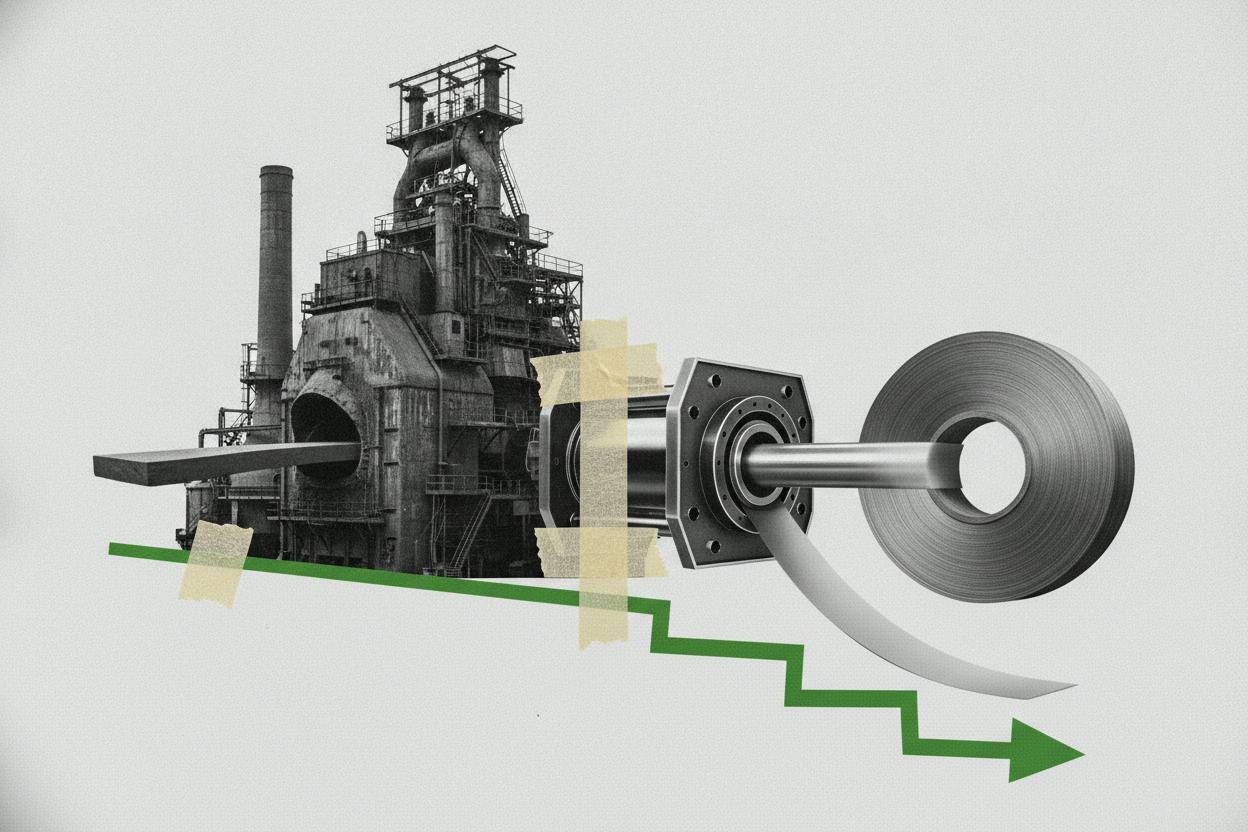
Nippon Steel, the Japanese steelmaker that recently acquired U.S. Steel, has unveiled plans to spend roughly $3 billion upgrading the Edgar Thomson plant in Pennsylvania's Mon Valley. The centerpiece is a new hot strip mill, with construction slated to start in the second half of 2029. Once complete, the facility's annual capacity would jump from 2.2 million tons to 3.5 million tons.
What is a hot strip mill?
For everyday investors, it helps to understand what a hot strip mill actually does. Steelmaking starts with thick, semi-finished slabs of metal. A hot strip mill heats those slabs and rolls them into thin, flat coils—the kind of steel used in car bodies, appliances, and construction materials. It's a critical step in turning raw steel into a usable product, and upgrading it can dramatically improve a plant's efficiency and output.
The Edgar Thomson site is one of the oldest steel plants in the United States, dating back to the 1870s. It sits along the Monongahela River, part of the historic Mon Valley steel corridor near Pittsburgh. Nippon Steel frames this project as part of a broader $11 billion commitment to its U.S. operations, signaling a long-term bet on domestic steelmaking.
Why this matters for investors
This is a significant capital expenditure for a company that only recently took control of U.S. Steel. The acquisition itself was controversial, drawing scrutiny from U.S. regulators and politicians concerned about foreign ownership of a iconic American company. By committing billions to upgrade existing facilities, Nippon Steel is signaling that it intends to operate and modernize U.S. Steel rather than simply extract value.
For investors, the key takeaway is capacity growth. Increasing Edgar Thomson's output by more than 50% could make U.S. Steel more competitive in the domestic market, especially if demand for steel in cars, appliances, and infrastructure remains strong. However, the timeline is long—construction doesn't start until 2029, so any benefits won't show up in financial results for years.
It's also worth noting that this investment comes at a time when the U.S. steel industry is facing headwinds. Other metals producers are also expanding in the U.S., but steel demand can be cyclical, tied to the health of manufacturing and construction. If the economy slows, higher capacity could mean more supply than demand, which could pressure prices.
For everyday investors, this news is more about the long-term direction of U.S. Steel than an immediate catalyst. It suggests that Nippon Steel is willing to invest heavily in American production, which could be a positive signal for the company's future competitiveness. But it also carries execution risk—large industrial projects often face delays and cost overruns.
Investors should also consider the broader context. Business confidence in North America has been uneven, and steel demand is sensitive to interest rates and infrastructure spending. If the Federal Reserve cuts rates later this year, that could boost construction and manufacturing, supporting steel prices. Conversely, a prolonged slowdown would make the new capacity less valuable.
Nippon Steel's $11 billion commitment is a clear statement of intent. The company is not just buying U.S. Steel for its existing assets; it's planning to modernize them. For investors, the question is whether that investment will pay off in a competitive global market. Other large capital raises and IPOs show that investors are willing to back big industrial bets, but steel is a mature industry with thin margins.
In the near term, the announcement is unlikely to move U.S. Steel's stock dramatically, given the long timeline. But it does provide a clearer picture of the company's future direction under new ownership. For those holding U.S. Steel shares, it's a sign that the new parent is committed to the business. For those watching the broader metals sector, it's another example of companies investing in expanding production capacity to meet expected demand.
As with any major capital project, the devil will be in the details. Investors will want to watch for regulatory approvals, engineering studies, and any changes to the timeline. But for now, the plan is a clear vote of confidence in American steelmaking.



