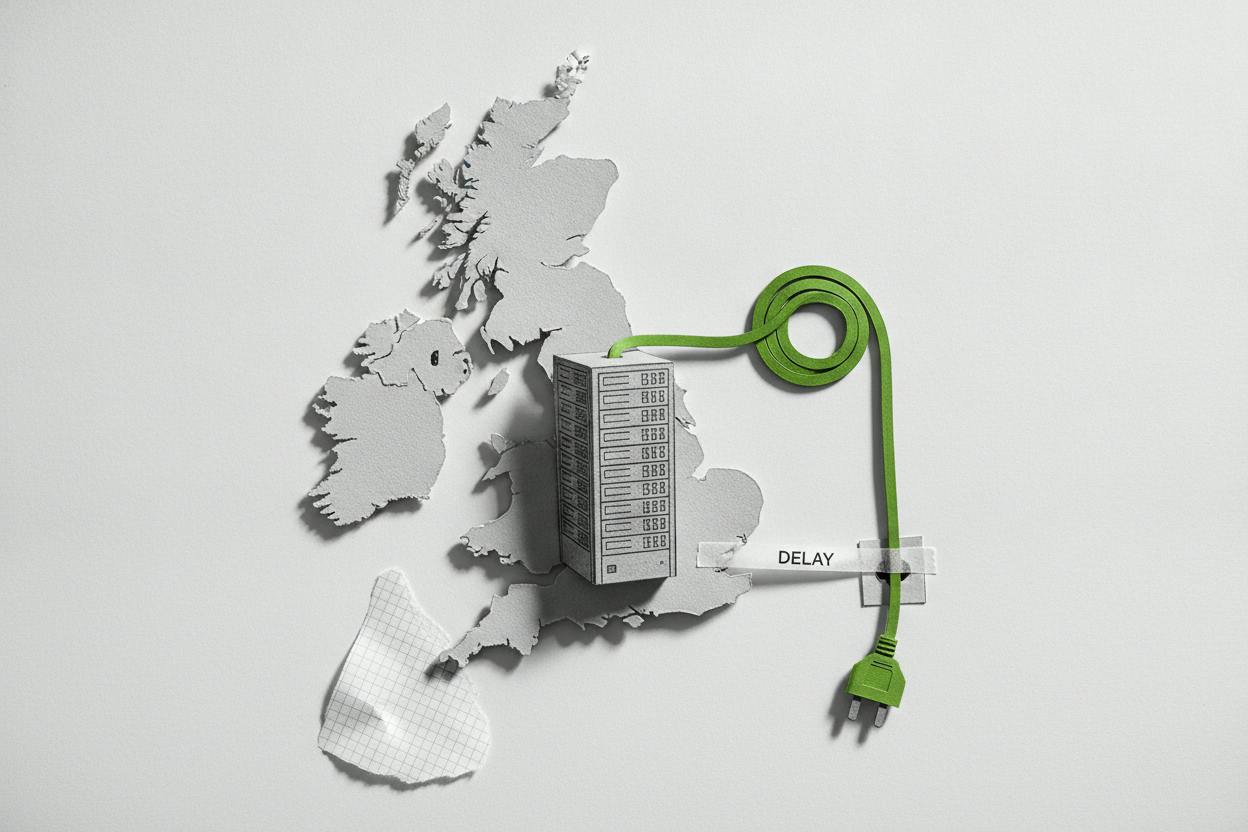
Nscale, a fast-growing provider of AI computing power, is in talks to raise roughly $3.5 billion ahead of a possible initial public offering (IPO). The funding would come in two parts: up to $1.5 billion in convertible notes led by hedge fund Third Point, and as much as $2 billion from chipmaker Nvidia, according to sources familiar with the discussions.
The pricing of these investments is tied to a $30 billion valuation cap, meaning early investors would get shares at a price that implies the company is worth no more than $30 billion when it eventually goes public. That cap gives investors some protection if the IPO values the company higher, while still allowing Nscale to raise money without setting a firm IPO price yet.
What is Nscale?
Nscale, founded in 2024, builds and operates data centers packed with graphics processing units (GPUs)—the specialized chips used to train and run AI models—along with the software to manage them. This “full-stack” approach puts it squarely in the middle of the race by AI labs and large corporations to secure reliable computing capacity, which has become one of the most sought-after resources in tech.
The company’s momentum was highlighted last month when Reuters reported that Anthropic, a leading AI company, signed a six-year, $45 billion deal to rent capacity from Nscale. That deal, if confirmed, would be one of the largest of its kind and underscores the scale of demand for AI infrastructure.
Nscale is not alone in this space. Rivals like CoreWeave and Lambda Labs have also raised billions to build out GPU clouds, and the sector has become a magnet for investors looking to profit from the AI boom without picking individual AI model winners.
How the funding works
Convertible notes are a type of debt that converts into equity at a later date, usually at a discount to the IPO price. They are popular with late-stage startups because they let companies raise money quickly without immediately setting a valuation. In this case, the notes are led by Third Point, a well-known activist hedge fund, which signals confidence from sophisticated institutional investors.
The potential $2 billion from Nvidia is notable because Nvidia is the dominant maker of GPUs. Investing in a customer like Nscale could help Nvidia lock in demand for its chips and deepen its ties to the AI infrastructure ecosystem. It also gives Nvidia a financial stake in the success of companies that buy its products, a strategy it has used with other AI startups.
This type of financing has become increasingly common in the AI sector. As we noted in our explainer on zero-coupon convertibles, AI companies have raised tens of billions of dollars through convertible notes, often with no interest payments, in exchange for future equity. The structure allows companies to delay valuation discussions while giving investors a chance to profit from future growth.
What it means for investors
For everyday investors, the key takeaway is that the AI infrastructure boom is still attracting enormous amounts of capital. Nscale’s ability to line up $3.5 billion—before it even has an IPO—shows that investors are willing to bet big on companies that provide the physical backbone for AI.
If Nscale does go public, the $30 billion valuation cap will be a reference point. That would put it in the same league as some of the largest tech IPOs in recent years. However, it’s important to remember that pre-IPO funding rounds are often structured to benefit early investors, and the final IPO price could be higher or lower depending on market conditions.
For those watching the broader market, this news is another sign of how central AI has become to corporate strategy. Nvidia’s potential investment is particularly telling: the chipmaker is not just selling the “picks and shovels” of AI; it’s also placing bets on the companies that use them. That could create a virtuous cycle, but it also raises questions about concentration risk if the AI bubble were to deflate.
As with any pre-IPO story, there are no guarantees. The talks could still fall through, and the final terms may change. But the fact that Nscale is attracting this level of interest—from both a major hedge fund and the world’s most valuable chipmaker—suggests that the AI infrastructure race is far from over.
Investors should keep an eye on how this develops, especially if Nscale files for an IPO. The company’s valuation, revenue growth, and ability to secure long-term contracts will be key metrics to watch. In the meantime, the deal highlights the growing importance of Nvidia’s investment strategy and the use of convertible notes as a funding tool in tech.