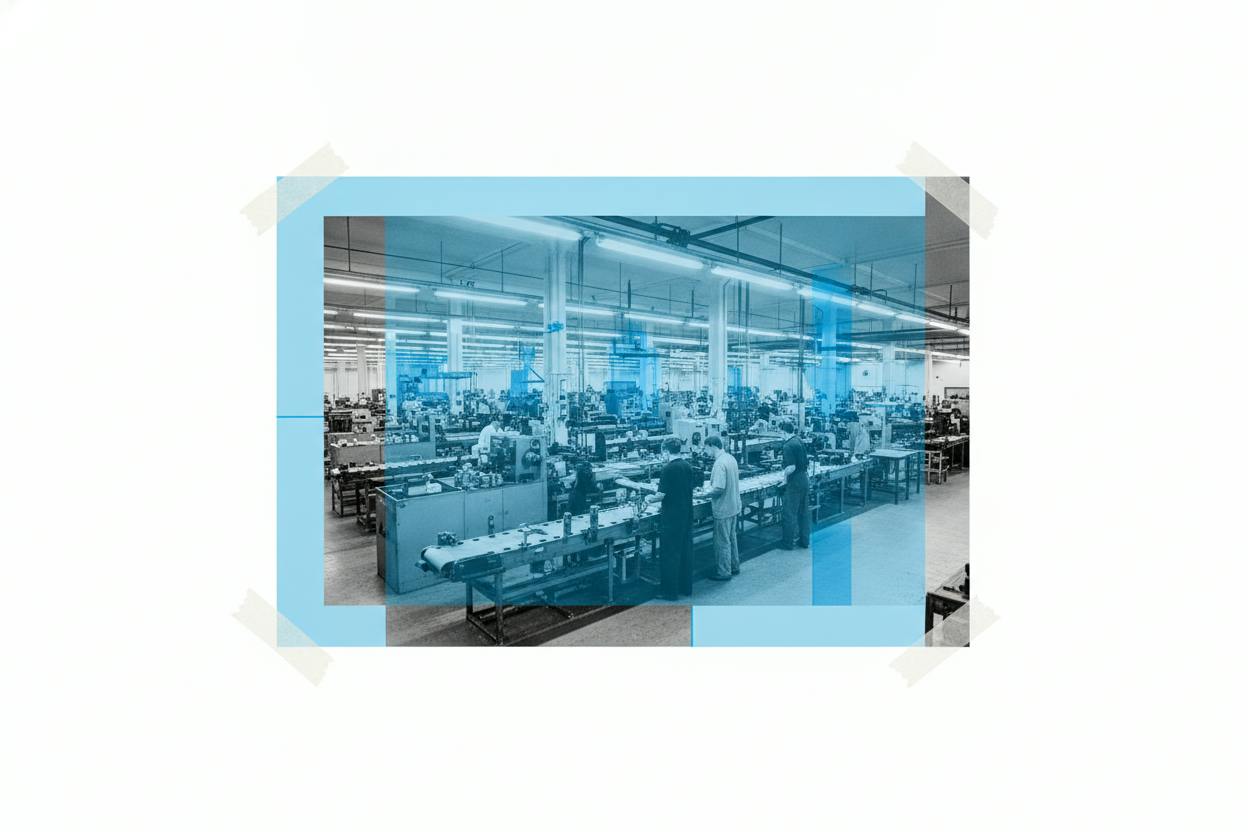
Industrial giant Siemens has started using artificial-intelligence tools developed with chipmaker Nvidia at its electronics plant in Erlangen, Germany. The move takes the two companies' long-running partnership beyond the demonstration stage and into live factory production, a step that could signal how quickly AI reshapes manufacturing.
Siemens, which makes automation equipment and industrial software, said the setup combines Nvidia's AI, simulation, and accelerated computing with its own factory software and control systems. The idea is to move more planning and troubleshooting into a virtual model of the factory, where changes are cheap and fast, rather than discovering problems only after production has started.
What the tools actually do
For printed-circuit-board assemblies, Siemens says the approach it calls “virtual production preparation” can cut engineering effort by up to 85% and reduce time to market by up to 40%. It also says AI-based production planning can enable cost savings of up to 20%. More applications are expected in the coming months.
These are big claims, and they come with the usual caveat that “up to” figures represent best-case scenarios. But the key point for investors is that Siemens is attaching specific, measurable targets to a real plant, not just a slide deck. That gives factory managers something concrete to evaluate when deciding whether to invest in similar technology.
Why factory AI often stalls
Artificial intelligence has been a hot topic in manufacturing for years, but many projects never get past the pilot stage. The reason is often simple: it is hard to prove that the technology pays for itself. A pilot might show promise in a controlled setting, but scaling it across a large operation requires confidence that the savings will hold up.
By publishing live-plant metrics, Siemens is giving budget holders a clearer return-on-investment case. Fewer engineering hours, fewer late-stage fixes, and faster product launches are the kinds of outcomes that finance teams can underwrite. If the Erlangen results hold up, the next step would be replicating the setup across other “discrete manufacturing” sites, such as electronics and machinery plants, where workflows repeat and savings can scale.
What it means for investors
For the broader market, the significance is that measurable returns could pull spending forward for the entire enabling stack that both companies sell. That includes Nvidia's accelerated computing and simulation platforms, as well as Siemens' industrial software that plugs into day-to-day operations.
Nvidia is already a household name in AI, but most of its revenue still comes from data centers and training large models. A push into factory automation opens up a new, potentially huge market for its chips and software. Siemens, meanwhile, is a traditional industrial giant that is trying to show that it can be a leader in the AI-driven transformation of manufacturing, not just a bystander.
The timing is also notable. Factory output has been a mixed bag lately, with some reports showing strength and others pointing to trouble. US factory output beat forecasts in September, but services activity has signaled weakness. In that environment, any technology that promises to cut costs and speed up production could get extra attention from companies looking to protect margins.
Beyond the factory floor
Nvidia's push into industrial applications is part of a broader strategy to diversify beyond its core AI training business. The company has also expanded partnerships in other sectors, such as Volvo's work on hands-free driving. And its technology is increasingly showing up in financial services, where Santander is using Nvidia AI to cut costs.
For everyday investors, the takeaway is that AI's impact is no longer just about chatbots or data centers. It is moving into the physical world, where it can change how goods are made. That could create opportunities for companies that provide the tools, but it also means that traditional manufacturers that fail to adopt such technology could fall behind.
As always, it is worth watching whether the promised savings actually materialize. If they do, expect to hear more about AI in factories in the coming quarters. If they don't, the hype could fade quickly. Either way, the Erlangen plant is now a test case that investors will be watching closely.



