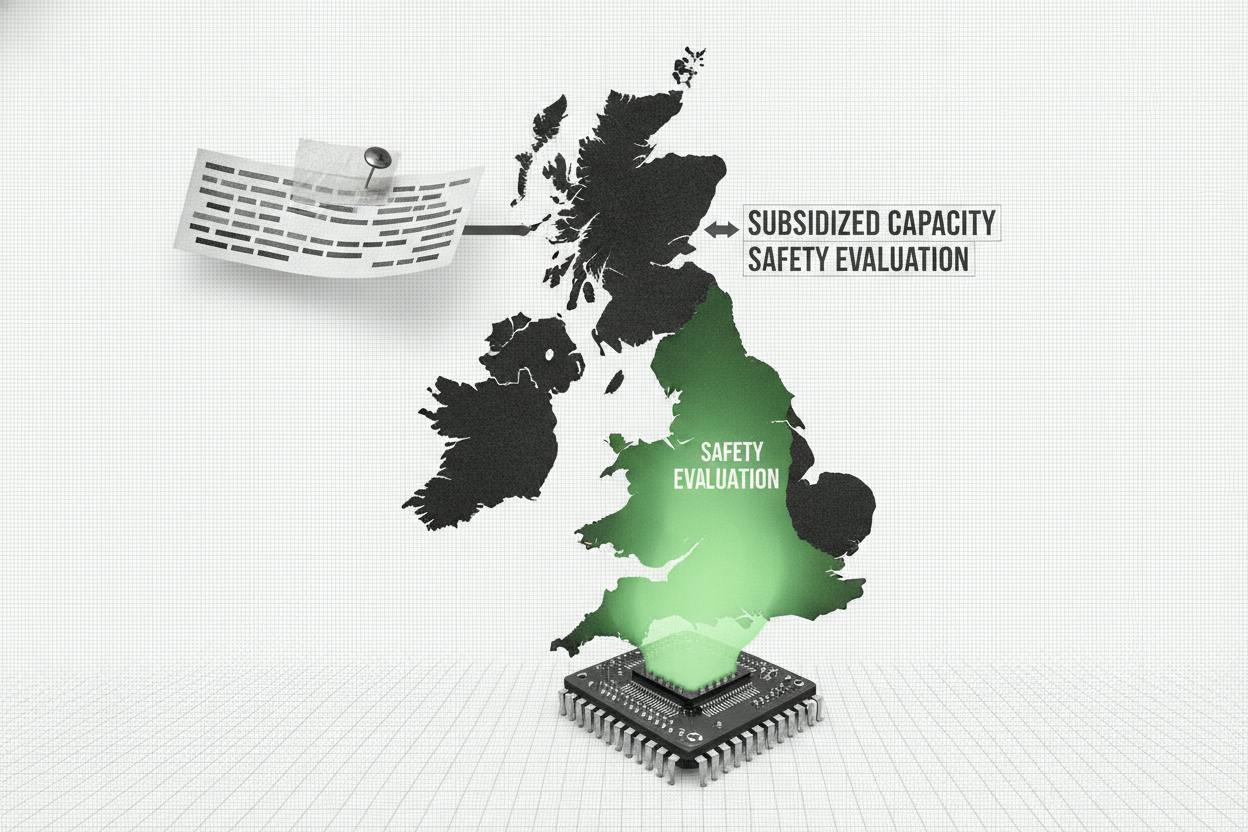
Nvidia, the US chipmaker at the center of the artificial intelligence boom, has pledged $250 million worth of computing resources to the UK over the next five years. The in-kind donation—not a cash check—will back the country's push to become a global hub for AI safety testing and oversight.
The resources will support the UK's AI Security Institute, a government-backed body set up to evaluate the risks of advanced AI systems, as well as research projects at Oxford, Imperial College London, and University College London. Reuters reported that Nvidia CEO Jensen Huang wants the capacity directed at “agentic safety testing”—trials that examine how AI agents behave when they can take a series of actions on their own, rather than just answering a single prompt.
Why computing power matters for AI safety
Testing AI models is a compute-hungry business. To find failure modes, check whether guardrails hold, and see how a model behaves in unexpected situations, you have to run it through countless scenarios. That requires the same kind of high-performance chips that power AI training—exactly what Nvidia makes.
By providing access to its accelerated computing systems, Nvidia is making it faster and cheaper for UK researchers to stress-test AI models. This is a significant boost for a country that, as Reuters noted, may not host the biggest AI model developers but is trying to shape the rules for how models get evaluated.
The UK's strategy is clear: even if it doesn't build the largest AI systems, it can become the place where the standards for AI safety are set. Regulators and corporate customers increasingly want evidence that AI systems are reliable and controllable before they deploy them. The UK wants to be the authority that provides that evidence.
What this means for investors
For investors, Nvidia's pledge is more than a charitable gesture. It could put UK-based testing on the critical path for AI labs worldwide.
If the AI Security Institute and its university partners produce benchmarks and test suites that become widely referenced in procurement contracts, regulation, or industry standards, they could act as a kind of compliance gate. AI developers—even the best-funded ones—would need to clear these tests to win business or meet regulatory expectations. And because the testing runs on Nvidia's stack, it deepens the company's footprint in the workflows that define what “safe enough” looks like.
That raises switching costs for AI labs that build their tools around Nvidia's ecosystem. It's a subtle but powerful way to reinforce the company's dominance in the AI hardware market, which already faces scrutiny from regulators and competition from rivals like Huawei in China.
For everyday investors, this deal is a reminder that AI safety is becoming a real business. Companies that can credibly evaluate AI risks—and the hardware that powers that evaluation—are likely to see growing demand. It also highlights how Nvidia is extending its influence beyond selling chips into the broader AI ecosystem, a trend that could shape its long-term competitive position.
The pledge also fits a pattern of Nvidia forging partnerships to embed its technology deeper into financial and research infrastructure. Earlier this year, for example, LSEG and Nvidia teamed up to speed up tick data processing, and the company has been involved in a wave of dealmaking across sectors.
What to watch next
Investors will be watching whether the UK's AI safety testing efforts gain international traction. If UK-developed benchmarks become the standard that global regulators and companies adopt, that would validate the country's strategy and give Nvidia an even stronger position in the AI value chain.
There are also open questions about how the AI Security Institute will work with AI labs, especially given recent clashes over what reviewers can publish. Transparency and independence will be key to the credibility of any safety testing regime.
For now, the $250 million pledge is a vote of confidence in the UK's role in AI governance. It's also a smart business move for Nvidia, one that could pay off for years as the world figures out how to keep AI safe—and who gets to decide what that means.