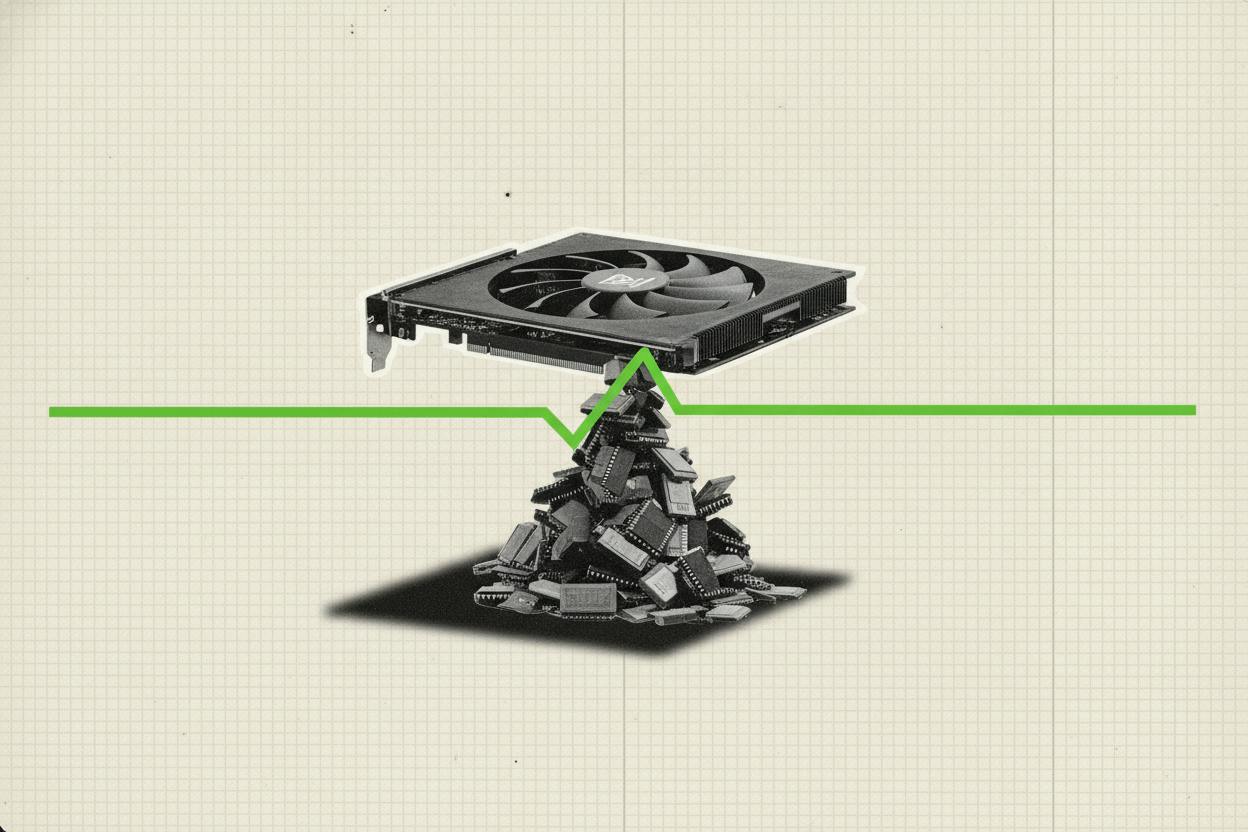
Nvidia, the chipmaker at the center of the artificial intelligence boom, is now trading at what Bloomberg describes as its cheapest valuation in more than a decade. The stock's price-to-earnings multiple has fallen to roughly half of where it stood a year ago, a striking shift for a company that spent much of the past two years as one of the market's most expensive large-cap names.
But the headline number is not the whole story. Investors are increasingly asking a more fundamental question: can Nvidia keep its profit margins intact as the cost of memory chips climbs?
Why the valuation looks cheap
A valuation multiple — most commonly the price-to-earnings ratio — measures how much investors are willing to pay for each dollar of a company's profit. When a multiple falls, it can mean one of two things: either the stock price has dropped, or earnings have grown faster than the share price. In Nvidia's case, the compression appears to be driven largely by the latter. The company's profits have expanded dramatically, so the same stock price now buys a much larger earnings stream.
That is why a falling multiple is not automatically a warning sign. For a business growing as quickly as Nvidia, a lower multiple can simply reflect that earnings have caught up with the hype. The question is whether that earnings growth is sustainable — and that is where memory costs come in.
The memory cost problem
Nvidia's advanced AI processors, such as its data-center GPUs, rely heavily on high-bandwidth memory (HBM), a specialised type of memory that stacks chips vertically to move data faster. HBM is expensive to produce, and demand for it has surged alongside the AI build-out. When memory prices rise, Nvidia's cost of goods sold goes up, which can pressure gross margins unless the company can pass those costs on to customers or offset them elsewhere.
Memory makers have been shifting capacity toward HBM and other high-margin products, which tightens supply for other types of memory and pushes prices higher across the board. For Nvidia, that means the bill for the components inside its chips is rising at the same time that customers — cloud providers, server makers and governments — are becoming more cost-conscious about their AI spending.
This is not a new dynamic. Companies in capital-intensive hardware businesses routinely face input-cost swings, and Nvidia has historically managed them well by commanding premium pricing. But the scale of the current AI build-out means even small changes in memory costs can translate into billions of dollars of margin impact over time.
What it means for investors
For ordinary investors, the key takeaway is that a low valuation multiple is not the same as a bargain. A stock can look cheap on trailing earnings while still being expensive if those earnings are about to decline. The market is essentially pricing in uncertainty: it is willing to pay less for each dollar of Nvidia's profit because it is not sure how durable that profit will be.
Investors will want to watch a few specific things in the coming quarters:
- Gross margin guidance. Nvidia's gross margin — the percentage of revenue left after the direct cost of producing its chips — is the clearest signal of how memory costs are flowing through the business.
- Pricing power. If Nvidia can raise prices or shift customers to higher-margin products, it can offset rising memory costs. If it cannot, margins will compress.
- Demand commentary. Any sign that cloud providers are slowing their AI infrastructure spending would compound the margin issue.
- Memory market conditions. HBM supply and pricing trends from the major memory manufacturers will feed directly into Nvidia's cost structure.
It is also worth remembering that Nvidia is not operating in a vacuum. Broader market conditions — from interest rates to energy prices — shape how investors value high-growth tech stocks. Recent sessions have seen stocks split as oil prices whipsawed on geopolitical signals, a reminder that macro forces can move even the most dominant companies. Meanwhile, the AI hardware race continues to evolve, with Apple pitching cheaper ways to run AI on local devices, a trend that could eventually influence how much enterprises spend on cloud-based AI compute.
The bigger picture
Nvidia's situation captures a tension that runs through the entire AI trade. The technology is real, the spending is enormous, and the company is central to it. But the easy phase — where every dollar of revenue growth was rewarded with an expanding multiple — may be giving way to a phase where investors demand proof that profits can grow without being eaten by costs.
That is a more mature market. It does not mean Nvidia is in trouble. It means the stock is being judged on earnings rather than narrative, and that the next few quarters of margin performance will matter more than any headline about a valuation discount.
For investors, the lesson is straightforward: cheap-looking valuations can be a sign of opportunity or a sign of risk, and the difference usually comes down to whether the earnings underneath them hold up. In Nvidia's case, the memory cost trend is the variable to watch.