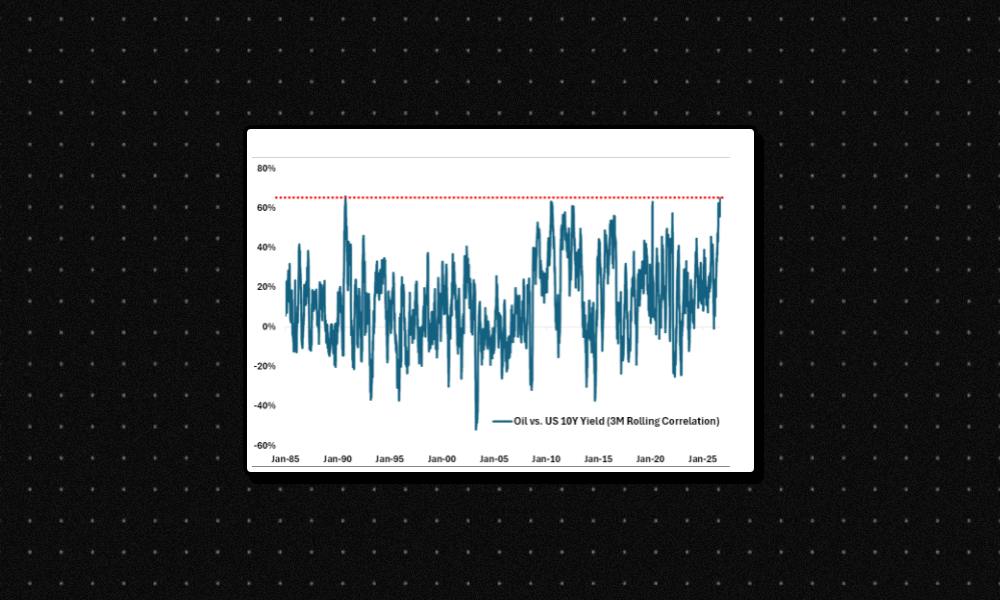
Oil prices and US Treasury yields are suddenly dancing to the same tune, and the move is turning heads on Wall Street. The three-month rolling correlation between West Texas Intermediate (WTI) crude and the 10-year Treasury yield jumped to 65% last week, the highest reading in 35 years. That puts the link just shy of the all-time peak of 66% recorded at the start of the First Gulf War in 1990.
For everyday investors, this matters because it suggests that swings in energy prices could now move borrowing costs as much as, or even more than, the Federal Reserve's own policy decisions. When oil and bond yields rise together, it can ripple through everything from mortgage rates to stock valuations.
What the correlation means
Correlation measures how closely two assets move in the same direction. A reading of 100% means they move in perfect lockstep, while 0% means there is no relationship at all. The current 65% reading is well above the peaks seen during the Covid pandemic and the 2011 Arab Spring, and it signals that oil and long-term Treasury yields are now highly synchronized.
Why would oil and bond yields move together? Higher oil prices tend to push up inflation expectations, which in turn push up long-term bond yields because investors demand higher compensation for the eroding purchasing power of their fixed payments. At the same time, strong economic growth—which often drives oil demand—can also lift yields as investors anticipate tighter monetary policy.
But the relationship has not always been this tight. For much of the past few decades, the Fed's control over short-term rates and its inflation targeting kept a lid on how much oil could influence long-term yields. Now, with supply shocks and geopolitical tensions playing a bigger role, the old link appears to be back.
Why this is happening now
The recent jump in correlation comes as oil prices have been volatile, driven by Middle East tensions and supply concerns. At the same time, Treasury yields have been climbing as investors reassess the path of Fed rate cuts. The combination has created a feedback loop: higher oil prices feed into inflation expectations, which push yields up, which in turn can weigh on stocks.
This dynamic is reminiscent of the early 1990s, when the First Gulf War sent oil prices soaring and bond yields followed. Back then, the correlation hit its record high. Today, with the world still recovering from a pandemic and facing new geopolitical risks, the same forces are at play.
Investors have already seen the impact in recent sessions. When oil prices slide, Treasury yields often ease, and stocks can rally—as seen in a recent Nasdaq jump of 2% on just such a day. Conversely, when oil spikes, yields tend to rise, putting pressure on growth stocks.
What it means for your portfolio
For ordinary investors, the key takeaway is that energy prices are no longer just a niche commodity story—they are a macro force that can move the entire bond market. That has implications for your 401(k) and any bonds you hold.
If oil keeps climbing, expect Treasury yields to stay elevated, which could hurt bond prices (yields and prices move inversely). It could also make borrowing more expensive for mortgages and corporate debt. On the flip side, if oil prices fall, yields could drop, giving bonds a boost and potentially lifting stock valuations.
The Fed is still a major player, but the market is now signaling that oil shocks could matter just as much. As one strategist put it, the central bank may no longer be the only game in town when it comes to setting long-term rates.
This is especially relevant for sectors sensitive to energy costs. For example, pipeline companies like Kinder Morgan have seen their earnings forecasts lifted on stronger oil prices, while airlines and other fuel-heavy industries could face margin pressure.
Geopolitical events remain a wildcard. Diplomatic efforts between the US and Iran have at times cooled oil prices, but tensions can flare up quickly, as seen in recent market moves where Iran tensions weighed on stocks.
Looking ahead
Investors will be watching whether this correlation holds. If it does, it could mean that the Fed's ability to control inflation is more limited than previously thought, because energy shocks can bypass its tools. That could lead to a more volatile bond market and a trickier environment for stocks.
For now, the message is clear: oil and bonds are joined at the hip again, and that has consequences for everyone from homeowners to retirement savers. Keep an eye on crude prices—they may be telling you more about the future of interest rates than any Fed speech.