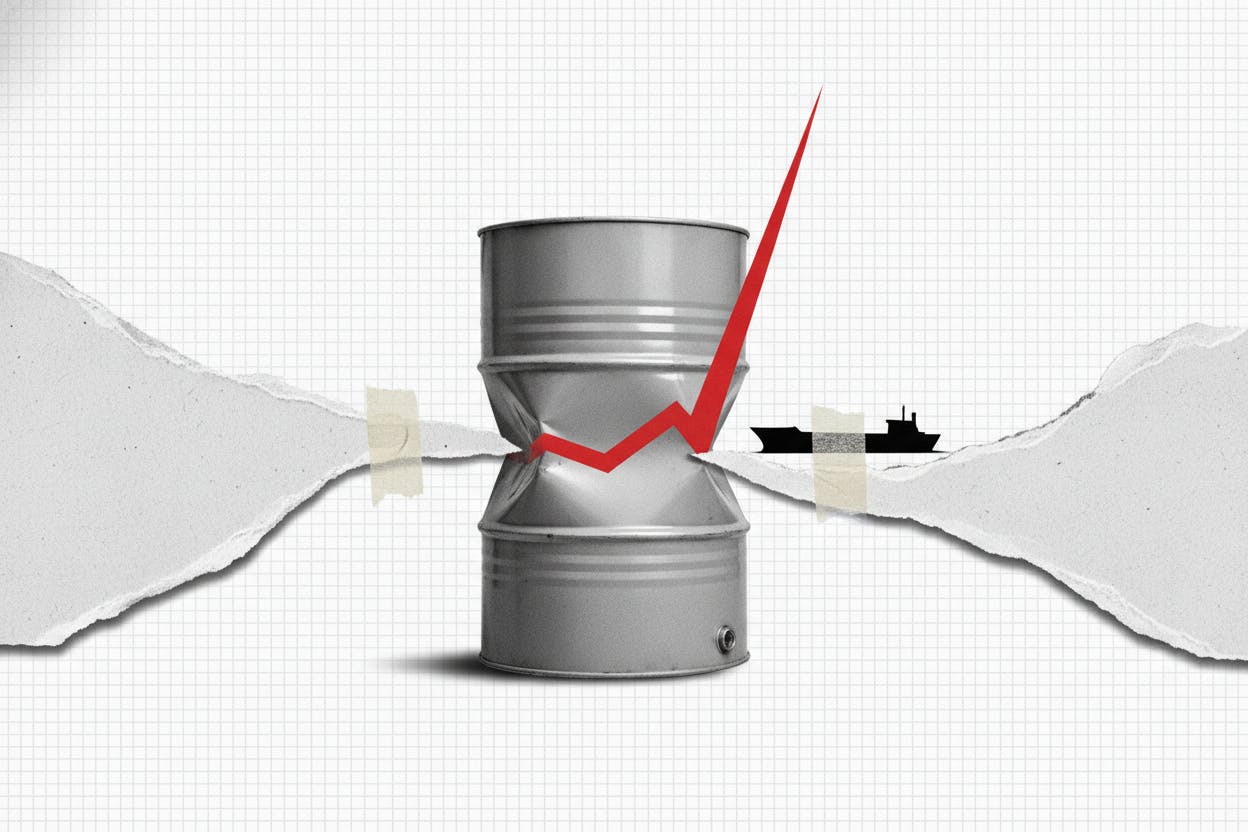
Oil prices surged back above the $100-a-barrel mark on [day] as escalating tensions between the United States and Iran raised fears of supply disruptions in a critical shipping lane. Brent crude, the international benchmark, climbed 2.9% to $100.78 a barrel, its first move above $100 in more than a month. US West Texas Intermediate (WTI) gained 3% to $95.83.
The jump came after US Central Command said it had destroyed five Iranian oil carriers, and Iran reported attacks on ships in the Strait of Hormuz—a narrow waterway that handles a large share of the world's seaborne oil. Even though no barrels have been lost so far, the mere threat of disruption is enough to move prices.
Why the Strait of Hormuz matters
The Strait of Hormuz, located between Iran and Oman, is one of the most important oil transit points on the planet. Roughly one-fifth of global oil consumption passes through it daily, mostly in the form of crude and liquefied natural gas. When tensions rise in the region, traders immediately worry that tankers could be delayed, rerouted, or attacked.
Even if shipments continue as normal, the perceived risk can push prices higher. Insurers may raise premiums for vessels traveling through the area, and shipping companies might demand higher rates to compensate for the danger. Those extra costs often get passed on to buyers, adding to the upward pressure on oil prices.
This is not the first time oil has reacted to Middle East tensions. Earlier this year, Houthi strikes on Saudi energy sites pushed Brent close to $100. Now, with the US and Iran directly involved, the market is on edge.
What this means for investors
For everyday investors, higher oil prices can ripple through the economy in several ways. First, they tend to push up gasoline and heating costs, which can squeeze household budgets. Second, they can feed into inflation, making it harder for central banks to cut interest rates. That's a key reason why European stocks slipped as Brent returned to $100 ahead of major central bank decisions.
Higher oil prices also tend to benefit energy companies, whose profits rise when crude climbs. But they can hurt airlines, shipping firms, and any business that relies heavily on fuel. For diversified investors, the effect is often mixed, as energy gains may offset losses elsewhere.
Gold, often seen as a safe haven during geopolitical turmoil, has also been moving. Gold rose 1% to $4,399 as the dollar softened and Iran tensions simmered, reflecting investor anxiety.
What to watch next
The key question is whether the conflict escalates further. If attacks on shipping continue or expand, oil prices could stay elevated or climb higher. If diplomacy gains traction, prices could quickly retreat.
Investors will also be watching for any signs of actual supply disruption. So far, no major oil producer has reported lost output, but the risk remains. The market is also keeping an eye on how central banks respond to rising energy costs, as higher inflation could delay rate cuts.
For now, the oil market is in a wait-and-see mode, with traders pricing in a risk premium that could vanish as quickly as it appeared. As always, geopolitical events are hard to predict, and oil prices can swing sharply in either direction.
For those with a long-term investment horizon, it's worth remembering that oil price spikes driven by geopolitical tensions often fade once the immediate crisis passes. But if the situation in the Strait of Hormuz worsens, the impact could be more lasting.