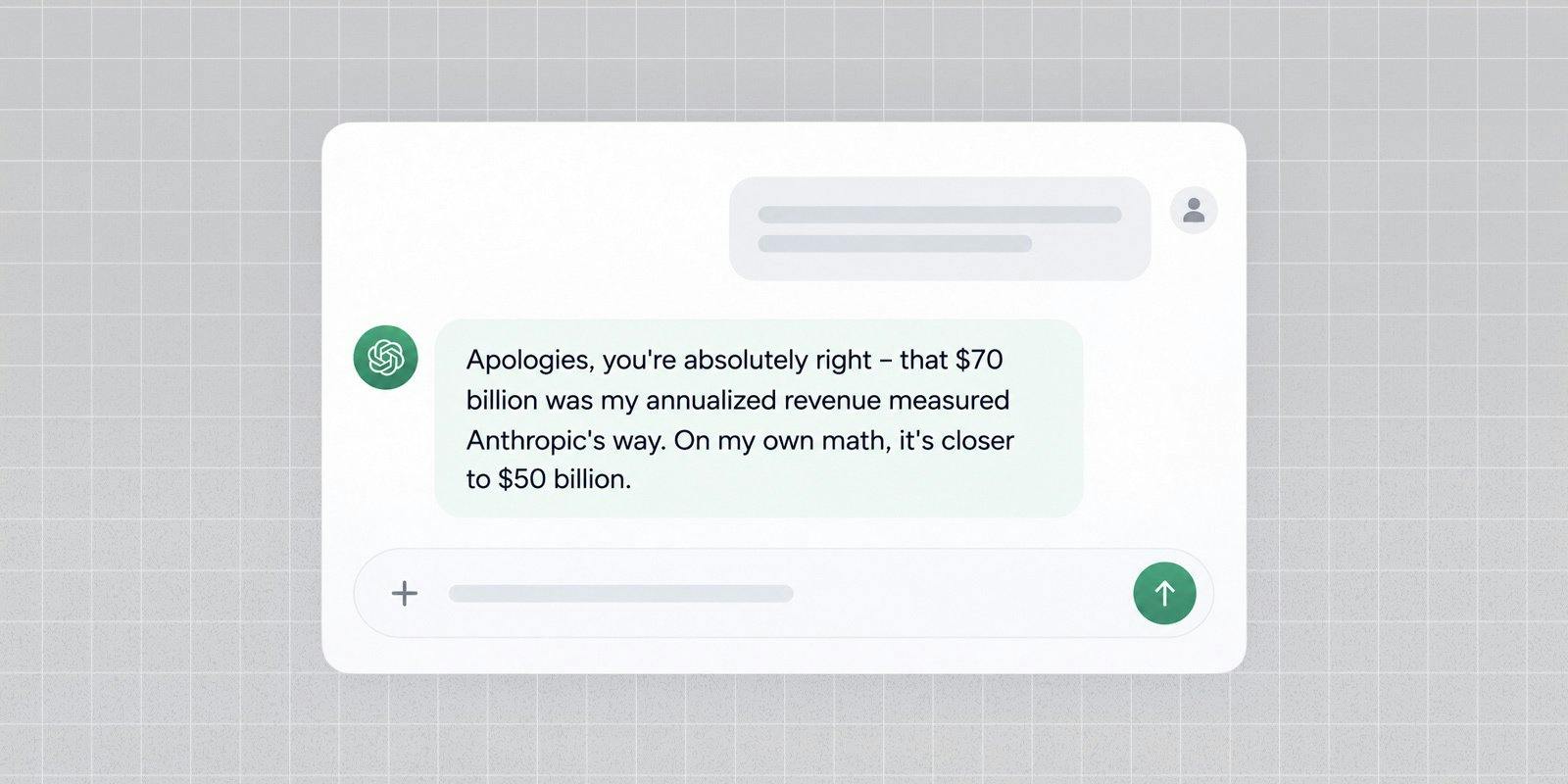
OpenAI, the company behind ChatGPT, is reportedly bringing in less money than some headlines suggested. Its annualized revenue—what it would earn in a year if recent sales kept up their pace—was about $50 billion at the end of September. That's roughly $20 billion below the nearly $70 billion that some outlets had previously reported.
The gap isn't a sign of trouble. It comes down to a simple but important difference: what counts as a sale. OpenAI appears to be using a more conservative definition of revenue than some analysts and media reports did. The company is reportedly seeking a new funding round of $30 billion or more at a valuation of $1.4 trillion, so investors are digging into the details of its financials.
What is annualized revenue?
Annualized revenue is a way to estimate a company's yearly sales based on its most recent performance. If a company makes $1 million in a single month, its annualized revenue would be $12 million—assuming that pace holds for the whole year. It's a useful snapshot, but it's not the same as actual annual revenue, which is only known after the year ends.
For fast-growing companies like OpenAI, annualized revenue is often used as a quick gauge of momentum. But it can be calculated in different ways, and that's where the confusion comes in. Some calculations might include revenue from partnerships, cloud credits, or other deals that aren't strictly cash sales. Others might only count direct customer payments.
The difference between $50 billion and $70 billion is huge—about 40%. For context, that's more than the annual revenue of many large public companies. But for OpenAI, which is growing rapidly, the exact number matters less than the trend. The company is still on track for big sales this year, according to the brief.
Why investors are paying attention
OpenAI is one of the most closely watched private companies in the world. Its valuation has soared as demand for AI tools has exploded. But with that valuation comes scrutiny. Investors are asking tough questions about how the company makes money and whether its growth is sustainable.
The revenue discrepancy is a reminder that not all revenue is created equal. For example, some of OpenAI's revenue might come from cloud computing partnerships, where customers pay for access to AI models through other platforms. That's real revenue, but it's different from direct subscriptions to ChatGPT. The way a company categorizes these streams can change the headline number.
This isn't just an accounting quibble. It affects how investors value the company. A higher revenue number can justify a higher valuation. A lower one might make investors pause. That's why the news has rippled through markets, with SoftBank shares dropping and tech stocks feeling the pressure.
What it means for everyday investors
For most people, OpenAI is not a stock you can buy directly—it's private. But its fortunes affect the broader market. AI has been a major driver of stock market gains over the past couple of years, and any sign that AI hype is cooling can hit tech stocks. Recent reports have already weighed on the sector.
If you own index funds or tech ETFs, you're indirectly exposed to OpenAI's performance through companies like Microsoft, which has invested billions in the startup. So even if you can't buy OpenAI shares, its revenue numbers matter to your portfolio.
The key takeaway is to be skeptical of headline numbers. When a company reports revenue, ask what's included. Is it cash sales? Or does it include barter deals, credits, or other non-cash items? The difference can be massive, as this case shows.
For OpenAI, the $50 billion run-rate is still impressive. It's a sign that the company is generating real money from its AI products. But the gap between $50 billion and $70 billion is a reminder that even the most talked-about companies can have murky financials. As the funding round progresses, investors will be watching to see how OpenAI defines its revenue and whether it can maintain its growth pace.
In the meantime, the broader AI trade remains intact. Companies like TCS are showing that AI demand is turning into actual revenue, and data center operators are seeing sales climb. The question isn't whether AI is real—it's how much of the hype is priced in.