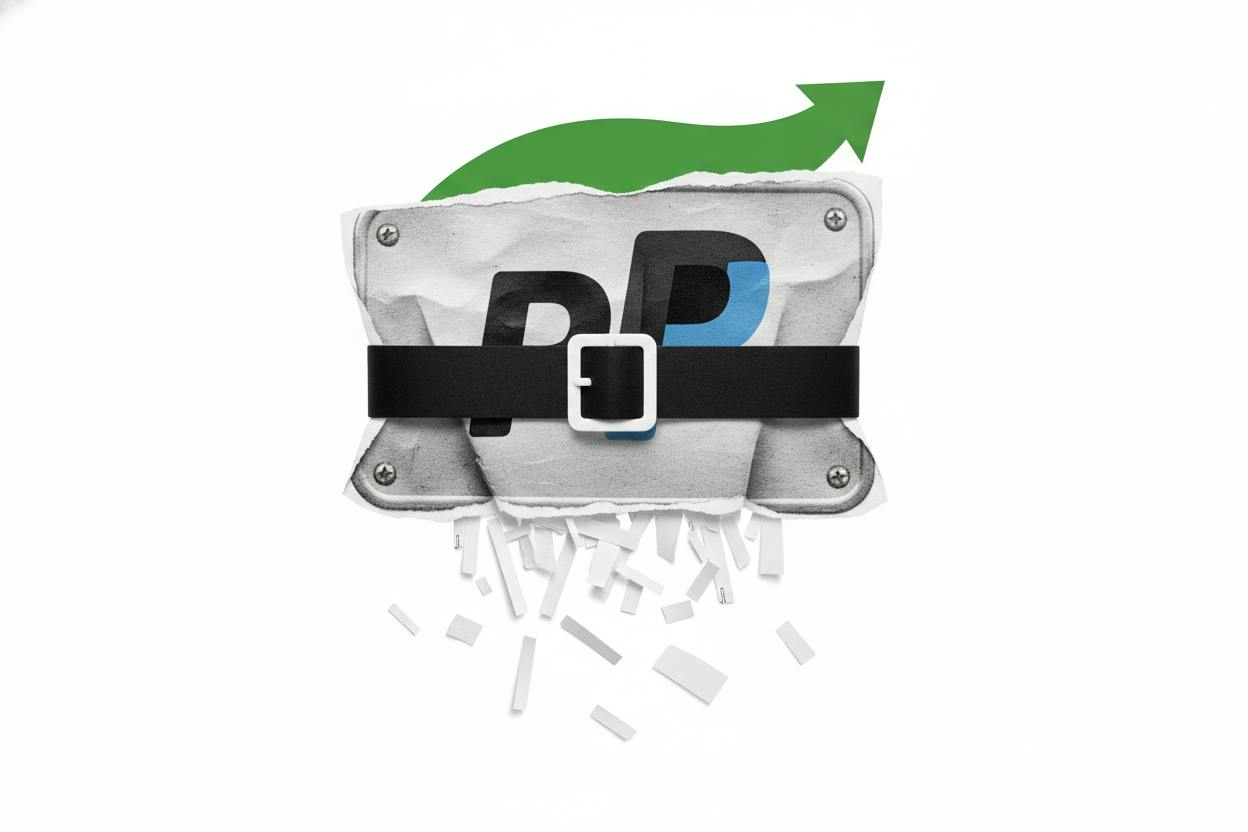
PayPal raised its full-year profit forecast on Tuesday, signaling that its multi-year turnaround is starting to pay off in the form of fatter margins and tighter costs. The payments company now expects about $5.60 in adjusted profit per share for the full year, up from its previous guidance and above the $5.38 that analysts tracked by LSEG had been expecting.
The update came alongside third-quarter results that beat estimates on the bottom line. PayPal reported adjusted earnings of $1.45 per share for the quarter, versus the $1.31 analysts had penciled in. Revenue and payment volumes also grew, with total payment volume rising 7% on a currency-neutral basis to $487.1 billion.
For everyday investors, the headline is simple: PayPal is trying to prove it can grow profits even as its breakneck pandemic-era expansion cools. The company's adjusted operating margin ticked up to 18.8% in the third quarter, and management is betting that a leaner cost structure will keep pushing that number higher.
What's driving the improvement?
PayPal's turnaround plan is built around efficiency rather than chasing growth at any cost. The company is targeting $700 million in gross annualized "run-rate" savings by the end of 2026, and it reiterated a longer-term goal of at least $1.5 billion in gross run-rate savings over the next two to three years.
Those savings are coming from a combination of job cuts and technology. PayPal has eliminated more than 2,000 positions and reduced its manager headcount by over 25%. It's also leaning on artificial intelligence tools, including customer-service chat agents, to handle routine tasks that previously required human staff.
This is a familiar playbook across the tech sector. Companies that grew rapidly during the low-interest-rate era are now under pressure to show they can convert that scale into consistent profits. For PayPal, the bet is that AI and a flatter organization will let costs rise more slowly than transaction volumes, creating what's known as operating leverage.
In plain terms, operating leverage means each additional dollar of revenue brings more profit to the bottom line because fixed costs are spread over a larger base. If PayPal can keep payment-volume growth in the high single digits while holding costs flat or growing them slowly, earnings can climb even without a return to the double-digit growth rates it once posted.
The holiday quarter is the next test
PayPal's fourth-quarter guidance also came in ahead of expectations. The company forecast adjusted profit of about $1.43 per share for the holiday period, topping the $1.35 analysts had projected. That's significant because the fourth quarter is typically the biggest for payments, as consumer spending surges during the holiday shopping season.
But the competitive backdrop remains intense. PayPal faces pressure from tech giants like Apple and Google, as well as a wave of newer fintech startups that are nibbling at its core payments business. The company has been trying to differentiate itself through features like its branded checkout button and Venmo, but investors will be watching whether those efforts can hold up against well-funded rivals.
The broader market context also matters. PayPal's stock has been volatile since its 2021 peak, when it was valued at roughly $360 billion. Today, its market capitalization is around $53 billion. That dramatic decline reflects a shift in how investors value payments companies: during the pandemic, they rewarded headline growth; now, they're more focused on durable profitability and how much profit each dollar of volume can generate.
What it means for investors
For investors, the key question isn't whether PayPal can recapture its pandemic-era momentum. It's whether the company can keep expanding its operating margin as the promised savings actually materialize through 2026. The third-quarter margin of 18.8% is a step in the right direction, but the real test will be whether that trend continues quarter after quarter.
PayPal's guidance implies a "margin first" strategy that aligns with what the market currently rewards. If the company can deliver on its savings targets and maintain mid-single-digit to high-single-digit volume growth, earnings per share could grow at a healthy clip even without a surge in top-line growth.
That said, there are risks. Cost cuts can only go so far, and competition in digital payments is unlikely to ease. The holiday quarter will be an early indicator of whether PayPal's operational improvements can withstand seasonal pressures and competitive headwinds.
For a broader look at how companies are balancing cost discipline with growth ambitions, see our coverage of Centene's profit outlook raise and Assa Abloy's cost-cutting beat. And for context on how tech companies are using AI to trim expenses, check out this look at AI-driven market moves.
Ultimately, PayPal's story is about whether a mature payments giant can reinvent itself as a more efficient, more profitable business. The latest numbers suggest it's making progress, but the proof will be in the margins over the next few quarters.