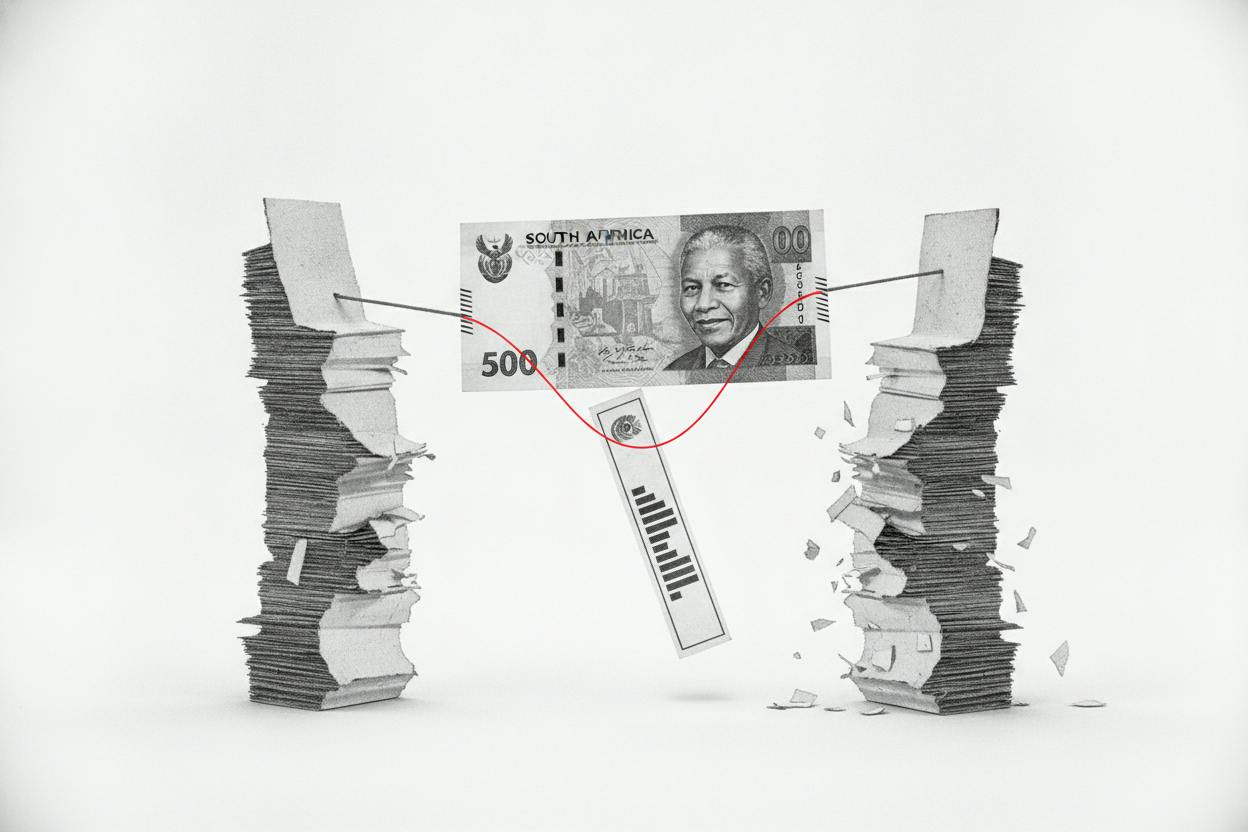
South Africa's rand is hovering near 17 per US dollar, a level that has become a quick gauge of investor confidence in the country's political stability. The currency was trading around 16.94 per dollar after briefly breaking above 17 last week, its weakest point since April. The immediate driver is politics: talks inside the African National Congress (ANC) suggest it may try to govern major cities without the Democratic Alliance (DA), a party that markets often view as more reform-minded.
The concern is spillover. If cooperation fails at the city level, investors start to question whether the national coalition the ANC formed after losing its parliamentary majority in 2024 can hold together. That uncertainty matters because it can change how much extra return investors demand to own South African assets. In plain English, if confidence in fiscal discipline and pro-growth reforms slips, overseas investors may reduce holdings of rand-denominated government bonds or require higher yields to stay invested, which can weaken the rand while pushing bond yields up.
What's driving the rand's slide?
The rand's recent weakness is not just about global factors. While a stronger dollar and risk-off sentiment in emerging markets have played a role, the political backdrop is front and center. Commerzbank, a German bank, noted that talks within the ANC suggest it may attempt to govern major cities without the DA. The DA is often seen by investors as a stabilizing force, particularly on economic policy. If the ANC decides to go it alone in key municipalities, it could signal a more fragmented political landscape, raising doubts about the durability of the national coalition.
This is not just background noise for traders. Coalition math feeds directly into South Africa's "risk premium" — the extra yield investors demand for taking on political and policy risk. When that premium rises, pressure often shows up first in longer-dated government bonds, such as the 2035 benchmark, and in rand-sensitive local stocks, including much of the JSE Top-40. So if negotiations look shakier, the rand can slide and yields can climb together; if talks stabilize, those stress signals can ease.
This week's data could amplify moves
Investors are also bracing for a one-two punch of local data. On Wednesday, Statistics South Africa will release the October inflation report. Economists polled by Reuters expect inflation to rise to 5.2% from 4.5% in September, partly due to higher fuel costs. That would still be within the central bank's target range of 3% to 6%, but it would mark a notable uptick and could influence the monetary policy outlook.
On Thursday, the South African Reserve Bank (SARB) will announce its interest rate decision. The central bank is widely expected to leave rates unchanged after hiking last time. That would pause a tightening cycle that has been aimed at keeping inflation in check. If inflation comes in hotter than expected, the SARB might signal that further hikes are possible, which could support the rand. Conversely, a softer inflation print might open the door to rate cuts later, which could weigh on the currency.
What it means for investors
For everyday investors, the rand's level is more than just a number. A weaker rand can push up the cost of imported goods, feeding into inflation and potentially affecting everything from fuel prices to food costs. It can also hit the returns of South African investors who hold foreign assets, as their overseas investments become worth more in rand terms, but it also makes local assets less attractive to foreign buyers.
The bond market is a key place to watch. If the risk premium rises, longer-dated government bonds could see yields climb, which means prices fall. That can hurt investors holding those bonds. On the other hand, if coalition talks stabilize, yields could ease, providing some relief.
For those with exposure to South African equities, the JSE Top-40 index is sensitive to rand moves. Companies with large international earnings, like miners and retailers, can benefit from a weaker rand because their overseas revenue translates into more rand. But domestically focused firms, especially those reliant on consumer spending, could feel the pinch if inflation erodes purchasing power.
The broader emerging-market context also matters. A stronger dollar and global risk-off sentiment have been pressuring currencies across the developing world, as seen in the Aussie and kiwi dollars sliding to multi-month lows. South Africa is not immune to these forces, but its political uncertainty adds a local layer of risk.
Investors will be watching Wednesday's inflation print and Thursday's rate decision for clues on the SARB's next move. But the bigger question remains whether the ANC and DA can find common ground. As one analyst put it, the rand's 17-per-dollar level has become the market's quick read on coalition credibility. If that level holds, it suggests investors are cautiously optimistic. If it breaks decisively, expect more volatility.
For now, the rand's wobble is a reminder that politics and markets are deeply intertwined. The outcome of coalition talks could shape South Africa's economic trajectory for years, and the currency is the most immediate barometer of that uncertainty.